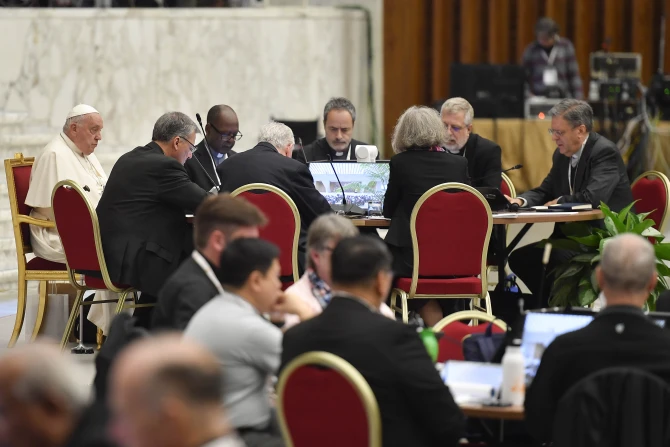
Is there more than meets the eye in the framing of discussions about ecclesiastical governance and the relationship between the local Churches and the universal Church — the main topic of conversation at the Synod on Synodality for the past week?
One gets the impression that many synod participants view the subject as a kind of Trojan horse, a theme that may seem innocuous on the surface but one that can be deployed to sneak sidelined issues such as married priests and women deacons back on the main agenda.
The mere possibility that this is what’s really going on has put those who want to hold the line on the Church’s governance structure and moral teaching on high alert.
The theme in question relates to Part 3 of the synod assembly’s Instrumentum laboris, or working document, which “invites” the people of God “to overcome a static vision of places that orders them by successive levels or degrees according to a pyramidal model (i.e. parish, deanery, diocese, or eparchy; ecclesiastical province; episcopal conference or Eastern hierarchical structure; and universal Church).”
“This has never been our vision,” the document goes on to say. “The network of relationships and the exchange of gifts between the Churches have always been interwoven as a web of relations rather than conceived as linear in form. They are gathered in the bond of unity of which the Roman Pontiff is the perpetual and visible principle and foundation.”
As Cardinal Jean-Claude Hollerich, archbishop of Luxembourg and the synod assembly’s relator general, emphasized during the week: “The Church from the beginning has referred to the city, to the places in which it lived, guided by the bishop in a close relationship with the territory.”
It was in this context that Cardinal Leonardo Steiner of Manaus, Brazil, said during a daily press briefing that “many of our women are true ‘deaconesses’” while arguing that Pope Francis “has not closed the question” of the ordination of married men in places like the Amazon. He advocated for the Church to be be open “to listening to cultures and religions” so that the Gospel can be “inculturated.”
What does this mean, exactly? In Steiner’s view, it allows for the possibility that some episcopal conferences might say yes to women deacons and married priests, based on cultural considerations, while others may say no. By that reasoning, even the synodal path of the Church of Germany could make sense, even though Pope Francis has not missed an opportunity to criticize and even to mock it, having made the quip to a German bishop in Belgium: “Is there a Catholic Church in Germany?”
At a pastoral-theological forum on Oct. 16 titled “The Mutual Relationship of the Local Church and the Universal Church,” Cardinal Robert F. Prevost, prefect of the Dicastery for Bishops, emphasized that local Churches are not merely parts of a larger structure but embody the true presence of the Church of Christ, achieving unity through diverse local expressions.
Echoing that theme, another forum participant, Miguel de Salis Amaral, a Portuguese priest and theology professor at the Pontifical University of the Holy Cross, said the local Churches are formed “in the image” of the universal one. Citing Lumen Gentium, the Dogmatic Constitution on the Church, he emphasized that “the power, the richness of all the sacramental and spiritual gifts” resides “in every local Church.”
Another speaker, Antonio Autiero, a priest of the Diocese of Naples, Italy, and a professor emeritus of moral theology at the University of Münster, highlighted how the experience of the Church is “purely local.” He expressed support for a “ministry of listening” at the local community level, which through their “elements of discernment” could make suggestions to the local Church.
An example of local bodies shaping Church policy highlighted during the form was Australia’s Plenary Council, convened to respond to the country’s sexual abuse crisis. Comprised of 44 bishops and 275 other members, the council is authorized by an indult from the Holy See to dialogue and make decisions.
Meanwhile, within the assembly hall, there was agreement of the need to highlight “the importance of preserving the unity of the Church,” according to Paolo Ruffini, prefect of the Dicastery of Communications.
How the delegates choose to articulate that consensus in the assembly’s final document at the end of the month, however, remains to be seen.
Cardinal-elect Roberto Repole, archbishop of Turin in Italy, for one, signaled that the document won’t express the views of the majority and the opposition but rather a consensus.
“We are not a parliament; we are searching for the voice of the Spirit also through listening to the voice of our brothers. Here, I see the catholicity of the Church,” he said.
“Synodality is an experience,” he added, “but requires an in-depth analysis of theological questions that cannot remain on the sidelines.”
This article was originally published on Catholic News Agency.