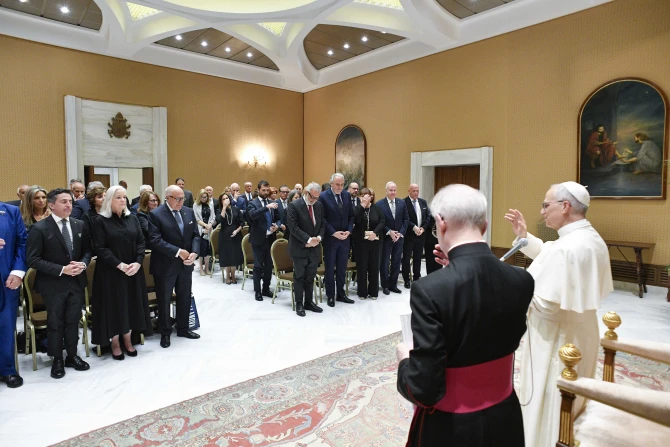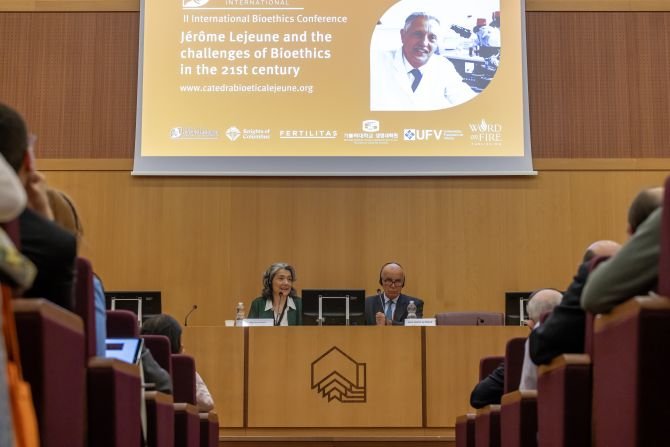
The International Chair of Bioethics Jérôme Lejeune held its second annual international conference in Rome on May 17–18 to reflect on the bioethical challenges surrounding the health and care of people at different stages of life.
Jérôme Lejeune, who discovered Trisomony 21 in 1958 (which causes Down syndrome), has been described as a prophetic “father of bioethics” and his legacy continues to steer the direction of bioethical thought within the Catholic Church worldwide.
“Bioethics is an interdisciplinary science,” said Dr. Mónica López Barahona, president of the International Chair of Bioethics Jerome Lejeune. “We have tried to address [bioethics] with different experts from different fields in order to give some light on different subjects. That was the way that Professor Lejeune addressed issues — from science to ethics — and that’s why we decided to organize this meeting in this way of reflection.”
Approximately 45 international speakers from 16 countries discussed critical issues surrounding scientific practices at the two-day conference including gene editing in humans and across species (CRISPR experiments), sex selection, assisted reproduction techniques, prenatal testing and diagnosis, neonatal care, euthanasia, and gender-affirming surgery.
On the opening day, Professor O. Carter Snead, an American legal scholar and bioethicist from the University of Notre Dame in South Bend, Indiana, shared insights from his book “What It Means to Be Human: The Case for the Body in Public Bioethics,” and invited conference participants to first consider the “anthropological question [about human nature, human flourishing, and human identity]” as a framework to examine the conference topics and case studies.
Snead stated that current laws and policies related to abortion, assisted reproduction, and end-of-life decisions in the U.S. and abroad reflect a reductive “expressive individualism” as described by philosopher Charles Taylor and sociologist Robert Bellah, whereby a person’s worth is primarily defined according to “their capacity to choose life pathways” and pursue personal projects.
“Expressive individualism doesn’t take our embodiment or incarnational nature into account. It can’t make sense of our vulnerability, our reciprocal dependence, and our natural limits,” Snead explained. “It leaves entirely out of the field of view the weakest and most vulnerable, the elderly, the disabled, children both born and unborn.”
More than 400 people from 19 countries across five continents attended the congress in person or online to listen to academics, researchers, medical doctors, health care specialists, as well as family members whose lives had been directly impacted by the work and example of Lejeune.
“Never in my life would I have thought that a doctor, much less a prominent one, would have the humility to contact the mother of a child from a foreign country to spare them a trip to Paris,” recalled Domitília Antão, a mother of a child with Trisomy 21. “I will never forget his gaze, which immediately infused hope in our discouraged hearts. We were amazed by such simplicity considering his great competence, so much tenderness. We were treated like his family.”
Thirty years since his death, institutes inspired by Lejeune’s dedicated work and care of his patients have been established around the world, including the Fondation Jérôme Lejeune and the Association des Amis du Pr. Jerome Lejeune in France, and the Asociacion de Medicos Jérôme Lejeune in Spain.
“My hope is really that, first, the figure of Professor Lejeune will be well known all over the world and that the conclusions of the congress — in the different subjects that we have addressed — may be transmitted and translated into the different fields in the different countries all over the world,” Barahona told CNA.
In 1994, only 33 days after his appointment as the first president of the then-newly established Pontifical Academy for Life by Pope John Paul II, Lejeune died from lung cancer on Easter Sunday. Pope Francis advanced his cause for canonization after declaring Lejeune “venerable” within the Catholic Church in 2021.
This article was originally published on Catholic News Agency.