Since Tuesday, April 22, cardinals have been gathering in general congregations — meetings of cardinals eligible to participate in discussions before the conclave and to vote on the general administration and care of the Church during the sede vacante period, also known as the interregnum.
SIGN UP FOR OUR NEWSLETTER HERE
There are 252 total cardinals eligible to participate in these meetings leading up to the conclave set to begin on Wednesday, May 7. Of these, 134 cardinals are under the age of 80 and will take part in the actual voting to elect a successor to Pope Francis.
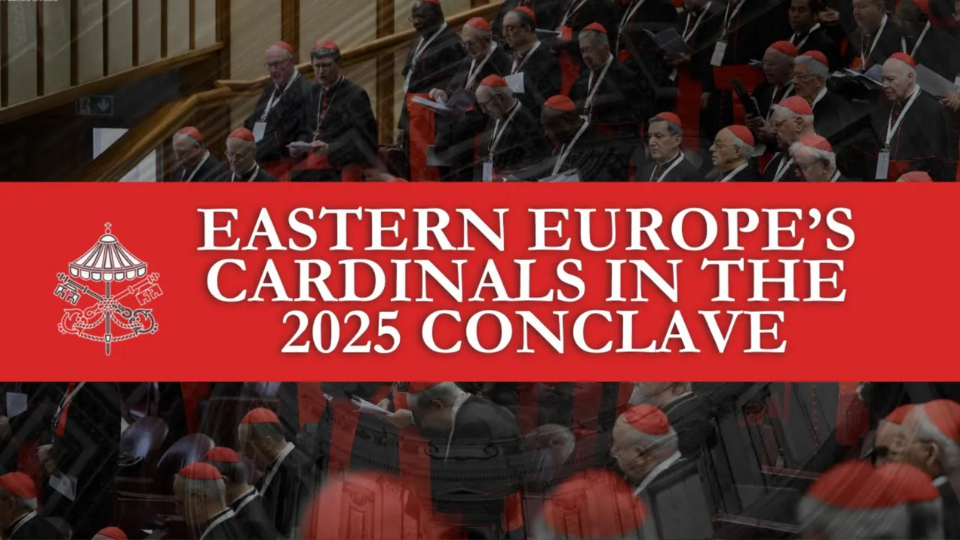
Europe stands out as the continent with the largest number of cardinals voting in the upcoming conclave, with 114 total cardinals and 53 electors. Within that, the voting cardinals from Eastern Europe represent a region of the Church marked by the post-communist era. The roughly 18 countries that currently make up the Eastern European bloc are represented by nine electors and eight non-electors — 17 cardinals in total. These countries include Bulgaria, Hungary, Moldova, Ukraine, Poland, Romania, Russia, Slovakia, the Czech Republic, Belarus, Albania, Bosnia-Herzegovina, Kosovo, Croatia, Macedonia, Montenegro, Serbia, and Slovenia.
Altogether, these 17 cardinals come from 11 countries: Albania, Bosnia-Herzegovina, Croatia, Czech Republic, Hungary, Latvia, Lithuania, Poland, Romania, Serbia, and Slovenia.
Poland leads the region with five total cardinals and four electors. Among them is Konrad Cardinal Krajewski, the pope’s almoner, who at 61 is the youngest. He is followed by Kazimierz Cardinal Nycz, Archbishop Emeritus of Warsaw at 75, and Stanisław Cardinal Ryłko, current Archpriest of the Basilica of St. Mary Major, at 79. Also notable is Stanisław Cardinal Dziwisz, 85, longtime personal secretary of Pope St. John Paul II and Archbishop Emeritus of Krakow.
Lithuania comes next with three total cardinals and one elector — Rolandas Cardinal Makrickas, 53, coadjutor Archpriest of the Basilica of Santa Maria Maggiore; Sigitas Cardinal Tamkevičius, Archbishop Emeritus of Kaunas, aged 86; and Audrys Juozas Cardinal Bačkis, Archbishop Emeritus of Vilnius, aged 88.
All other countries in the region are represented by one cardinal, and only four of these have electors. They include László Cardinal Német, current Archbishop of Belgrade, Serbia, 68 years old and appointed just last year by Pope Francis; Josip Cardinal Bozanić, Archbishop Emeritus of Zagreb, Croatia, 76 years old; Vinko Cardinal Puljić, 77, appointed by John Paul II in 1994 and Archbishop Emeritus of Sarajevo, Bosnia-Herzegovina; and perhaps most notably, Péter Cardinal Erdő, Archbishop of Esztergom-Budapest, Hungary, 72, appointed by John Paul II.
The non-electors from Albania, Czech Republic, Latvia, Romania, and Slovenia are Ernest Cardinal Simoni, Dominik Jaroslav Cardinal Duka, Jānis Cardinal Pujats, Lucian Cardinal Mureșan, and Franc Cardinal Rode, respectively.
The history of the Church in Eastern Europe is marked by persecution under communist regimes and, in more recent years, the challenges of secularism, the clerical abuse crisis, and rising consumerism.
Adapted by Jacob Stein