Rome’s skyline is crowned with domes and bell towers, and among the more than 900 churches scattered across the Eternal City, some of the most remarkable are dedicated not to apostles or popes, but to women whose stories continue to echo through stone, fresco, and mosaic.
Three such churches—Santa Brigida, Santa Cecilia in Trastevere, and Sant’Anna dei Palafrenieri—offer a glimpse into different models of holiness: the mystic reformer, the early Christian martyr, and the quiet matriarch of the Holy Family.
Saint Bridget of Sweden: A Pilgrim in Rome
Tucked into the narrow streets near Campo de’ Fiori stands the Church of Santa Brigida, dedicated to Saint Bridget of Sweden. A mystic, pilgrim, and founder of the Bridgettine Order, Bridget arrived in Rome in 1348 as a widow and made the city her spiritual home.
Sister Karin Kwiatkowska of the Order of the Most Holy Savior of Saint Bridget explains that Bridget’s journey to Rome was deeply tied to the Church’s Holy Year tradition. As she notes, “Rome became significant because in 1350 the Pope declared the Holy Year. Brigit, who had traveled all over Europe and decided that she must also go to Rome for the Holy Year… Saint Brigit received many revelations from the Lord Jesus, and in one of these revelations, Jesus told her that she was to go to Rome.”
The present church rises on the site where Bridget lived and died, transforming a medieval residence into a place of pilgrimage. Sister Karin explains that the building still preserves traces of the saint’s life: “This house has been connected with us since those times. The building has been rebuilt and adapted many times, yet there are still rooms where Saint Brigit traditionally lived.”
Today, thirty-five Bridgettine sisters from around the world serve the church. In the rooms where Bridget once lived, relics are preserved—including a rough wooden tabletop on which she chose to die, uniting her final moments with Christ’s suffering on the wood of the Cross. The adjoining Baroque chapel is decorated with scenes from her life and visions—revelations that urged reform during the turbulent years of the medieval Church and the Avignon Papacy.
Saint Cecilia: Faith Unto Martyrdom
Across the Tiber, in the winding streets of Trastevere, stands another church dedicated to a remarkable woman: Santa Cecilia in Trastevere, honoring the early Christian martyr and patron saint of music.
Tour guide Jowita Ludwikiewicz explains Cecilia’s story: “Who was Cecilia? She was a woman of noble origin. She was born in the region of Trastevere. And at the early stage of her life, she devoted herself to the Lord. She decided that she wanted to keep her virginity. And she wanted to be a Christian. However, her family forced her to marry… And she married a pagan. His name was Valerian.”
Valerian soon converted to Christianity, but their life together was brief. When the Roman authorities discovered their faith, both were executed.
The present basilica stands atop what is believed to have been Cecilia’s family home. Ludwikiewicz recounts the dramatic details surrounding her death: “Cecilia died in terrible agony, She was found in a very curious position. She was lying on her side, and her head was not visible. The only thing that was visible on her neck was the wound caused by the executioner.”
Within the walls of this ancient church—one of Rome’s oldest, dating back to the fifth century—art and martyrdom intertwine. Cecilia’s quiet testimony of faith continues to resonate with pilgrims who visit the basilica today.
Saint Anne: A Hidden Presence in the Vatican
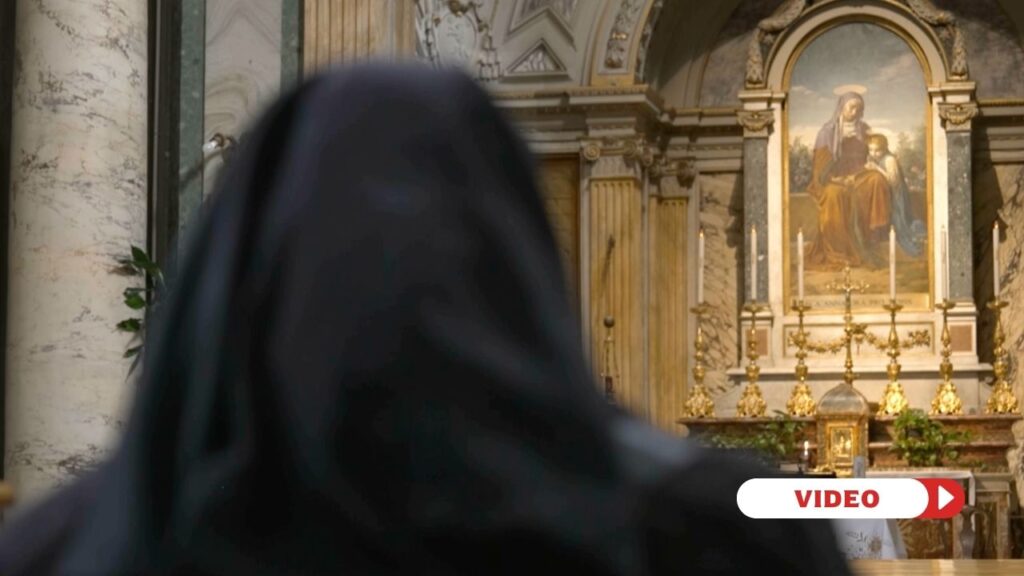
Just steps from the grandeur of St. Peter’s Basilica, another church dedicated to a woman saint stands quietly within Vatican City: Sant’Anna dei Palafrenieri, built in the sixteenth century and dedicated to Saint Anne, the mother of the Virgin Mary.
Although Anne is not widely mentioned in Scripture, her importance in Christian tradition remains significant. The parish priest, Fr. Mario Millardi, explains: “Perhaps the reason is that she is not mentioned in the Gospels; Anne and Joachim are referred to only in the Protoevangelium of James. And yet, this small church, which in ancient times was dedicated to Saint Anne, has certainly remained an important symbol in history.”
Sant’Anna dei Palafrenieri holds a unique distinction—it is the only parish church within Vatican City, serving the smallest country in the world.
Fr. Millardi describes its unusual character: “It is, so to speak, a parish without ordinary parishioners, because the faithful here are all in a unique situation, living within the Vatican. Only a few families remain, along with the gendarmes and the Swiss Guards, who each have their own chaplain and their own services.”
As a result, the life of the parish looks different from most others in Italy. “So there isn’t the same kind of activity you would find in other parishes in Italy. Here, it is more a matter of pastoral service: administering the sacraments and celebrating the Eucharist. For all the employees and the sisters who need specific times in order to take part in the Eucharist.”
On September 22, Pope Leo XIV paid his first official visit to Saint Anne’s Church. The moment carried special meaning, as the parish has been entrusted to the Fathers of the Order of Saint Augustine—the confreres of the new Pope—since the founding of Vatican City in 1929.
A Map of Feminine Sanctity
Together, Santa Brigida, Santa Cecilia in Trastevere, and Sant’Anna dei Palafrenieri form a quiet map of feminine sanctity across Rome.
Bridget the reformer, Cecilia the martyr, and Anne the matriarch represent three distinct paths of holiness—yet each continues to inspire believers today. Through their churches, their relics, and their stories, these women remain living witnesses to the enduring influence of faith in the Eternal City.
Discover more of Rome and beyond on the free EWTN Travel App.
Adapted by Jacob Stein. Produced by Alexey Gotovskiy; Camera by Alberto Basile, Fabio Gonnella.