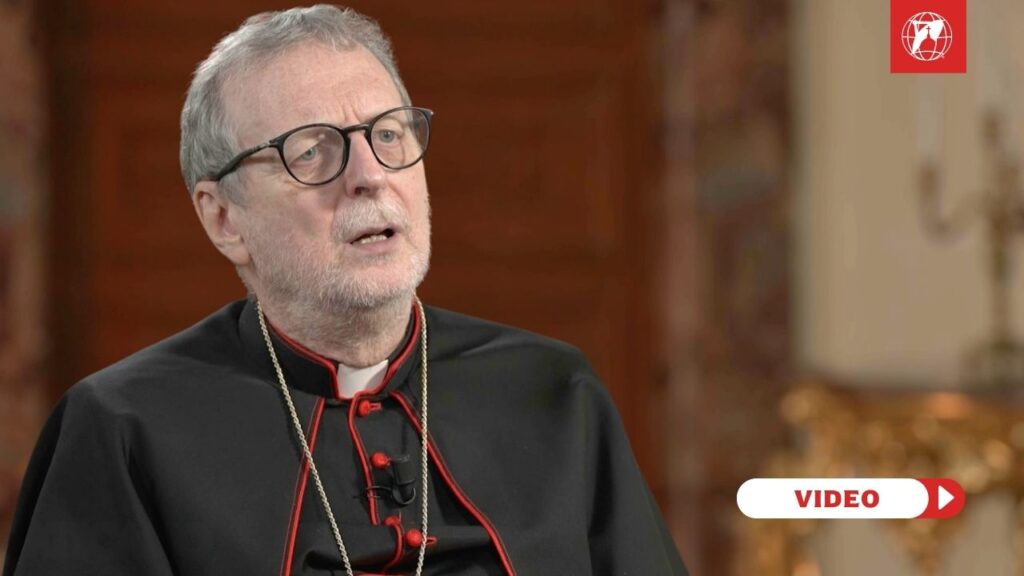
Cardinal Claudio Gugerotti is one of the Vatican’s most experienced voices on the Christian East. Over the course of his career, he has served in some of the Church’s most fragile regions, living and working as a papal nuncio in places such as the Caucasus, Belarus, and Ukraine.
In November 2022, Pope Francis appointed him Prefect of the Dicastery for the Eastern Churches, the Vatican department responsible for the 23 Eastern Catholic Churches in communion with Rome. Less than a year later, in September 2023, he was created a cardinal.
Fluent in nine languages—including Armenian, Kurdish, Russian, Latin, and both ancient and modern Greek—Cardinal Gugerotti brings decades of diplomatic experience to his role. In a conversation about the situation in the Middle East and Iran, he reflected on how political change can affect Eastern Christian communities in the region.
Political Change and the Future of Eastern Christians
As tensions escalate in Iran—home to historic Christian communities rooted in the ancient traditions of the Christian East—Cardinal Gugerotti emphasized that the future of these communities often depends on the direction political leadership takes.
“If the kind of political approach, which is also a religious approach in their case, changes, certainly it might be better if, of course, the new politicians are not going to be more radical than those who are now ruling the countries,” he said.
The instability has already affected the Church’s presence in the country. Referring to the situation in Tehran, the cardinal confirmed that foreign diplomats and church leaders are facing pressure to leave.
“Yes, because, all the embassies are putting a pressure on them, on foreigners in general, to leave the country, because, as you said, it is difficult to imagine what’s going to happen,” he explained.
Why Vatican Diplomacy Is Different
Unlike most states, the Holy See does not operate through military or economic power. Yet that absence, Cardinal Gugerotti noted, often becomes a strength.
“It is, definitely,” he said when asked whether the Vatican’s lack of an army or political interests can be an advantage. “Because it deprives any approach of violence or of interest. And we can look at people in the eyes. And then they can look at our eyes without being afraid.”
He added that the Vatican’s presence is often perceived as sincere and non-threatening, particularly in regions affected by war or political tension.
“And just feeling that we have not come to teach them how to live, but to share our experience, which is an experience of love and appreciation,” he said.
Drawing on his experience as a nuncio in Eastern Europe and the Caucasus, Cardinal Gugerotti explained that this perception of neutrality often opens doors for humanitarian dialogue.
“So my experience in the areas, I was mainly in former communist areas, in Eastern Europe or in the Caucasus, is that they have the perception that we are not going to cheat them. So we are sincere.”
Because of that trust, Vatican representatives are often among the first to be contacted when humanitarian crises arise.
“For example, if they have prisoners of war, or if they have problems with refugees, with ill people, with people who have been hurt in the war, they know that the first approach will be with the nuncio,” he said. “Because, of course, he is a representative not only of the Holy Father, but of 1 billion, 400 million Catholics in the world.”
Distinguishing Christians From Political Conflicts
One challenge the Church often faces in conflict zones is the risk that local Christian communities become associated with political actions carried out by Western nations.
Cardinal Gugerotti recalled how this dynamic played out during the Iraq War, when some Christians were blamed for decisions made by Western governments.
“Yes, there is something, of course,” he said when asked what the Church can do diplomatically during ongoing conflicts. “The problem is to make these people understand clearly that the fact that we are Christians and the fact that those who bomb their cities are Christians does not mean that we have the same ideas.”
He pointed to the intervention of St. John Paul II, who publicly opposed the Iraq War.
“When the Pope started, John Paul II, a blessed memory, holy, he said, please don’t start a war. They were completely astonished. And they came and apologized,” he said.
According to Cardinal Gugerotti, that intervention helped Eastern Christian communities distinguish themselves from Western political decisions.
“The Oriental patriarchs came to meet with John Paul II, and they said, thank you for what you said, because at least our Christians are no more identified with Western Christians.”
Supporting Christians in the Holy Land
Looking ahead to Easter, Cardinal Gugerotti also spoke about the Good Friday collection for the Holy Land, known as Pro Terra Sancta.
The initiative was established by Pope Paul VI, encouraging Catholics around the world to support the Christian presence in the places connected to the life of Jesus.
“You know that was an initiative that was fixed by Pope Paul VI,” he explained. “The idea that all over the world, in the Catholic Church, on Good Friday, people collect money for the holy places, as we call them, which means the places where Jesus was born are preached.”
The funds are administered by the Franciscan Custody of the Holy Land, which cares for the region’s sacred sites while also supporting the local Christian population.
“And of course, they try to work not only for guarding or rebuilding or reshaping of special important historical places, but also about the life of the Christians, of the Catholics that live in that area up to now,” he said.
The support extends across the wider region of the biblical lands.
“The area is not only extended to, let’s just say, Israel, but also to Syria, to Lebanon, all the areas where Jesus moved and where Christians live.”
Adapted by Jacob Stein. Produced by Alexey Gotovskiy; Camera by Alberto Basile, Fabio Gonnella; Video Edited by Andrea Manna.