Spring in Rome begins with an ancient and deeply meaningful celebration. On March 25 — exactly nine months before Christmas — the Church marks the Solemnity of the Annunciation, the moment when the angel Gabriel appears to Mary and announces that she will become the mother of Jesus.
It is a quiet, almost hidden scene, yet one that carries immense significance. Speaking from the Basilica of Santa Maria sopra Minerva, Dominican friar Father Alessandro Monti explains how this date came to hold such importance in the Christian tradition.
“In ancient times, the Annunciation Day marked the beginning of the new year,” he says. He points to a medieval tradition connected to the monk Dionysius Exiguus: “the very day in which our Lord Jesus died on the cross was the 25th of March. So they thought that in order for life to be complete, one had to die on the same day in which he was conceived.”
For this reason, March 25 became associated not only with Christ’s Passion, but also with the beginning of His earthly life. The date also coincides with the spring equinox, reinforcing its symbolism as the dawn of a new creation. “Just like Adam, according to tradition, was created on the 25th of March,” Father Monti adds, “so Jesus also came into the world on the 25th of March.”
Mary’s “Yes” and the Role of Freedom
The Annunciation marks more than the beginning of Christ’s life—it signals a turning point in the relationship between God and humanity. In the Old Testament, God spoke through patriarchs and prophets. In this moment, He turns instead to a young woman.
Mary’s response echoes the great “here I am” of figures like Abraham, Moses, and Samuel. Yet her response is not immediate. First, she asks a question.
Father Wojciech Giertych, theologian of the Papal Household, highlights the importance of this moment. “It’s interesting to see that Mary asked the question, how is it possible?” he explains. “Which means that the reception of the divine promptings is not blind.”
For Father Giertych, Mary’s question reveals a key truth about faith. “We are not to be blind in our faith in the sense that we don’t think,” he says. “We are entitled to think both within faith and outside of faith. But faith is the humility of the mind, which accepts the mystery.”
Her eventual “yes” is not passive—it is a free and conscious act. In that moment, Christian tradition holds that something entirely new takes place: the Word becomes flesh, and the union between divine and human nature begins.
Father Monti emphasizes the importance of this cooperation between grace and freedom. “God decreed from the very eternity that humankind would be saved through the incarnation,” he explains. “However… it is also included that mankind has to freely ascend to give the consent, so to speak, to God’s plan for our salvation.”
He recalls a famous line from Saint Augustine: “the one who created you without you will not save you without you,” underscoring that salvation involves both divine initiative and human response.
Art, Devotion, and the Message of the Annunciation
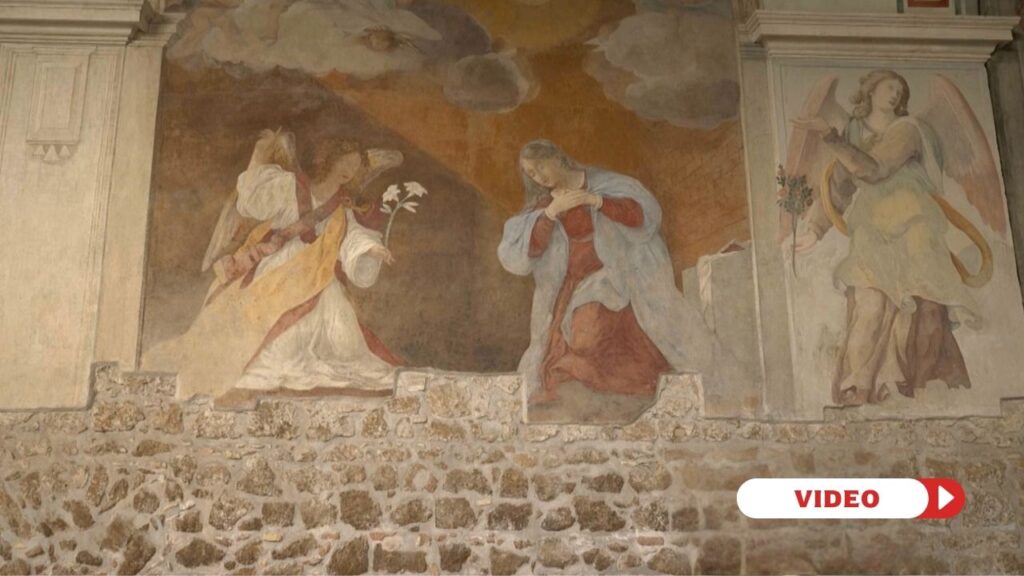
Over the centuries, artists have sought to capture the mystery of the Annunciation in countless ways. One particularly unique interpretation can be found in the Cappella dell’Annunziata, painted by Antoniazzo Romano for the Jubilee year of 1500.
Father Monti points out that the work includes unexpected elements. “If you pay close attention to it, you will see that there is something strange,” he says, noting the presence of figures not traditionally part of the Gospel scene.
Among them is a Dominican cardinal, Johannes de Torquemada, who founded a confraternity dedicated to the Annunciation. The painting reflects not only the biblical event, but also the charitable work of this group. “The Blessed Virgin Mary is actually handing them a little bag with some money inside,” Father Monti explains. “That was because the main purpose of the fraternity was to give dowries to poor women… so they needed financial support in order to marry or to become nuns.”
In this way, the Annunciation becomes not only a theological mystery, but a living inspiration for acts of charity and service.
A Celebration of Life
Today, March 25 is celebrated worldwide as the Solemnity of the Annunciation. It is also observed as the International Day of the Unborn Child, drawing attention to the value and dignity of human life.
At its heart, the feast recalls the moment of the Incarnation—the instant when Christ took flesh in Mary’s womb. It is a reminder that salvation began not in grandeur, but in silence, through the free “yes” of a young woman.
A simple moment, hidden from the world, yet one that forever changed the course of history.
Adapted by Jacob Stein. Produced by Alexey Gotovskiy; Camera by Ilaria Chimenti, Andrea Manna; Video Edited by Giada D’Ottavi. Special thanks & Credits: Basilica of Santa Maria Sopra Minerva.