Tuscany, the cradle of the Renaissance, gave rise to some of history’s greatest artists. Among them stands Fra Angelico, the Dominican friar whose work transformed sacred art into a form of preaching. In the early 15th century, within the walls of the Convent of San Marco in Florence, he painted what would become one of the most celebrated frescoes in Christian art: the Annunciation.
Father Alessandro Monti, a Dominican friar at Santa Maria sopra Minerva, explains that Fra Angelico’s artistic vocation was inseparable from his religious calling. “I think he felt sort of a calling within the calling,” he says. “He had an extraordinary natural ability for painting and when he was also called to religious life, his superiors understood that his ability could be put at the service of the Gospel.”
For Fra Angelico, painting was not merely artistic expression—it was a form of evangelization. As Father Monti puts it, “The specific way in which Fra Angelico preached was through his paintings, so you can think of his paintings as sort of homilies in figures and colors.”
The Annunciation and the Language of Symbols
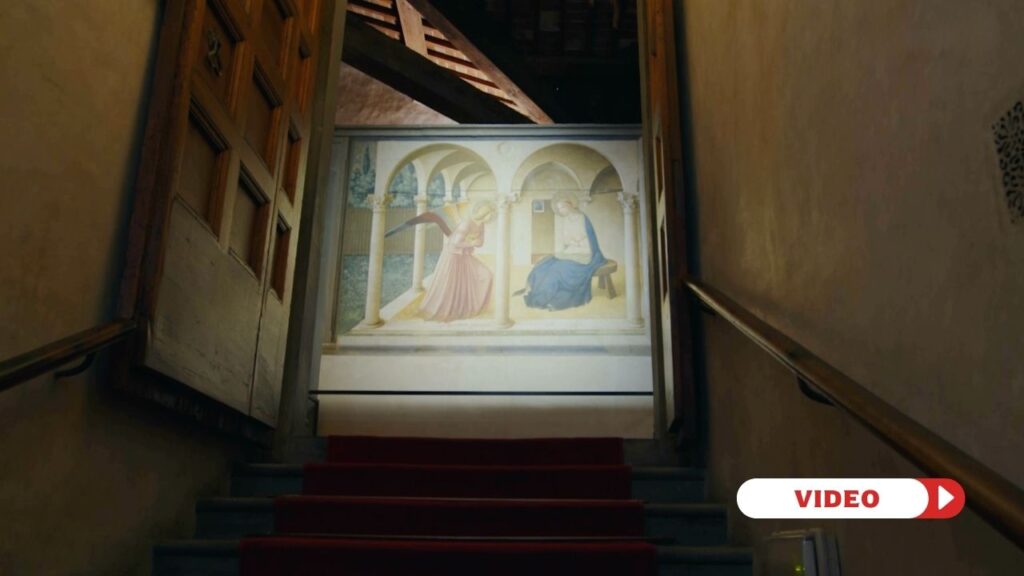
Fra Angelico created several depictions of the Annunciation, including the renowned version now housed in the Prado Museum in Madrid. Yet it is his fresco at San Marco that continues to captivate visitors.
The friar painted 44 cells within the convent, each adorned with biblical scenes meant to accompany the daily prayer and meditation of the Dominican community. But as one enters the dormitory, it is the Annunciation—Mary’s moment of “yes”—that draws immediate attention.
Father Monti highlights the depth of symbolism embedded in the work. “Fra Angelico had a very powerful way of describing the role of Mary in the work of salvation with subtle symbols,” he explains. “For example, you see that the garden at the forefront is very colorful and ordered. But if you look behind the wall, Fra Angelico depicted a forest which is really thick and full of disorder.”
This contrast, he notes, reflects a deeper theological reality: “there is a sort of separation between the world of grace, of union with God, and Mary, of course, is the clear example of that, and the world of sin that lies behind this garden.”
A Convent Built for Prayer and Formation
The Convent of San Marco itself is inseparable from Fra Angelico’s legacy. Commissioned by Cosimo de’ Medici—known as Cosimo the Elder—it was designed as a new center for Dominican life in Florence.
“The leader of Florence, Cosimo il Vecchio… wanted to build a brand-new convent and a brand-new friary for the friars,” Father Monti explains. “And he wanted to have the best artist decorate it.”
The frescoes inside the convent served distinct purposes. “Two kinds of scenes are depicted within this friary,” he says. “One of them is scenes from the New Testament and the other one is a special series on the crucifixion.”
These images were not decorative—they were formative. “The scenes on the crucifixion are depicted specially for novices,” Father Monti notes. “So when a novice… entered into those rooms in which he spent most of his day, he had to meditate on the passion of Christ.”
Rome and the Final Years of Fra Angelico
Fra Angelico’s life eventually brought him to Rome, where he worked for Pope Nicholas V in the Niccoline Chapel. He spent his final years at the Convent of Santa Maria sopra Minerva, where he continued to paint and live as a Dominican friar.
Standing in the cloister where the artist is buried, EWTN Vatican correspondent Paola Arriaza Flynn asked about his final years and enduring legacy.
“Fra Angelico lived here in his very final years between 1453 and 1455,” Father Monti explains. “That was a major period in his life because he was commissioned with several paintings… He also spent his final days here, and he was buried here in Santa Maria sopra Minerva.”
Even at the end of his life, Fra Angelico remained both artist and religious. “If you look at the short record of his activities,” Father Monti adds, “you understand he was both a religious and a painter until the very end of his life.”
When Art Becomes Prayer
Fra Angelico’s works have long been recognized not only for their beauty, but for their spiritual depth. In 1982, Pope John Paul II approved his veneration, and in 1984 he was declared the universal patron of artists.
According to Father Monti, this recognition reflects the deeply prayerful nature of his work. “According to the witnesses, for example Vasari, his great biographer, tells us that he never started a painting without praying first,” he says. “So each painting is a prayer in itself.”
This insight was echoed by Pope John Paul II, who affirmed that in Fra Angelico’s work, “art becomes prayer.”
Even great masters of the Renaissance recognized something extraordinary in his paintings. As Father Monti recounts, Michelangelo once observed that “those figures were first seen by Fra Angelico in heaven and then he put them on earth.”
Fra Angelico himself expressed this union of art and faith in a simple but profound motto: “chi fa cose di Cristo, con Cristo deve stare sempre”—“those who make the work of Christ shall always be with Christ.”
In his life and work, the Dominican friar embodied that truth, leaving behind a legacy where beauty, faith, and contemplation remain inseparably united.
Adapted by Jacob Stein. Produced by Alexey Gotovskiy; Camera by Ilaria Chimenti, Andrea Manna; Video Edited by Ilaria Chimenti.