As Holy Week begins, Catholics around the world turn their hearts toward the Passion and death of Jesus Christ. Nowhere is this journey more tangible than in the Holy Land, where the places themselves still bear the memory of Christ’s final days.
From the Upper Room to Calvary, the geography of Jerusalem becomes a living Gospel — inviting pilgrims not only to remember, but to encounter the events that define the Christian faith.
The Upper Room and the Mystery of Betrayal
On Holy Thursday, the Church commemorates the Last Supper — the moment when Jesus gathered with his apostles before his Passion. According to tradition, that very room can still be visited in Jerusalem.
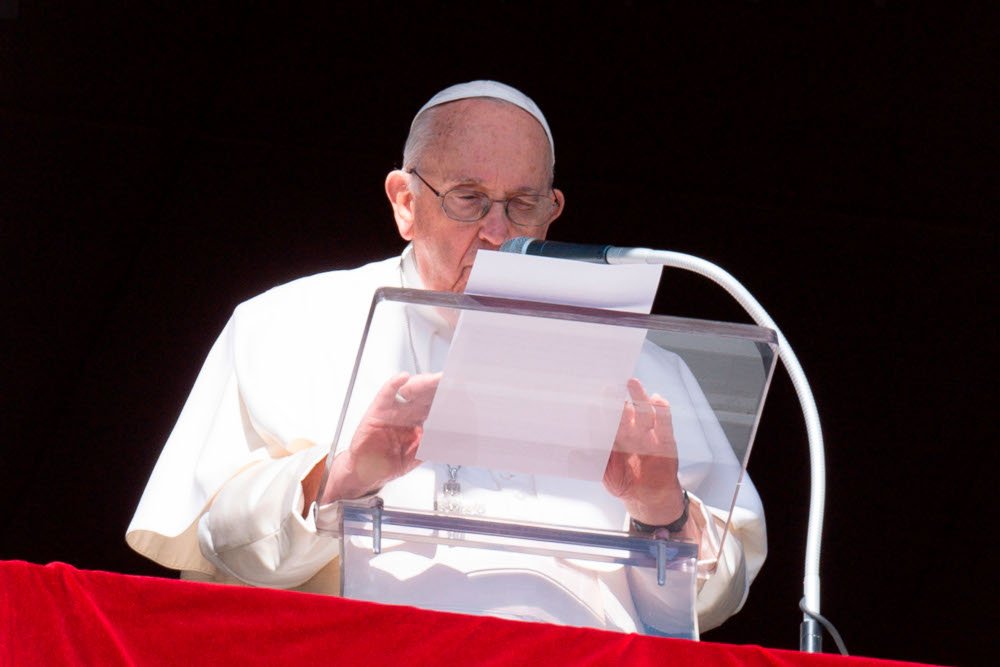
When Pope Francis made his pilgrimage to the Holy Land in 2014, he reflected on the deeper spiritual meaning of this place, reminding believers that the story of the Passion is not only about the past, but about the human heart today.
As he said, “The Upper Room, however, also reminds us of pettiness, of curiosity – ‘Who is the traitor?’ – and of betrayal. We ourselves, and not just others, can reawaken those attitudes whenever we look at our brother or sister with contempt, whenever we judge them, whenever by our sins we betray Jesus.”
Gethsemane: The Place of Prayer and Arrest
From the Upper Room, the path leads to the Mount of Olives — where Jesus often withdrew to pray. Just below lies the Garden of Gethsemane, the place of His agony and arrest.
For many pilgrims, visiting these sites transforms the Gospel from something heard into something experienced. Khaled Jacoub, founder of Nativity Pilgrimage, has accompanied countless visitors through the Holy Land and has seen the impact firsthand.
“When people come here, they go home differently,” he says. “You know, this land is going to renew their soul, renew their relationship with God. They lived the gospel here. It’s like when you are sitting in the church reading the gospel or the priest reads it, or in your home, or you listen to radio station, but when you come here and finally understand the gospel, it’s totally different.”
Standing among the ancient olive trees of Gethsemane — some believed to date back as far as the time of Christ — pilgrims are confronted with the reality of that night.
As one guide explains, “Most likely that when the Lord Jesus came down from the upper room, Judas knew the place.”
Denial, Suffering, and the Way of the Cross
Not far from Gethsemane stands the site traditionally associated with the house of Caiaphas, the high priest. Today known as St. Peter in Gallicantu, it marks the place where Peter denied Jesus three times.
The symbolism of that moment continues to speak to visitors. As one guide points out, the church’s entrance itself carries a powerful message:
“When you walk into the modern church, you will see this beautiful bronze gate… Only one thing is springing out: It is the pointing finger of Jesus. And if you look to the direction where it is pointing, actually it’s pointing towards the entrance to the church. That means even you are going to deny Jesus three times in one of the stages in your life. And it happens.”
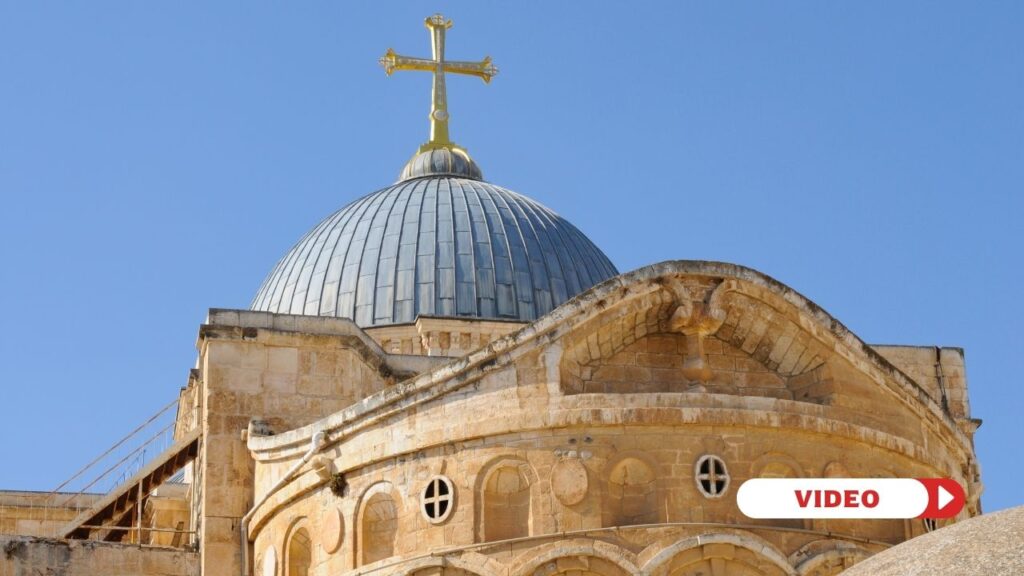
From there, the journey continues along the Via Dolorosa — the path Jesus walked to His crucifixion. It leads to the Church of the Holy Sepulchre, built on the site of Golgotha and the tomb where Christ was laid.
Yet even here, the story does not end in death. As pilgrims stand before the empty tomb, the message of Easter comes into focus.
“The tomb of the Lord is empty, and we are witnesses for the resurrection,” one guide explains. “It is empty. We are witnesses. And you are the witnesses as well.”
Hope Amid Conflict
This year, Holy Week in the Holy Land unfolds under the shadow of ongoing conflict. Due to the war, the traditional Palm Sunday procession in Jerusalem has been cancelled, replaced instead by a moment of prayer for the city.
In a region marked by uncertainty and suffering, the message of the Passion takes on renewed urgency.
And yet, at its heart, Holy Week points beyond suffering to hope — a hope rooted in the Resurrection, and one that continues to resonate even in the midst of war.
In the very places where Christ suffered, died, and rose again, that hope remains alive — perhaps now more than ever.
Adapted by Jacob Stein. Produced by Alexey Gotovskiy; Special thanks & Credits to Nativity Pilgrimage and Khaled Jacoub.