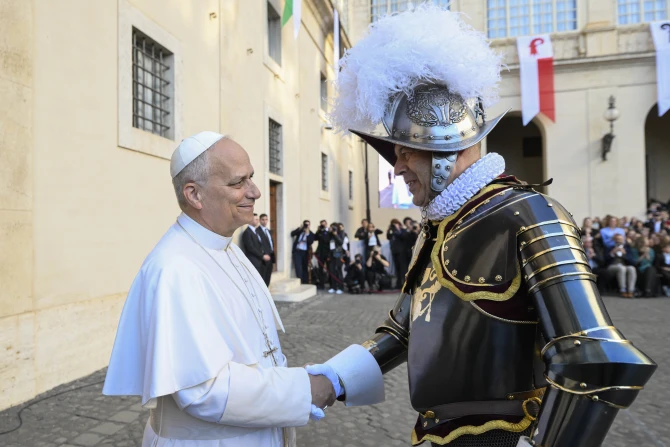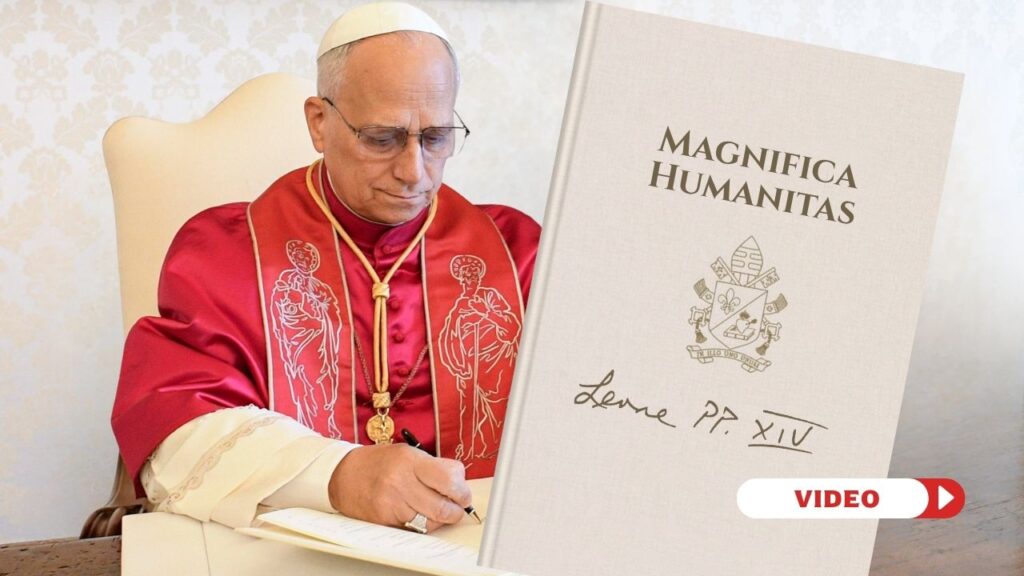
When Pope Leo XIV presented his first encyclical, Magnifica Humanitas, he did something highly unusual. Rather than leaving the document’s presentation to cardinals, theologians, and experts—as is customary in the Vatican—the pope personally attended and addressed the gathering himself.
For veteran Vatican journalist Frank Rocca, who was present at the event, the pope’s participation underscored the significance of the document and the urgency of its message.
“Well, certainly the presence of the Pope always adds a lot of weight to any occasion in the Vatican or anywhere else,” Rocca observed. “And we can’t think of any precedent for this, that the Pope would appear at the presentation of his own document. Usually this is left to cardinals and experts and so forth.”
The choice of language was equally notable. Pope Leo delivered his remarks in English, reflecting the international character of both the technology sector and the conversation surrounding artificial intelligence.
“It was impressive,” Rocca said. “And also, I think another notable thing was that the Pope spoke in English, and most of the people spoke in English, which is appropriate because we’re dealing with an industry not only that is very strong in the US, but the global language of information technology and so many other industries is in fact English.”
Published 135 years after Pope Leo XIII’s landmark social encyclical Rerum Novarum, Magnifica Humanitas seeks to address what Pope Leo XIV sees as the defining social challenge of the present age: artificial intelligence.
Human Wisdom Cannot Be Replaced
As the first papal encyclical devoted specifically to artificial intelligence, Magnifica Humanitas covers a wide range of topics, from economics and labor to governance and ethics. Yet according to Rocca, several themes emerge repeatedly throughout the text.
“Well, I mean, it’s a long document. It’s more than 40,000 words long and it’s wide ranging,” he explained. “But I think one main point that he comes back to again and again and again is that we can’t allow a small group of monopolists to control this.”
For Pope Leo XIV, artificial intelligence presents not only technological challenges but also political and social ones. The concentration of power in the hands of a few corporations, the lack of transparency surrounding AI systems, and the absence of meaningful accountability are among his chief concerns.
“There has to be transparency. There has to be accountability. There has to be regulation,” Rocca summarized.
At the same time, the pope warns against equating machine-generated outputs with genuine human thought. While artificial intelligence can process enormous amounts of information and produce increasingly sophisticated responses, it cannot replicate the uniquely human capacities that arise from lived experience.
“We can’t mistake what AI does with human thinking,” Rocca said. “Humans have a kind of judgment and a kind of wisdom that comes out of their very vulnerability, out of their very limitations.”
Throughout the encyclical, Pope Leo repeatedly emphasizes that wisdom, moral discernment, and responsibility remain distinctly human tasks. Technological innovation may assist human beings, but it cannot replace the moral agency at the heart of human dignity.
A New Form of Colonialism?
Among the most striking sections of Magnifica Humanitas is the pope’s warning that artificial intelligence could create new forms of domination and exploitation.
In the document, Pope Leo writes that if AI develops without adequate safeguards, “the digital age will not be post-colonial but colonial in another form.”
The phrase has attracted considerable attention, particularly because the pope connects contemporary technological concerns with the Church’s historical reflections on slavery and exploitation.
According to Rocca, Pope Leo uses the concept of “digital colonialism” to describe situations in which individuals lose control over valuable personal information or become subject to systems designed without regard for their rights and dignity.
“For example, he says that health data has become a very valuable good that is being exploited and that people should have control of their own health data,” Rocca explained. “And if not, they’re victims of a new colonialism.”
The pope also points to workers involved in the extraction of raw materials necessary for modern technology, as well as victims of human trafficking whose exploitation is facilitated through digital tools.
“He talks about all the workers who work in the literal extraction industries to produce the materials that are needed to produce the devices,” Rocca noted. “And also human trafficking victims, whose traffickers use it to move people around. And he says these people are victims of a new slavery.”
These reflections lead Pope Leo XIV to a broader examination of the Church’s own history. In a striking passage, he acknowledges that the Catholic Church took centuries to fully condemn slavery and argues that this history carries important lessons for the present.
“He says that in order to be credible on this point now the Church has to understand that it took a long time to condemn slavery,” Rocca explained. “He’s saying if we don’t want to lose our moral authority, we have to make sure we don’t do something like that again.”
For the pope, confronting the ethical challenges of artificial intelligence today requires the same moral clarity that previous generations eventually brought to questions of slavery and human exploitation.
Building a Civilization of Love
Despite its warnings, Magnifica Humanitas is ultimately a hopeful document.
Rather than presenting technology as an inevitable threat, Pope Leo XIV calls for the construction of what he describes as a “civilization of love in the digital age”—a society in which technological innovation is directed toward the service of humanity rather than its domination.
For some observers, such a vision may seem unrealistic amid ongoing wars, social divisions, and political instability. Yet Rocca argues that the pope grounds his hope in concrete historical examples.
“He points to all these great saints, some of them actually canonized saints of the Catholic Church, some of them are just heroic figures in society who are not necessarily Catholic,” Rocca said.
Among those examples are Saint Teresa of Calcutta, Martin Luther King Jr., and Nelson Mandela—individuals who demonstrated that moral courage and selfless service can transform societies.
“He comes back and he says, we see that people have been able to do great things for their fellow human beings,” Rocca explained. “So that’s where he draws hope is from the example of people from the past.”
In many ways, Magnifica Humanitas follows the path first charted by Rerum Novarum more than a century ago. Just as Pope Leo XIII sought to guide society through the upheavals of industrialization, Pope Leo XIV is attempting to offer a moral framework for the age of artificial intelligence.
His message is neither anti-technology nor nostalgic. Rather, it is a call to ensure that innovation remains ordered toward the common good, human freedom, and the dignity of every person.
As artificial intelligence continues to reshape economies, institutions, and daily life, Magnifica Humanitas asks a simple but profound question: Will technology serve humanity, or will humanity become subject to technology?
For Pope Leo XIV, the answer depends on the choices society makes today.
Kristina Millare contributed to this article. Adapted by Jacob Stein.