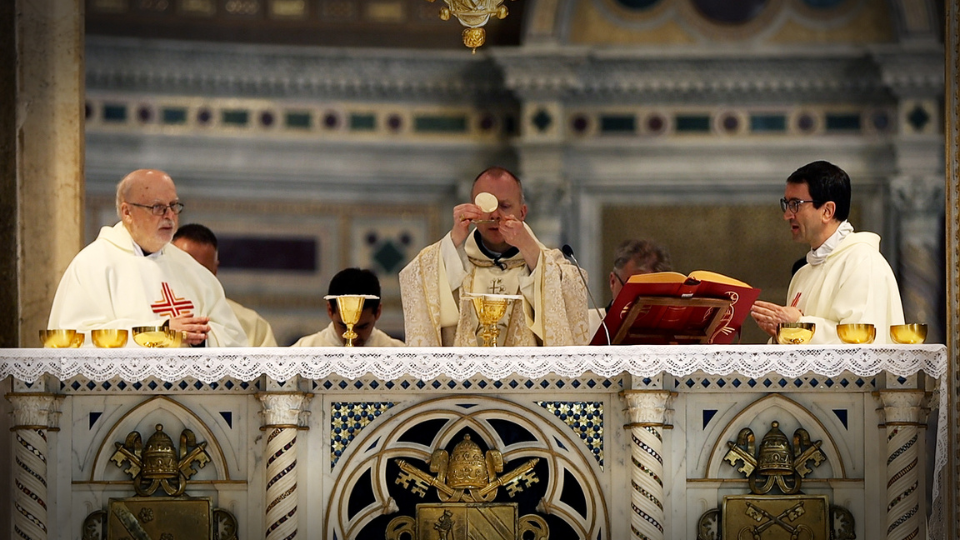
On June 10, Pope Leo XIV will celebrate Holy Mass in Barcelona’s Basilica of the Sagrada Família and inaugurate the Tower of Jesus Christ, marking the centenary of Antoni Gaudí’s death and becoming only the third pope to visit the iconic basilica. The visit comes at a pivotal moment in the history of one of the world’s most recognizable churches, as the completion of its tallest tower brings Gaudí’s vision closer than ever to fulfillment.
Produced by Paola Arriaza-Flynn, EWTN News’ new documentary, Sagrada Familia: The Masterpiece Uniting Heaven and Earth, explores why the basilica remains far more than an architectural landmark. Through conversations with architects, clergy, historians, and young Catholics, the documentary reveals how Gaudí’s masterpiece continues to shape lives, inspire conversions, and draw visitors toward God more than a century after construction began.
A Basilica Built to Express the Christian Faith
For Jordi Faulí, chief architect of the Sagrada Família since 2012, understanding the basilica begins with understanding its purpose.
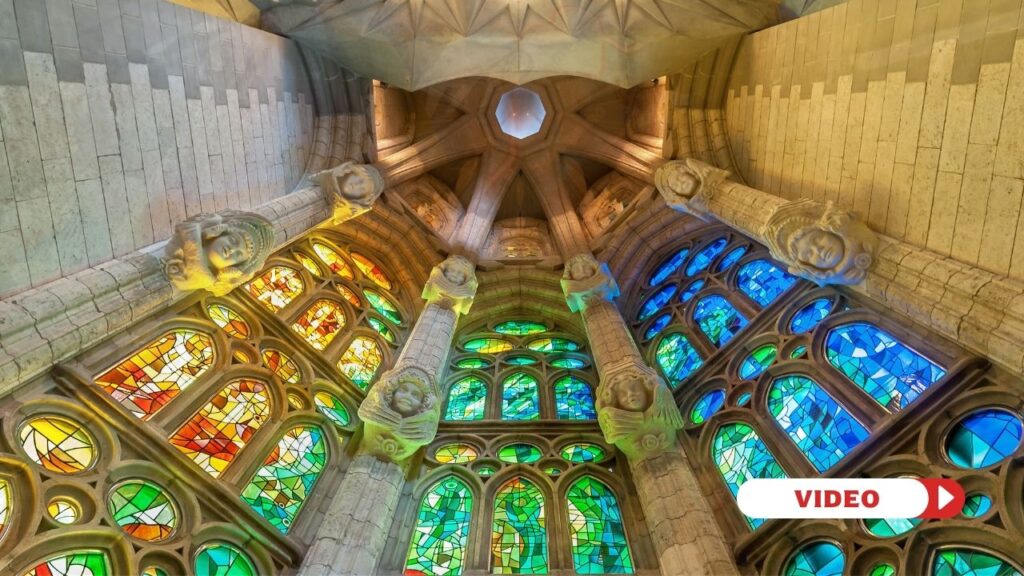
Standing beneath the soaring vaults that Gaudí envisioned, Faulí explains that the church is “first and foremost, an expression of Christian faith.” Every architectural element, from the branching columns that resemble a forest canopy to the symbolism woven into the façades, was designed to communicate the mysteries of Christianity.
According to Faulí, Gaudí’s goal was never simply to create something beautiful. Rather, he wanted those who encountered the basilica “to understand the Christian faith, to deepen their relationship with God, and to feel welcomed and loved by God.” For Gaudí, architecture served a missionary purpose. Beauty was meant to move hearts and lead people toward an encounter with Christ.
That vision is visible throughout the church. The Nativity Façade celebrates the joy of Christ’s birth through abundant natural imagery. The Passion Façade conveys the suffering of the Crucifixion through stark and dramatic forms. The future Glory Façade points toward eternal life and humanity’s ultimate destiny in God. Together, they form a visual catechism carved in stone.
Faulí notes that even the basilica’s structure serves a spiritual purpose. The columns rise upward like trees, allowing light to flood the interior through hundreds of windows and skylights. “All of this is designed to draw our gaze upward, toward God,” he explains.
The Way of Beauty
The Sagrada Família welcomes more than five million visitors every year. Many arrive as tourists, curious to see Gaudí’s famous creation. Yet the documentary suggests that something deeper often takes place once they step inside.
According to Fr. Josep Maria Turull, rector of the Sagrada Família, the basilica continues to demonstrate the power of beauty to awaken spiritual curiosity. Visitors, he says, frequently arrive with little expectation of a religious experience. Yet the building itself often becomes a point of encounter.
“Upon entering the Sagrada Familia, people gasp in awe at such beauty,” Turull observes. After that initial reaction, he says, many find themselves opening their hearts “to the author of this beauty.”
For Turull, this is one reason Pope Leo XIV’s visit carries such significance. Following the example of Pope Benedict XVI, who consecrated the basilica in 2010, Leo’s presence highlights the enduring role of sacred beauty in the Church’s mission of evangelization.
Turull believes the Pope understands what millions of visitors experience each year: that the Sagrada Família is not simply a monument to human creativity but a place where beauty points beyond itself toward God.
A Living Church in Barcelona
The documentary also looks beyond the basilica’s walls to explore the life of the Church in contemporary Barcelona.
At the parish of Saint Michael of the Saints, Fr. Bruno Bèrchez describes a growing number of young people seeking meaning in a culture that often feels fragmented and uncertain. Contrary to common assumptions about religion in Western Europe, he says many young adults are actively searching for faith.
“There’s a bit of a stereotype out there that young people today aren’t interested in the Church,” Bèrchez explains. “But in my experience, that’s not the case.”
The documentary features several young Catholics whose stories reflect that reality. Some found their way to the Church through personal study, others through friendships and parish communities. Many describe discovering in Catholicism answers they could not find elsewhere.
Bèrchez sees the Sagrada Família as part of that renewal. With the completion of the Tower of Jesus Christ, the illuminated cross atop the basilica will now be visible throughout much of the city.
“All of Barcelona—if it so chooses—can look up and see that there’s a cross there,” he says, “a cross that’s illuminated day and night.”
The Meaning of the Tower of Jesus Christ
The focal point of Pope Leo XIV’s visit will be the inauguration of the Tower of Jesus Christ, which now rises more than 550 feet above Barcelona.
For many, the tower’s completion represents the culmination of decades of work. Yet those closest to the project insist its significance is spiritual rather than architectural.
As Fr. Turull explains, Gaudí never intended to create the world’s tallest church simply to break records. Instead, the architect wanted the basilica to serve as a visible sign of humanity’s relationship with God.
“His intention wasn’t to be the greatest,” Turull says, “but rather he wanted it to reflect how this Basilica unites heaven and earth and invites us to lift our gaze toward the cross.“
That idea lies at the heart of both the documentary and the Pope’s visit. The inauguration of the tower is not merely the unveiling of a new architectural feature. It is the completion of a central element in Gaudí’s spiritual vision—a vision rooted in the conviction that beauty, faith, and truth ultimately lead to Christ.
As Pope Leo XIV prepares to celebrate Mass beneath the basilica’s soaring vaults and bless its highest point, the moment serves as a reminder that the Sagrada Família remains exactly what Gaudí hoped it would become: a place where visitors are invited to look upward, open their hearts, and encounter God who inspired its creation.
Follow the LIVE updates from EWTN News for Pope Leo’s Trip in Spain.