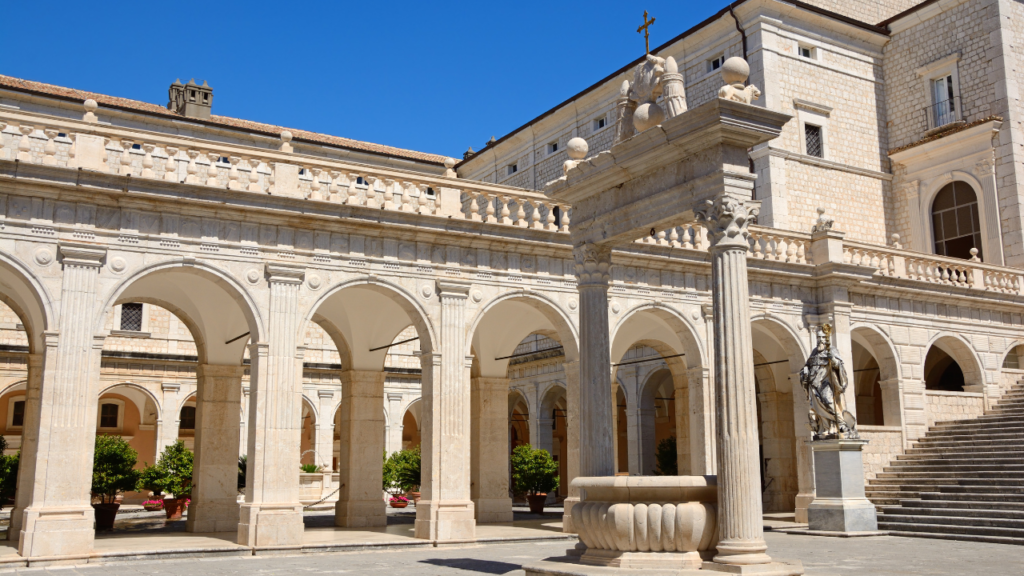
Discover the extraordinary history of the Abbey of Monte Cassino, the Abbey where St. Benedict of Norcia lived and created the Rule of the same name. A millennial symbol of faith, resilience and spiritual rebirth, it continues to inspire the faithful throughout Europe.
The origins and foundation of the Abbey
Founded by St. Benedict in 529, the Abbey of Monte Cassino stands as one of the most important places of Western monasticism. After leaving Subiaco because of local conflicts, St. Benedict chose Monte Cassino as the ideal place for his new monastery, where he wrote the famous Benedictine Rule. This rule, based on Ora et Labora, became the mainstay of European monastic life, promoting a life dedicated to prayer, work and study.
The influence of Charlemagne and the Carolingian period
The importance of the Abbey of Monte Cassino grew further during the Carolingian period. Thanks to the support of Charlemagne, the Benedictine Rule spread rapidly throughout the West, becoming the norm for European monasteries. During the tenure of Abbot Desiderius, who would become Pope Victor III, Monte Cassino reached its political and cultural zenith. The monastery’s library, enriched with manuscripts from all over the world, became one of the most important in Europe.
Destructions and historical revivals
The Abbey of Monte Cassino suffered many destructions: by the Lombards in 570, by the Saracens in 883, and finally during World War II in 1944. However, on each occasion, the abbey has been rebuilt. As Dom Luca Antonio Fallica, the abbey’s current abbot, said, “From these destructions, monasticism here at Monte Cassino has always been reborn, so true is it that the abbey’s motto is ‘Succisa Virescit,’ a severed root comes back to flourish.”
Miraculously, the tomb of St. Benedict and his sister Scholastica was spared from destruction. Pope Paul VI reconsecrated the abbey in 1964, proclaiming St. Benedict Patron of Europe for his spiritual and cultural contribution to European history. Today, the abbey is home to 8 Benedictine monks, who continue to live by the principles of prayer and work.