In Rome, art is far more than something to simply admire.
From the city’s most ancient churches to the grandest masterpieces hidden within them, Sr. Emanuela Edwards, a Member of the Missionaries of Divine Revelation, is one of many who guides pilgrims, faithful and visitors through the heart of the Eternal City.
Through the beauty of sacred art and architecture, she invites them to see beyond what is visible, and encounter the faith that inspired it.
The church often speaks of the way of beauty, Via Pulcritudinis in Latin, as a path that can lead to God. Could you explain to us, what is this path and how can Rome’s art and beauty lead on that path?
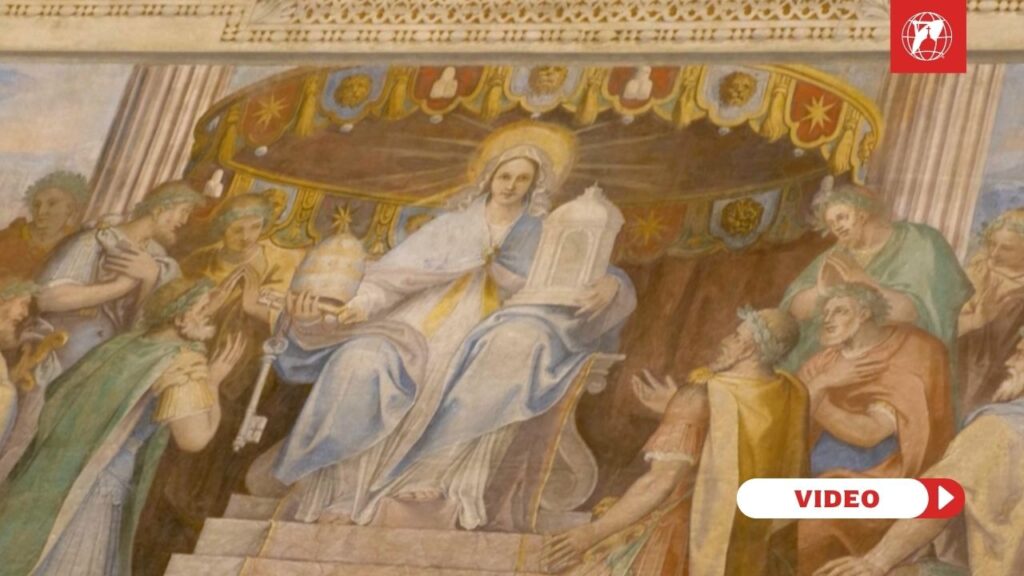
Today we have to think about our society and culture as it is. Often truth is seen as something that’s relative, and goodness is often obscured in some way. But beauty remains as something which still has the ability to really capture the heart. And it can bring the other two things along, because a wonderful work that is beautiful is also true and also good. And so beauty can lead the way. And beauty is like a call, a call to a person. And so, a person coming into the Great Basilica sees these wonderful stories of faith, they may be uninterested in the story of faith on itself, but they may be interested in the work of art. […] But if you explain a work of art, there opens a door which is actually in their own hearts, which gives them the ability to listen to something otherwise they would never listen to. And so the way of beauty, I think, enters with the eyes and finishes with the heart.
Part of your mission includes accompanying pilgrims through some of Rome’s greatest basilicas and to help them discover some of the art and architecture and even history here in the Eternal City. What do you hope that the pilgrims take away from these encounters?
A pilgrim or a tourist arriving in Rome, you know, they see the wonderful basilicas and the great statues and then the great masterpieces, and it’s very, it’s a very good way of, introducing them to the history of the Eternal City, which in one way or another kind of, incarnates the faith. And so when we accompany a group through the Eternal City, the most important thing is that they’re in some way transformed, and it’s not necessarily a transformation or a movement from one place to another, which is always part of a pilgrimage, but rather it’s a transformation of the heart.
And sister, do you have an example of a church, some art here in Rome, that you think is particularly beautiful and moving to behold?
The mosaic of Christ in Saint Paul outside the walls. And so, we see in that beautiful mosaic which is resplendent with gold, so you know you’re looking at something that is out of this world, something that depicts paradise. We see Christ blessing with his right hand. But you can see he’s got his thumb and his ring finger connecting. And this, of course, as a deep meaning for us because this tells us of the union of the divine and human nature as it speaks of the incarnation. The Lord with the other hand is holding the scriptures and there’s that beautiful phrase, ‘Come to me all you blessed of my Father for the place that has been prepared for you from the beginning of time’. So, you’re there in this beautiful place and there’s this huge mosaic with this invite. And St. Paul, his scroll says, ‘Before the name of Jesus, every knee will bow’. And so, you’re brought into contact with the greatness of our Lord.
And for someone who is visiting Rome for the first time or perhaps only has one day to visit the city, what piece of art or sacred place would you encourage them to not miss and why?
Well, I think if you’re going to come to Rome, you have to go to St. Peter’s Basilica. You have to go to the heart of the church because, you know, just walking across the Piazza, you see all those wonderful saints who adorn the colonnades and the obelisk with its testimony of all those martyrs, all those Christians who lost their lives to proclaim the faith that we can proclaim freely today.
And speaking of evangelizing through beauty, which is what we’re doing here, how does that form of evangelizing differ from other forms, such as perhaps intellectual arguments or personal witness?
If you go and listen to a discourse or a discussion on the faith or a program about the faith, that’s one type of catechesis. You may get people who are really interested in the faith to listen to the discussion, or those who are interested in the argument to listen to the discussion. But art is open to everyone. And indeed in the basilicas we find people from all over the world, from every country, every race, every place on earth, And so it gives us another, a wider audience with which to bring this beautiful story, which of course is the greatest love story ever told. And so I think it differs in the way that it can be an opening for those who are very far from the faith, those who’ve never heard of God, or those who’ve perhaps gone to catechism class and never listened.
Adapted by Jacob Stein