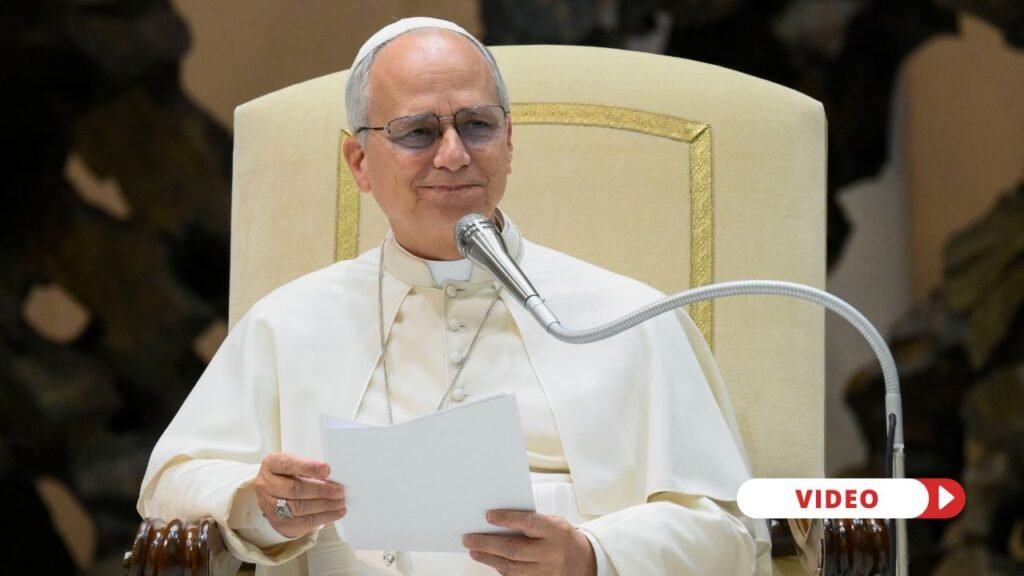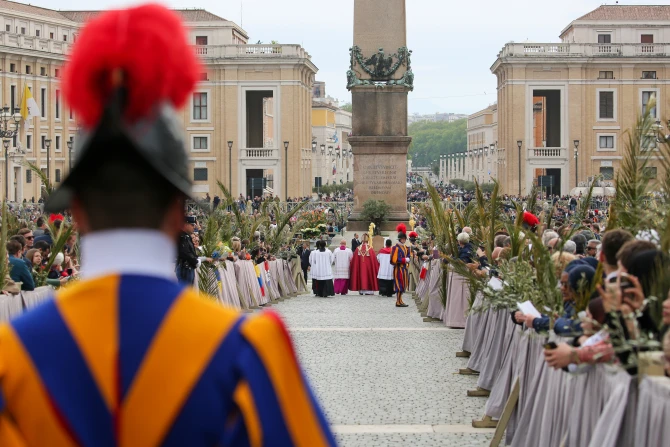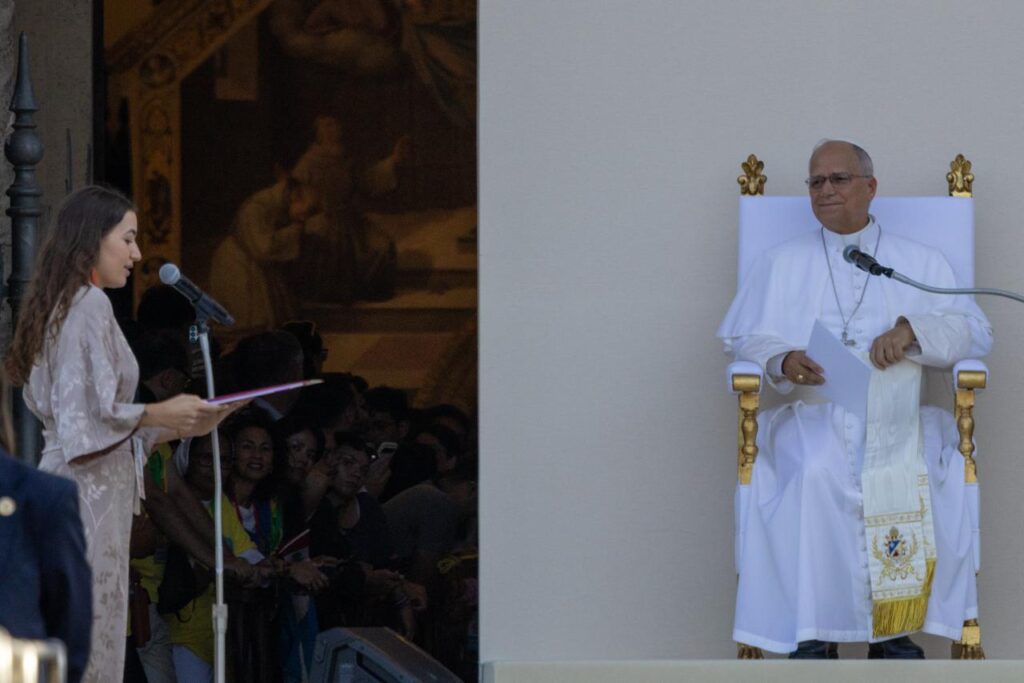
At the GO! Franciscan Youth Meeting in Assisi, Italy, the pope urged 2,500 young adults to become “artisans of peace,” make lasting commitments and help renew the Church through service.
ASSISI, Italy — Eight centuries after St. Francis gathered thousands of friars near the Portiuncula, Pope Leo XIV met with 2,500 young adults in Assisi, Italy, on Thursday and urged them to embrace Gospel radicalism, work for peace, and remain faithful to the Church despite her wounds and internal crises.
The pope spoke Aug. 6 at the Basilica of St. Mary of the Angels during the GO! Franciscan Youth Meeting 2026, a gathering of young people ages 18 to 33 from throughout Europe and from countries including the United States, Vietnam, and South Sudan.
The event formed part of celebrations marking the 800th anniversary of the death of St. Francis of Assisi.
In 1221, St. Francis gathered approximately 5,000 friars from across Europe near the Portiuncula for what became known as the Chapter of Mats. With nowhere else to stay, the friars slept on simple mats — an image Pope Leo XIV invoked in his remarks to the young participants, many of whom had spent the gathering sleeping in bags.
The pope arrived by helicopter at approximately 8:28 a.m. near St. Mary of the Angels. He was welcomed by Bishop Felice Accrocca of Assisi and local civil authorities before traveling to the basilica, where he was received by the ministers general of the principal Franciscan orders.
According to Father Alfio Vespoli, Pope Leo XIV personally chose the youth gathering from among the many events planned for the Franciscan centenary year.
Father Marco Vianelli, provincial minister of the Friars Minor of Umbria and Sardinia, welcomed the pope and recalled the importance of the Portiuncula in Franciscan history.
“Your Holiness, here at the Portiuncula St. Francis understood his vocation; here he welcomed his first brothers; here St. Clare consecrated her life to the Lord; here the indulgence of the Pardon of Assisi blossomed, a sign of God’s boundless mercy,” Vianelli said.
“Here, on Oct. 3, 1226, naked on the bare earth, he welcomed Sister Death in song,” the friar continued. “We thank you for accepting our invitation and for wanting to meet these young people.”
Becoming artisans of peace
The first question came from Karolina, a young woman from Zagreb, Croatia, who described the challenge of witnessing to the faith in a rapidly changing society.
“Today, however, we live in a rapidly changing world, where many young people struggle to find points of reference, to build authentic relationships and open their hearts to God,” she said. “We too want to be credible witnesses to the Gospel wherever we live, study, and work, and to bring the light of Christ with the simplicity and fraternal spirit of St. Francis.”
She asked the pope what advice he would give young people formed in the Franciscan spiritual tradition so that they could remain faithful disciples of Christ and bring hope to their peers without losing the joy and simplicity of the Gospel.
Pope Leo XIV noted that Karolina came from a part of Europe that was marked by war only three decades ago and praised the Franciscans’ history of promoting dialogue and peaceful coexistence among Catholics, Orthodox Christians, and Muslims.
“Increasingly, Christians will be called to become artisans of peace within societies that are tempted to place religion at the service of competing identities,” the pope said.
“Being witnesses to Christ, therefore, is both captivating and demanding. It enlarges our minds and hearts, freeing us from artificial boundaries, from the fears created by misinformation, and from walls built by prejudice,” he continued. “Rejecting the culture of power and building a civilization of love are choices that are not immediately understood or accepted.”
The pope encouraged the young people to learn from St. Francis a radical commitment to the Gospel that should never be confused with fundamentalism.
“St. Francis, however, teaches that radicalism of the Gospel is the very opposite of fundamentalism,” he said. “It does not make us blind or violent; instead, it makes us aware, attentive, and always eager to follow Jesus, and therefore humble and welcoming toward everyone. It is not an easy path, but it brings much joy.”
Pope Leo XIV then asked the participants to imagine the site eight centuries earlier, when young friars from across Europe gathered around St. Francis.
Citing “The Little Flowers of St. Francis of Assisi,” the pope described the friars gathered “company by company, here 40, there a hundred, and there 80 together, all employed in speaking of God, in prayers, in tears, and in exercises of charity, behaving themselves with so great silence and with such sobriety that no clamor was heard there.”
“That silence stands in stark contrast to war, with its violence, clamor, and cruelty,” he said. “The simple mats on which those friars slept speak to us of peace — just like your sleeping bags today. This is the Church: an assembly of brothers and sisters to which everyone is invited.”
The pope also encouraged the young people to bear witness through personal encounters at a time when technology is making face-to-face relationships less common.
“More than words, it is this joy that evangelizes, and it cannot be hidden,” he said.
The courage to choose forever
Giovanni, a 27-year-old from Bologna, Italy, asked about discerning and remaining faithful to a vocation in a culture dominated by temporary commitments.
“How can we say a full and courageous ‘yes’ to him, without ‘putting our hand to the plough and looking back,’ by dwelling too much on the hardships and sacrifices that the journey may entail?” he asked. “What helped you most on your own vocational journey?”
Pope Leo XIV said contemporary misunderstandings of freedom can lead people to believe that no decision is truly permanent because both individuals and the world around them are constantly changing.
“In such a context, the courage to make a definitive choice may well be the most revolutionary act of all,” he said.
A permanent choice, the pope continued, “does not imprison us within a cage; rather, it opens us to a greater dynamism.”
“To love is an exodus,” he said. “It is a path to be discovered, a journey that God himself walks with us. This is the meaning of every vocation.”
Faith, trust, and faithfulness are inseparably connected, the pope said, warning that people cannot solve their problems simply by fleeing commitments or moving continually from one experience to another.
“We may multiply our experiences, our acquaintances, and our possessions yet remain in exactly the same place,” he said. “The human cost is immense, and the inner emptiness that follows is profound.”
Reflecting on his own vocation, Pope Leo XIV said God had always accompanied him through the people placed beside him.
“Looking back on my own life, I can say that the Lord has never left me alone,” he said. “He has always accompanied me, often by placing people beside me with whom I could share the journey.”
The pope said the light that guided him as a priest, an Augustinian, and a missionary remained with him when he was called to accept the unique vocation of serving as pope.
Rebuilding a wounded Church
The final question was posed by Luigi, a 22-year-old from Paternò, Sicily, who spoke on behalf of the Franciscan Youth of Sicily.
Luigi recalled that St. Francis remained obedient to the pope and the Roman Church despite the contradictions and difficulties of his time. Rather than attacking or judging the Church, Francis responded through compassion, obedience, and reparative love, he said.
“Today many young people say that they ‘believe, but not in the Church,’” Luigi said. “Even within our own communities we sometimes see a Church marked by contradictions and internal crises.”
“How can we remain faithful to this reparative love?” he asked. “Why is it so difficult today to see the Church as a mother who, despite her wounds, is always ready to welcome us and to love us?”
Pope Leo XIV acknowledged that many people throughout history have struggled to experience the Church as Christ desires her to be.
“This causes deep suffering; it leaves wounds and disappointments, and for some it even becomes an obstacle to faith,” he said.
Yet the Church continues to bring together men and women who otherwise might never have met, the pope said. Whenever people overcome discrimination and inequality by recognizing one another as brothers and sisters, the miracle desired by Christ is renewed.
“The word of God, the sacraments, and the practice of fraternal love are the means by which the image of Christ is formed within us,” Pope Leo XIV said.
“Francis walked this path: not to dominate, but to serve; not to grasp, but to receive; not to withhold, but to give back,” he continued. “This is the very life of God, which continually renews the Church and makes her a free people, a place of refreshment and salvation.”
Each Christian has a role in the continuing work of rebuilding the Church, the pope said, through different vocations and responsibilities undertaken together.
“Then we shall speak of the Church with the affection one has for a mother, because we shall know that we belong to her,” he said.
After the public exchange, the pope greeted representatives of the Franciscan orders, bishops attending the gathering, and members of the national committee responsible for the eighth centenary of St. Francis’ death. He later celebrated Mass in the Basilica of St. Mary of the Angels.
Father Luca De Pasquale, one of the organizers, told ACI Stampa, the Italian-language sister service of EWTN News, that the gathering was not intended to create a temporary spiritual high in which the young people merely enjoyed spending several days together.
Its central objective, he said, was to prepare a “missionary charter” offering concrete guidance to help participants return home and place the Gospel and fraternity at the center of their daily lives.
This story was first published by ACI Stampa, the Italian-language sister service of EWTN News. It has been translated and adapted by EWTN News English.