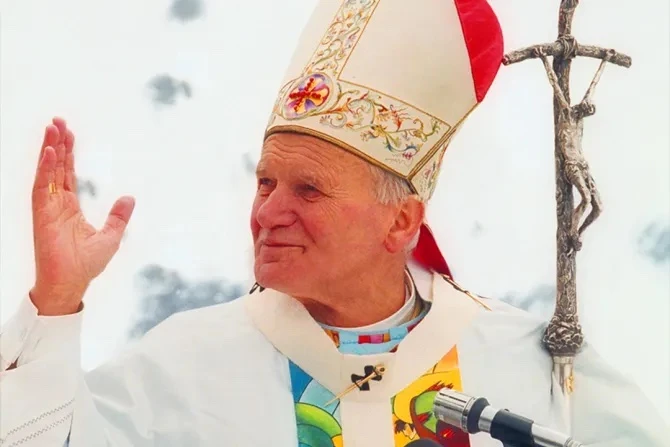
You probably know that St. John Paul II was the second pope with the longest pontificate in modern history, lasting 27 years, and that he was the first non-Italian pontiff since Dutch Pope Adrian VI in 1523. But did you know that in those 27 years he also changed the Catholic Church forever? Here are five ways he did so:
- He contributed to the fall of communism in Eastern Europe in 1989
The pope’s official biographer, George Weigel, who has documented the pontiff’s involvement with civic leaders for decades, noted John Paul II’s enormous political influence. This is especially seen in the way his engagement with world leaders helped the fall of the USSR. A few days before President Ronald Reagan asked Mikhail Gorbachev to “tear down” the Berlin Wall, he met with the pope. According to historian and author Paul Kengor, Reagan went so far as to consider John Paul II his “best friend,” saying that no one knew his soul better than the Polish pontiff, who had also suffered an assassination attempt and carried the burden of world leadership. Over the course of 38 official visits and 738 audiences and meetings with heads of state, John Paul II influenced civilian leaders around the world in this epic battle against a regime responsible for the deaths of more than 30 million people.
- He beatified and canonized more saints than any predecessor, making sainthood more accessible to ordinary people
One of the most enduring aspects of John Paul II’s legacy is the large number of recognized saints. He held 147 beatification ceremonies, proclaiming 1,338 blessed, and 51 canonizations for a total of 482 saints. A well-known example is Mother Teresa of Calcutta, but the first saint of the new millennium, particularly dear to the pope, was St. Faustina Kowalska, the Polish compatriot who received the message of divine mercy. Another significant example is Pier Giorgio Frassati, beatified in 1990 and called by John Paul II “the man of the beatitudes.”
- He transformed the papal travel calendar
John Paul II visited some 129 countries during his pontificate – more than any other pope up to that time. He also created World Youth Day in 1985 and presided over 19 as pontiff. Weigel said the pope understood that the pontiff had to be present to the people of the Church wherever they were, and that his trips were not just visits, but true pilgrimages.
- He made an extraordinary contribution to the teaching of the Church
John Paul II was a great scholar. He promulgated the Catechism of the Catholic Church in 1992, reformed the Eastern and Western Codes of Canon Law and wrote 14 encyclicals, 15 apostolic exhortations, 11 apostolic constitutions and 45 apostolic letters. His intellectual influence continues to be fundamental, with works such as The Theology of the Body remaining central to ecclesial debate.
- He breathed new life into the Catholic Church in Africa
John Paul II’s evangelical enthusiasm found fertile ground in Africa. The pope visited the continent numerous times, inspiring a generation of African Catholics. His influence in Africa also played an important role during synods on marriage and the family, with African bishops strongly defending the Church’s classical understanding of marriage and the family.
John Paul II’s legacy not only transformed the world, but also changed the Catholic Church forever.