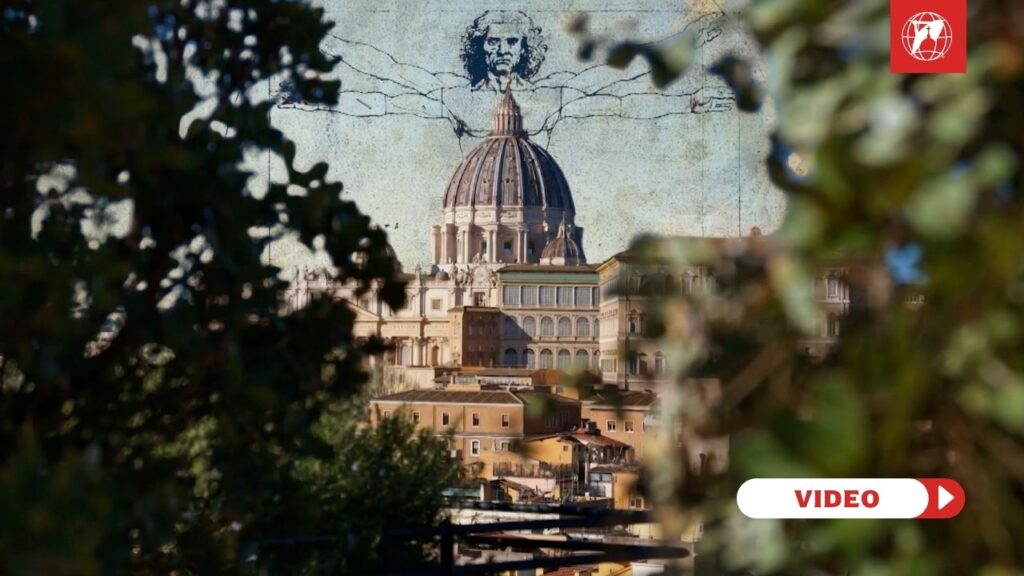
The Renaissance placed a new emphasis on the extraordinary capacities of the human person: reason, creativity, craftsmanship, discovery and the ability to transform the world through art and knowledge.
But that achievement also contained a tension that would become increasingly important over the following centuries.
What happens when humanity moves from occupying an important place within creation to becoming the ultimate reference point for understanding reality itself?
Five centuries after the Renaissance, artificial intelligence, transhumanism and rapidly developing technologies have given that old question a new urgency.
And Christian Humanism may once again have something important to say.
When Humanism became a challenge
The Catholic Church’s relationship with Renaissance Humanism was not always straightforward.
Art historian Dr. Elizabeth Lev notes that Church leaders responded differently to the renewed interest in Greco-Roman art, philosophy and culture.
At times, the Church enthusiastically supported the movement. At others, Church leaders became suspicious of its implications and attempted to slow its development.
Artists experienced the same tension.
Celebrating human creativity and potential could illuminate the dignity of the human person. But it also raised a fundamental question: Could humanity become so fascinated with its own achievements that it eventually placed itself above God?
The Protestant Reformation intensified that debate.
Some Reformers viewed the Catholic fascination with pagan antiquity as evidence of corruption. At the same time, Lev argues, certain currents of the Reformation introduced another form of individual emphasis: the conviction that the individual believer could interpret Scripture apart from the accumulated authority and tradition of the Church.
Art itself became caught in the controversy.
Should the Catholic Church continue commissioning the kind of ambitious art that had flourished within Renaissance Christian Humanism?
The Council of Trent ultimately affirmed the continued place of sacred images within Catholic life, even as the Church sought to address abuses and clarify their religious purpose.
The Catholic artistic tradition continued.
From God to the autonomous self
The centuries that followed brought an even more significant philosophical transformation.
The human person increasingly came to be understood not primarily as a creature in relationship with God, but as an autonomous point of reference for interpreting reality.
Cardinal Gianfranco Ravasi, president emeritus of the Pontifical Council for Culture, identifies René Descartes as an important figure in that transition.
Descartes himself was a believing Catholic and even made a pilgrimage to the Holy House of Loreto. Yet his famous principle cogito, ergo sum — “I think, therefore I am” — placed individual consciousness at the foundation of his philosophical method.
Descartes did not intend to construct an atheistic worldview. Nevertheless, the emphasis on the thinking subject would become influential in subsequent Western philosophy.
Humanism itself eventually developed in several directions, including religious, secular and explicitly atheistic forms.
By the 20th century, Lev notes, the term was increasingly associated with a worldview that excluded religion altogether.
That modern definition can make the historical origins of Humanism easy to forget.
Recovering Christian Humanism
For Lev, speaking today about “Christian Humanism” helps recover an important part of that forgotten history.
Renaissance Humanism emerged from a Christian culture that believed revelation did not need to fear human creativity, intelligence or discovery.
Christianity could encounter what was true, good and beautiful in human culture and incorporate it into a larger vision of the human person and creation.
That conviction produced some of the greatest artistic achievements of the Renaissance.
But the same idea may have particular relevance today.
The question is no longer only how Christians should engage with classical philosophy or pagan antiquity. New technologies are challenging humanity’s understanding of intelligence, creativity, the body and even human identity itself.
Artificial intelligence can generate images, music and text. Transhumanist ideas raise the possibility of technologically altering or augmenting human capacities.
Behind these developments lies an older question: What makes the human person unique?
Can art defend human dignity?
Lev believes art has an important role to play in answering that question.
Modern art has often experimented with abstraction and the fragmentation of the human form. Artificial intelligence now introduces another possibility: creative works generated by machines rather than through the direct craftsmanship of a human artist.
Christian Humanism, Lev suggests, offers another way of thinking about artistic creation.
A sculptor takes stone. A painter takes pigment and canvas. Through skill, intelligence and physical labor, the artist transforms material into something capable of communicating an interior vision.
There is something profoundly incarnational about that process.
An idea in the human mind becomes something visible and tangible through the work of human hands.
The significance of art, therefore, does not reside only in the finished object. It can also be found in the human act of making it.
In an age when machines can increasingly imitate the products of human creativity, craftsmanship raises a deeper question: Is artistic value determined only by what is produced, or does the human person who creates it matter?
Pope Leo XIV and the human person
That question forms part of a much larger challenge facing the Church in the technological age.
From Renaissance Christian Humanism to Pope Leo XIV’s encyclical Magnifica Humanitas, the Catholic tradition has continued to insist upon the central importance and dignity of the human person.
Technological development is not simply a question of what humanity can accomplish. It also demands reflection on what those accomplishments are for.
Artificial intelligence, biotechnology and transhumanism can offer new possibilities, but they can also challenge fundamental assumptions about the meaning of intelligence, embodiment, work and creativity.
For Christian Humanism, progress cannot be measured by technological capability alone.
It must ultimately be judged according to whether it serves the human person.
A Christian voice in contemporary culture
Cardinal Ravasi argues that responding to these challenges requires dialogue rather than retreat.
But genuine dialogue also requires identity.
Christianity, he warns, risks losing its distinctive voice at precisely the moment when contemporary culture is wrestling with fundamental questions about humanity.
For Ravasi, Christians must continue engaging with other visions of the human person while remaining capable of presenting their own.
That task is particularly urgent amid what he describes as not only the physical ruins produced by war but also “intellectual and cultural ruins” and an increasing fragmentation of communication and understanding.
The Christian response, he argues, must continue to plant “the seed of hope.”
What does it mean to be human?
The Renaissance asked that question through paintings, sculptures, architecture, philosophy and literature.
The 21st century is asking it through algorithms, artificial intelligence, biotechnology and machines.
The circumstances have changed dramatically, but the underlying question has not.
Christian Humanism offers a vision in which human intelligence and creativity are celebrated without becoming absolute. Technology can be welcomed without becoming the measure of human worth. The material world can be transformed through human ingenuity without forgetting the dignity of the person doing the transforming.
Perhaps that is Christian Humanism’s most important legacy.
Its greatest achievement may not be found only in the masterpieces it left behind, but in the conviction that every artistic creation, technological advancement and cultural achievement must ultimately be measured against something greater than progress itself: the unique and irreducible dignity of the human person.
Adapted by Jacob Stein.