The pontiff said AI “cannot answer questions that concern the meaning of human life, which is rooted in lived experience.”
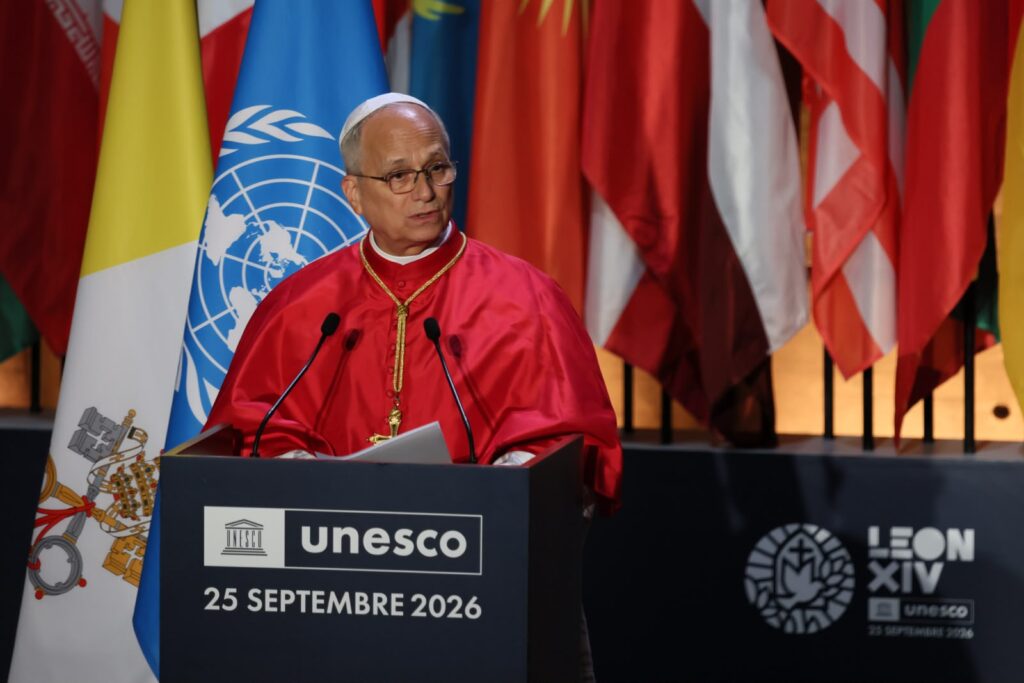
PARIS — Pope Leo XIV warned that Artificial Intelligence has fostered a “corruption of culture” that could affect what it means to be human, during a speech at the United Nations Educational, Scientific and Cultural Organization (UNESCO) on Friday.
The pontiff visited the headquarters of UNESCO — a specialized UN agency that preserves cultural heritage sites and promotes peace, sustainable development, and human rights — on the first day of a Sept. 25-28 journey to France.
“A fundamental question deserves to be explored, one that urgently calls for a response: What does it mean to be human?” Leo said in a speech delivered half in French and half in English.
“Every culture is challenged by this question, which lies at the heart of every form of knowledge, every art and every religion. Even in the twenty-first century, after all, we cannot take for granted that we know who the human person is or what it means to live as a human being,” the pontiff said.
He contrasted the domination and confusion of the Tower of Babel, to which he has previously likened AI, with the peace and unity found at Pentecost.
“The corruption of culture which we are considering finds its redemption in the public square of Pentecost,” he said. “There, a message of peace is received as good news by people of every nation. This message proclaims the resurrection of Jesus, that is, the victory of life over death and the salvation that gives hope to the world.”
Leo also spoke about the development of communications and the risk of spreading false information, and “words devoid of meaning,” thereby “hindering dialogue rather than fostering it.”
“Artificial intelligence amplifies this problem,” he continued. “Although such systems can correlate data, they cannot answer questions that concern the meaning of human life, which is rooted in lived experience.”
He condemned oppressive power, pride, injustice, and conflict.
“Science itself, when reduced to a technique of power, no longer serves to elevate the human person, but instead risks degrading the fruits of human endeavor,” he said.
The pontiff devoted significant portions of his speech to underlining the care due to every human life, especially the most vulnerable, such as “children in their mothers’ wombs and in the various theaters of war, persons with physical and intellectual disabilities, the elderly, migrants and refugees, and all those arrogantly excluded as unproductive.”
They are the true test of our claims to respect human dignity, and their protection and promotion extend also to creation,” he said.
On technological advancements, the Holy Father said, “the paradox has become increasingly evident: while ‘intelligence’ is attributed to computational systems, we struggle to recognize the inalienable dignity of human persons, whose lives are judged according to the criterion of efficiency and, when deemed no longer productive, are rejected and discarded.”
Pope Leo’s arrival at UNESCO was met by a warm applause from the audience.
Before his address, the pope was given a brief tour of the headquarters, including the library, which houses UNESCO’s diplomatic archives. Leo also received a loud applause when he watered an olive tree as a sign of nurturing peace.
He was also given a copy of the Book of Peace Memorandum, an archival document submitted to the 4th session of the UNESCO General Conference in 1949 to support its mission to prevent global conflicts after World War II.
Leo underlined that he was visiting UNESCO, “as a pastor, to speak to you on behalf of the Church, which continually seeks to enter into dialogue and has a message to share with every people, with all women and men of good will,” and praised the agency’s mission to build a just world and favor authentic human development
Citing his encyclical Magnifica Humanitas, he said the Holy See looks “upon this Organization as a privileged partner in the service of the common good, which is the ‘social expression of the dignity’ shared by all of us from the very beginning and in equal measure.”
The pope emphasized the importance of truth, without which language becomes subject to violence and power, and noted that “corruption of the law begins with the corruption of the heart.”
Follow the Live Updates of Pope Leo’s Trip in France available at EWTN News.
This article was originally published by EWTN News English.