France has been known for centuries as the “Eldest Daughter of the Church,” a title rooted in a Catholic history stretching from the baptism of King Clovis to the saints, shrines and great cathedrals that have shaped the country.
But after decades of secularization, what remains of that Catholic identity today?
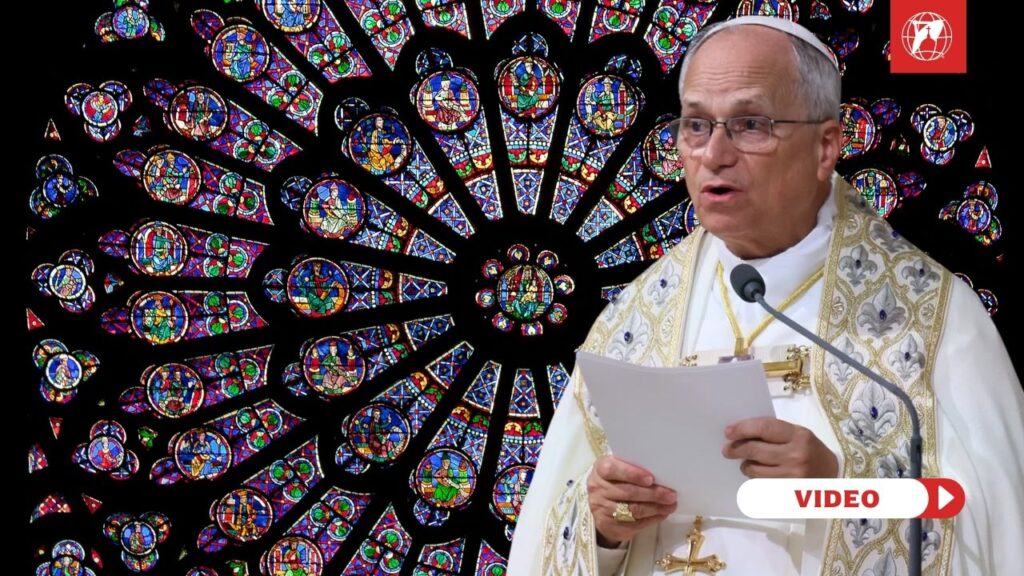
In a conversation with EWTN during Pope Leo XIV’s visit to France, Charles Personnaz, France’s Ambassador to the Holy See, reflected on the country’s enduring Catholic heritage, growing interest in the faith among young people and the challenges facing the Church in contemporary French society.
“It’s part of French history to be a Catholic nation,” Personnaz said.
At the same time, the relationship between Church and state has long been a source of debate in France. Today it is governed principally by the 1905 law on the separation of churches and the state.
But Personnaz stressed that France’s secular system does not mean that religious belief has no place in civil society.
“The Catholic community remains a real strength in the French society,” he said, pointing to the resurgence of Catholic life following the French Revolution and the contributions of religious congregations and Catholic intellectuals to French culture.
Today’s situation is different, he acknowledged, because “secularization has made its work.”
“Something is happening”
One of the clearest signs of change within the French Church has been the significant rise in adult baptisms.
Asked by EWTN Senior Vatican Analyst Francis X. Rocca whether France is experiencing a revival of Catholicism, Personnaz pointed particularly to younger generations.
“Something is happening in the French society and especially [among] the French youth,” he said.
Unlike previous generations, many young French people have not inherited Catholicism through their families and consequently know relatively little about the country’s Christian heritage, he explained.
Yet that distance can also mean that they approach Christianity without inherited prejudices.
“In a world where their youth is searching [for] sense to its life, the Catholic proposal remains very interesting, very attractive,” Personnaz said.
Despite the transformation of France’s religious landscape and increasing secularization, Catholic landmarks such as Notre-Dame Cathedral and the Basilica of the Sacred Heart of Montmartre remain prominent symbols of French identity.
France’s relationship with the Virgin Mary is particularly significant, Personnaz said.
That heritage can be seen across the country, but nowhere more clearly than at the Sanctuary of Our Lady of Lourdes.
Lourdes: A place for suffering and healing
Asked what Lourdes represents for France, Personnaz described a sanctuary where people are received amid physical, moral and spiritual suffering.
Pilgrims come “from everywhere in the world,” he said, describing Lourdes as “a place of recovery” where people are welcomed as they are and “taken by the hand by the Virgin Mary” and by those who serve at the sanctuary.
Lourdes also provided the setting for one of the most sensitive encounters of Pope Leo XIV’s visit to France.
During his stay at the Marian shrine, the Pope met privately with victims of sexual abuse committed within the Church, offering an opportunity for personal listening and prayer.
Personnaz emphasized the importance of encountering victims individually.
“To receive them individually is very important,” he said, calling recognition a first step toward allowing victims to speak about “these terrible stories.”
Human dignity and the end of life
The conversation also turned to contemporary debates over human dignity and the protection of vulnerable people, particularly questions surrounding the end of life.
Rocca asked the ambassador about France’s assisted-dying legislation and what the debate reveals about the Catholic Church’s influence on French society.
Personnaz said longer life expectancy has raised increasingly complex questions about aging, illness and death.
“The Catholic Church has participated to the debate very strongly,” he said, particularly by emphasizing “the attention that should be paid to the weakest in the population.”
He acknowledged disagreements over the resulting legislation while stressing that the work of accompanying vulnerable people does not end with the political debate.
“Our responsibility is now to continue our work and the work that is done in France to accompany people at the end of their lives,” he said.
Catholicism and the common good
France’s religious landscape has changed dramatically since the era when Catholicism stood at the center of national life.
Yet Personnaz said French Catholicism continues to display considerable vitality.
Catholics remain active in education, social initiatives, academia and intellectual life, he said, contributing as citizens to the construction of the common good.
“We see the vivacity, I should say, of the French Catholicism,” Personnaz said, highlighting the “participation of the Catholic citizens to the construction of common [good] and general interest.”
Against the backdrop of Pope Leo XIV’s visit, that continuing presence offers a contemporary dimension to France’s ancient title as the “Eldest Daughter of the Church”: a Catholic heritage that remains part of the nation’s history while confronting the realities of a profoundly changed society.
Adapted by Jacob Stein. Francis X. Rocca contributed to this article. Produced by Bénédicte Cedergren; Camera by Alberto Basile, Fabio Gonella; Video Edited by Ilaria Chimenti; Special thanks & Credits to The French Embassy to the Holy See.