For centuries, sacred music has flourished within the Church’s religious orders, each developing musical traditions that reflect its spirituality and way of life. Among them is the Dominican tradition of Gregorian chant, which continues to shape the prayer of the Order of Preachers.
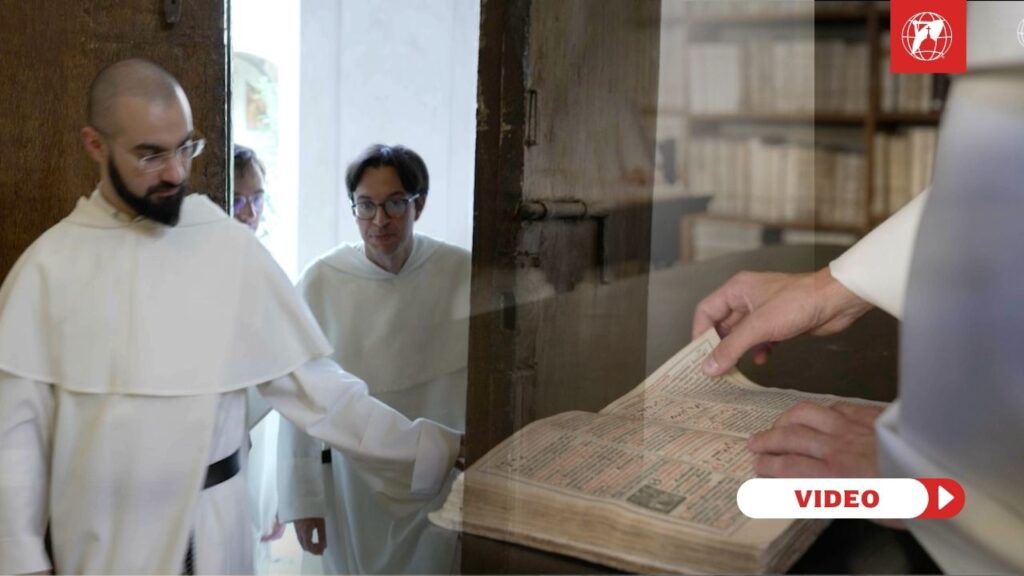
At the convent of Santa Maria sopra Minerva in Rome, Dominican friars from around the world are keeping this centuries-old tradition alive, rediscovering how chant can deepen their spiritual lives and express the heart of their vocation.
Br. Gabrielius Juškevičius, O.P., a Dominican friar from Lithuania with a background in sacred music, explains that the Order developed its own adaptation of Gregorian chant during the Middle Ages.
“Music and chant adapt to people and to a particular way of life,” he said.
Because the Dominicans were a mendicant order dedicated to preaching, the friars needed a form of liturgical chant that accommodated their demanding apostolic mission. Their version of Gregorian chant was therefore adapted and shortened, allowing them to maintain the daily rhythm of prayer without lengthy offices that could last for hours.
Yet the distinctive character of Dominican chant goes beyond practicality. It also reflects the evangelical counsels of poverty, chastity and obedience that shape religious life.
Chant as an expression of Dominican spirituality
Gregorian chant is monodic, meaning that it is sung in unison rather than through multiple harmonizing voices. For Juškevičius, this simplicity reflects the Dominican commitment to poverty.
“It is quite an austere practice,” he explained, noting that chant also expresses obedience through the discipline required to sing together according to established rules and rhythms.
The music, he added, depends on the fraternity of the community. When the friars live in harmony with one another, that unity can be heard in their singing.
For an order dedicated to preaching and teaching the faith, chant also serves as a means of transmitting theological truth. One prominent example is Pange Lingua, the Eucharistic hymn composed by St. Thomas Aquinas, a Dominican theologian whose writings continue to shape Catholic theology.
The hymn offers what Juškevičius describes as a concise theological synthesis of the Church’s teaching on the Eucharist. Its final verses, Tantum Ergo Sacramentum and Genitori Genitoque, are traditionally sung during Benediction of the Blessed Sacrament and Eucharistic adoration.
Through these hymns, the Dominican musical tradition connects prayer, doctrine and the contemplation of the mysteries of faith.
The Salve Regina: A Dominican tradition of mercy
Another chant closely associated with the Order is the Salve Regina, the Marian antiphon sung by Dominican friars each evening at Compline, the final prayer of the day.
Although similar to the Roman version, the Dominican Salve Regina contains distinctive musical elaborations that emphasize particular words.
Br. Alessandro Monti, O.P., an Italian Dominican friar, points to the word misericordia, meaning mercy, as one example. Its more elaborate musical treatment draws attention to a theme central to Dominican spirituality.
St. Dominic understood his mission as one of bringing God’s mercy to others, particularly sinners and those struggling with errors in matters of faith.
The nightly singing of the Salve Regina is a tradition with deep historical roots. According to Monti, Jordan of Saxony, the Order’s second master, already attested to the practice, which gradually became a distinctive hallmark of Dominican life.
Today, the chant remains a powerful expression of the friars’ devotion to the Blessed Virgin Mary and their mission of preaching the Gospel.
Preserving the fire of tradition
The survival of Dominican chant reflects centuries of efforts by religious communities to preserve sacred musical manuscripts and practices. Although many traditions suffered losses during the French Revolution and the anticlerical movements that swept across Europe, the music endured.
For Juškevičius, recovering this heritage is not simply an exercise in historical preservation. It is an opportunity to restore a living practice to contemporary religious communities.
He recalls a saying attributed to the composer Gustav Mahler: tradition is not the worship of ashes, but the preservation of fire.
Even when a tradition appears to have faded, he explained, traces of it remain. By returning to these musical sources, Dominican friars are rediscovering the tradition and integrating it into their communities today.
Chant at the heart of daily prayer
The importance of Dominican Gregorian chant becomes especially clear in the Divine Office, the Church’s daily cycle of prayer that sanctifies the hours of the day.
Br. Matteo Peddio, O.P., an Italian Dominican friar, explains that the Divine Office accompanies religious life from the earliest moments of the morning, and sometimes during the night, until the close of the day.
Through the psalms, readings and prayers, the Word of God continually nourishes the spiritual life of the friars. Chant provides a way to enter more deeply into that Word, meditating on its meaning through music.
The Dominican tradition can still be heard in particular chants and responsories throughout the liturgical year, especially during Lent.
For Peddio, Gregorian chant invites the singer to linger over the words being sung. Its elaborate melodies often place numerous notes on a single syllable, allowing the text to unfold gradually without becoming cumbersome.
Rather than distracting from the words, this musical richness creates space for contemplation and interiorization.
“It gives you the opportunity truly to ruminate on, to interiorize, what you are singing, which is above all the Word of God,” he said.
Peddio compares this practice to the short invocations used by the Desert Fathers, whose repeated prayers punctuated the day and helped keep the mind directed toward God.
Through singing, the Word becomes more deeply rooted in the heart: received in listening and offered back to God in prayer.
At Santa Maria sopra Minerva, the Dominican friars continue to demonstrate how Gregorian chant is more than a remnant of the past. Shaped by the Order’s vocation, sustained through daily prayer and renewed by each generation, it remains a living expression of Dominican spirituality and the Church’s enduring musical heritage.
Adapted by Jacob Stein. Produced by Bénédicte Cedergren; Camera by Fabio Gonella, Ludovico D’Onofrio; Video Edited by Ilaria Chimenti; Special thanks & Credits to The Dominican Convent of Santa Maria Sopra Minvera