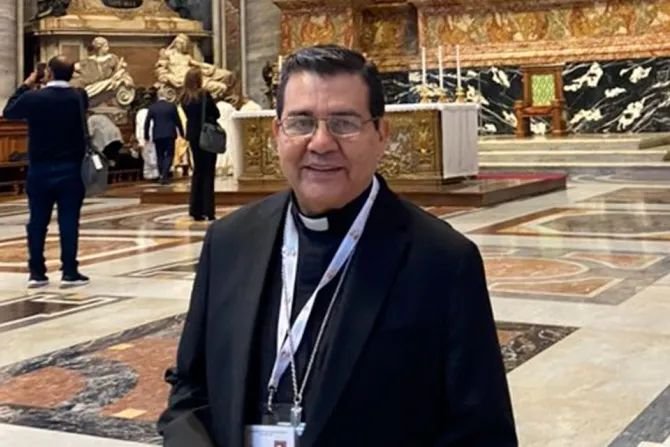
“Who is God and who is Jesus? Ask a question and in three seconds, five, you’ll have an answer in a paragraph that can begin your own search,” explained Fr. David Nazar, the Rector of the Pontifical Oriental Institute.
“The Church should be on the cutting edge of this, both for the students and just for people who have questions. They’re 20 years old, they have a feeling about God, they never had any instruction, they want to know something pretty simple. What does the Church say about God?”
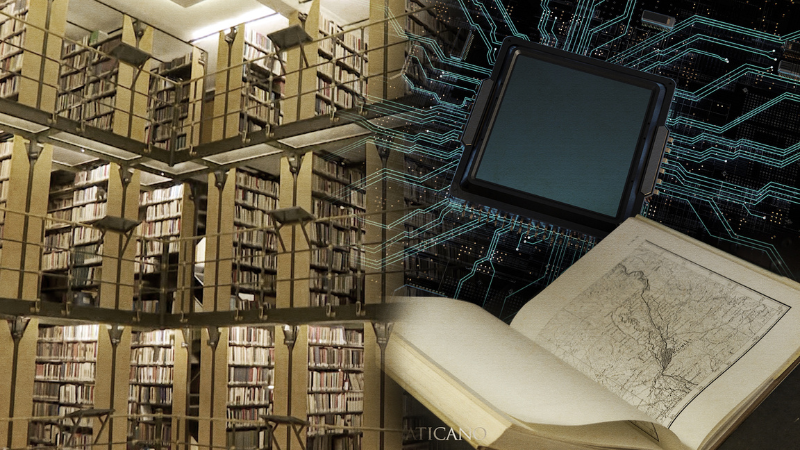
For millennia, knowledge has been passed down through writing, preserved in libraries as symbols of wisdom and culture. The ancient Egyptians, with their refined papyrus writing techniques, were among the first to preserve and transmit knowledge. The patriarchs of the early Christian communities and the Eastern Church continued this tradition, safeguarding sacred and philosophical texts of incalculable worth.
The Pontifical Oriental Institute’s use of digitization allows for the preservation and distribution of historical texts and works to go far beyond their usual reach.
Andreas Thonhauser, EWTN Vatican Bureau Chief, takes us inside this incredible library.
“Wow. This is really incredible. More than 200,000 books one can find here, which is really the heart of the Pontifical Oriental Institute. And the project to digitize the most valuable and also oldest volumes that can be found here will open this treasure to the whole world,” noted Thonhauser.
Gloria Soccorsi of the Pontifical Oriental Institute works in the Digitization Office. Soccorsi explained, “We have two different types of scanners. The first type features a platform that moves the volume towards a glass surface for scanning. This design allows for the scanning of very large volumes. The second type is equipped with a V-shaped glass lectern that rests on the volume, making it suitable for scanning books or documents that cannot be fully opened 180 degrees.”
But it is the Institute’s use of artificial intelligence that is truly a game changer and puts this Vatican affiliated university at the cutting edge of technology as Fr. David Nazar explains.
“It’s not a big university,” Fr. Nazar explained. “We have maybe 200 academic students, maybe another 150 come just for languages. And we can have as many as 400 visiting scholars within a year just for the library, because the resources are here to study. If 400 come, 4,000, 40,000 can’t come. So clearly, for us, there was a desire to put as many things online as we possibly could. But the resources were very weak. The software resources for doing that were weak. So out came AI and it answered what for us was a frustration. What they could do was translate the document into a computer language. Then AI could go to work on the document. AI also allows us to translate. So you could do a search in your native language. The document might come back in three languages. And then you could say, well, could you translate this into Hungarian so that I can understand it in my native language? And it would do that in three seconds. So, as a research tool, it is extraordinary. You do not have to read the equivalent of the entire Summa to find out what Saint Thomas says about the nature of Jesus. You can ask the question and you’ll get a summary based on all that he has written.”
Through the shared consultation of ancient texts held in the online library of the Pontifical Oriental Institute, two researchers from nations in conflict historically discovered a powerful tool for reconciliation.
“A brilliant young student who came from Baghdad,” Fr. Nazar recounted, “and she had lived through four wars and was now very concerned for the rebuilding of her country. She was born and raised in Baghdad. One of her points was that we cannot import French or American democracy. It has to be on the genius of her own people, as well as borrowing ideas from others.”
Leveraging the Pontifical Oriental Institute’s advanced research facilities and cutting-edge technology, scholars were able to meticulously analyze and preserve critical historical documents. Fr. Nazar details:
“There were certain documents that were in Persian. There was an Iranian student here doing a doctorate. So this is her father, Iraqi, who was in an Iranian prison for seven years during the war in the 1980s. She needed this guy’s help to translate the Persian documents. They became the closest of friends. So, I mean, there’s a whole story of both research and the reconciliation of peoples and cultures, carrying on a war today, things that had started centuries ago.
Adapted by Jacob Stein