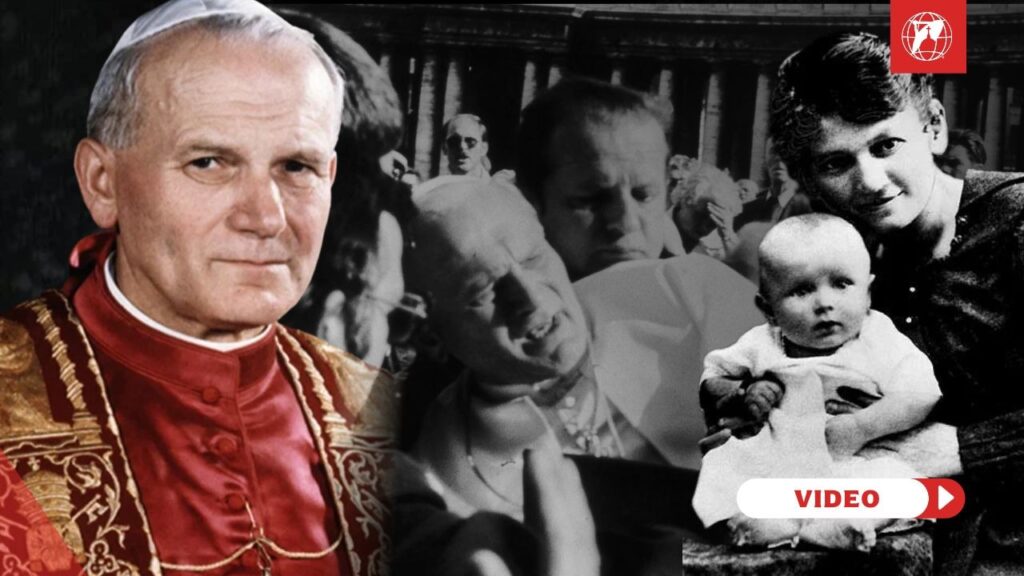
A tireless pilgrim. A messenger of peace. An avid athlete and skier. A man of prayer. A true friend of youth.
Pope St. John Paul II is remembered for many things. But behind his remarkable life was also a story of suffering, shaped by personal loss, war, an assassination attempt, and years of declining health. Through these trials, the Polish pope offered a powerful witness to faith, courage, and the redemptive meaning of suffering.
A childhood marked by loss and war
Karol Wojtyła experienced profound suffering from a young age. His mother died when he was a child, followed by the death of his older brother, Edmund, a doctor who contracted scarlet fever while caring for patients.
Cardinal Stanisław Dziwisz, who served as John Paul II’s personal secretary for nearly 40 years, recalled the pope’s enduring love for his mother and the loss of his brother.
“His mother died when he was still very young, but the bond remained strong. He always spoke of his mother with tremendous respect. He liked to recall that his mother had hoped one son would become a doctor and the other a priest, and in the end that wish came true. Sadly, she died before Karol became a priest. His older brother, Edmund, was a doctor in Bielsko. While caring for patients, he contracted scarlet fever and died at a young age. He was only twenty-eight years old.”
When Wojtyła was 19, Nazi Germany invaded Poland, beginning the Second World War. Living under Nazi occupation and later Communist rule, he witnessed cruelty, oppression, and suffering firsthand.
To avoid deportation and forced labor in Germany, he worked in a limestone quarry. He also went into hiding from the Gestapo and helped Jews escape Nazi persecution.
Gian Franco Svidercoschi, former vice-director of L’Osservatore Romano, recalled one episode from the young Wojtyła’s life during the war.
“Wojtyła, while still a seminarian, found a young Jewish girl outside a train station in 1945, lying on the ground and close to death. He picked her up and saved her by carrying her for three kilometers to safety.”
In 1942, Wojtyła had entered the underground seminary directed by Archbishop Adam Stefan Sapieha. At a time when religious formation could expose seminarians to arrest, deportation, or death, he continued discerning his vocation while working in the factory.
In his own words, he recalled the solidarity he experienced among his fellow workers.
“At the factory I worked eight-hour shifts, both during the day and at night. I brought a few books with me. My colleagues, the workers, were somewhat surprised, but they were not scandalized by it. They told me: ‘We’ll help you. You can even get some sleep, and we’ll try to keep watch in your place.’”
The suffering of an assassination attempt
Wojtyła’s election as pope in 1978 brought him onto the world stage. His pontificate would be marked by extensive travels, encounters with young people, and appeals for peace and freedom. But it would also bring a dramatic personal ordeal.
On May 13, 1981, an assassination attempt in St. Peter’s Square left John Paul II gravely wounded. As the pope made his way through the crowd before the general audience, gunshots rang out.
Dziwisz, who was at his side, remembered the shocking moments that followed.
“As we approached the vicinity of the Bronze Door, the shots rang out. It was shocking. I remember even the pigeons suddenly taking flight. At first he remained standing. I asked him where he had been hit. He indicated his abdomen and his hand. Then he began losing a tremendous amount of blood.”
Even in those critical moments, the pope’s response was not one of anger or accusation. Dziwisz recalled hearing him pray as he was being taken for medical treatment.
“At first he was still conscious. I could hear him praying. He wasn’t asking who had shot him. Instead, he was offering his suffering for the Church and for the world. He was making an offering of himself. Eventually he lost consciousness.”
After surviving the attack and enduring a long recovery, John Paul II met his would-be assassin, Mehmet Ali Ağca, and extended his forgiveness. The encounter became one of the most widely remembered expressions of the pope’s commitment to mercy.
For Svidercoschi, the assassination attempt revealed something essential about John Paul II’s spiritual life.
“I think of the time of the assassination attempt, for example. It was there, a holiness shown in the way he lived through it. Or of his final years, when he was unwell. There, too, it was a mystical holiness that kept growing within him.”
A public witness to suffering
In the early 1990s, John Paul II began showing signs of Parkinson’s disease. His hands trembled, his facial expressions became more limited, and speaking grew increasingly difficult.
As his physical condition deteriorated, his illness became visible to millions of people around the world. Yet he continued to carry out his pastoral mission, determined to remain present to the faithful despite his limitations.
Vatican engineers developed special ramps and lifting devices to help him move around. Even so, the pope continued to undertake demanding public appearances, including the World Youth Day celebrations in Rome in August 2000.
Paolo Sagretti, head of the Vatican City Floreria, recalled the pope’s determination during the final day of the event.
“On the final day, after the Mass, the Pope arrived and insisted on walking the entire ramp behind the stage, supporting himself with a cane. He was clearly struggling. At one point, I was struck by the fact that he simply could not move forward. Frustrated with himself, he struck the ground with his cane.”
The same resolve characterized the Great Jubilee Year of 2000, when John Paul II continued to preside over Masses and ceremonies despite his declining health.
“He was always incredibly determined. I remember him wearing a very important and elaborate chasuble, one that was perhaps even a little heavy for a body already weakened by illness. Yet, with his pastoral staff in hand, he was determined to do it, and so he did. John Paul II wanted to be present at every Mass and every ceremony. Right to the very end, he truly sought to fulfill his mission,” Sagretti said.
The pope’s perseverance did not mean that his suffering was insignificant or that his physical limitations disappeared. Rather, his willingness to continue serving while visibly weakened offered the faithful a public example of fidelity amid illness.
Finding meaning in suffering through Christ
John Paul II’s understanding of suffering was not shaped by personal experience alone. He reflected on its meaning throughout his pontificate, most notably in his 1984 apostolic letter Salvifici Doloris (“On the Christian Meaning of Human Suffering”).
In the letter, he explored the mystery of human suffering in the light of Christ’s Passion and Resurrection. He explained that suffering, while remaining a profound human trial, can take on redemptive meaning when united with Christ’s salvific suffering.
For John Paul II, the answer to suffering was ultimately found in divine love. As he wrote in Salvifici Doloris, “love is . . . the fullest source of the answer to the question of the meaning of suffering.”
That answer, he explained, was revealed by God in the Cross of Christ. Through Christ’s sacrifice, suffering could become an occasion for spiritual transformation, solidarity with others, and participation in the work of redemption.
The pope’s teaching reflected the way he approached his own trials. From the early loss of his family members to the violence of war, from the assassination attempt to the physical limitations of his final years, he repeatedly sought to unite his suffering with the suffering of Christ.
Dziwisz, who witnessed these experiences at close range, said that fear and complaint were not characteristic of the pope’s response to adversity.
“The Pope was not afraid. ‘Non abbiate paura’ — ‘Do not be afraid,’ he would say. Those were not just words; above all, they reflected his own character. Fear was something he simply did not have. He never complained. He never lamented. For him, suffering had meaning. That was always his approach.”
Pope St. John Paul II died on April 2, 2005, after years of declining health. His life remains a testament to the conviction that suffering need not have the final word. Through his example and teaching, he invited the Church to look to Christ on the Cross and discover in divine love the hope that sustains humanity through its deepest trials.
Adapted by Jacob Stein. Produced by Bénédicte Cedergren; Camera by Alberto Basile, Fabio Gonnella.