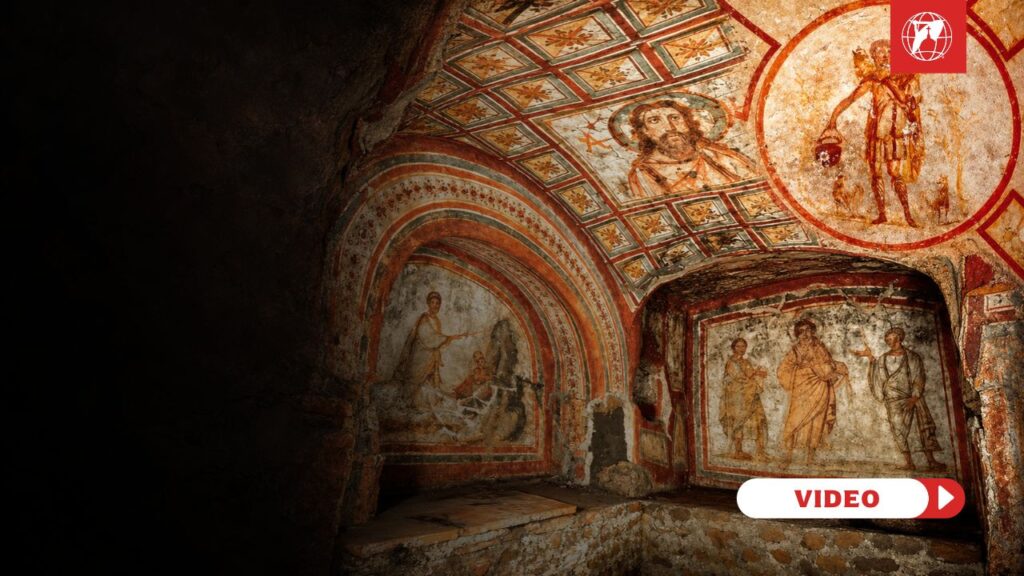
Beneath the ancient roads of Rome lies a vast network of underground tunnels that preserves some of the earliest evidence of Christian faith. The catacombs, where generations of Christians buried their dead, offer a glimpse into the beliefs, symbols, and practices of the early Church — and reveal a striking message of hope in life after death.
Though often associated with persecution and the suffering of the first Christians, these ancient burial places tell a story that reaches beyond death. Their inscriptions, paintings, and symbols express a profound confidence in the promise of eternal life.
The Origins of Rome’s Christian Catacombs
The catacombs did not emerge immediately after the birth of Christianity in Rome. According to Dr. Raffaella Giuliani, Secretary of the Pontifical Commission for Sacred Archaeology, the earliest sections date to the late second and early third centuries.
“It is important to note that the catacombs did not appear immediately with the birth of the Christian community in Rome. The oldest sections of these burial complexes date only to the late second and early third centuries. Before that, members of the first Christian community were buried alongside people of other faiths in the common necropolises of the city.”
As the Christian community grew, believers began establishing burial grounds specifically for members of their faith. Approximately 60 catacombs were eventually established throughout Rome, although only six of these ancient complexes remain open to visitors today.
Their location outside the city walls was no coincidence. Roman law prohibited burials within the city limits, a restriction dating back to the fifth century BC and known as the Law of the Twelve Tables.
“In general, all of Rome’s catacombs are located outside the city walls, the Aurelian Walls. This is because ancient Roman law, dating back to the fifth century BC and known as the Law of the Twelve Tables, prohibited burials and cemeteries within the city limits. The ban was motivated by practical concerns, including hygiene, public health, limited urban space, and the risk of fires associated with the cremation of pagan dead,” explains Fr. Marian Stempel, SDB, a guide at the Catacombs of Saint Callixtus.
For more than a decade, Father Stempel has welcomed visitors to this underground world. Together with his fellow Salesian brothers, he serves at the Catacombs of Saint Callixtus, the oldest and most famous of Rome’s catacombs.
The Catacombs of Saint Callixtus: The “Little Vatican” of the Early Church
The Catacombs of Saint Callixtus are the largest and most extensive in Rome. Their underground network stretches for nearly 20 kilometers, across four levels and an area of approximately 15 hectares.
Their history began at the end of the second century, when Pope Zephyrinus purchased a small plot of land from the Caecilii family to establish a Christian cemetery. He entrusted its care to one of his seven deacons, Callixtus, whose name would eventually become associated with the entire burial complex.
Over the following three centuries, nearly half a million Christians were buried there, including 14 popes. Among the most significant areas is the Crypt of the Popes, where nine popes and prominent Church leaders of the third century were laid to rest.
Fr. Stempel describes its importance:
“This is the most important and sacred place in the entire catacomb complex: the Crypt of the Popes. Nine popes, along with some of the most prominent Church leaders of the third century, were laid to rest here.
Its importance earned it the title of the ‘Little Vatican’ of the early Church.”
By the end of the eighth century, Church authorities decided to transfer the relics of the popes into the city walls to protect them from raids and invasions by barbarian tribes from northern Europe. The relics of the nine popes were subsequently transferred to the Basilica of Saint Praxedes, also known as Santa Prassede.
The catacombs themselves reveal how the early Christians understood burial and the dignity of every person. Their corridors are lined with rows of burial niches, known as loculi, where the dead were laid to rest one above another.
From popes and bishops to the poorest members of the Christian community, everyone could receive a Christian burial. Donations from wealthier believers and payments for private burial chambers helped provide burial places for the poor and support the fossores — the gravediggers responsible for excavating and maintaining the underground complexes.
Christian Burial and the Symbols of Faith
The burial practices of the early Christians reflected their belief in the resurrection of the body and their desire to follow the example of Christ.
“Christians in the first centuries did not burn their dead because they remembered how the Lord Jesus had been buried: He was wrapped in a shroud and placed in a tomb. The tomb was then sealed with a single large stone, a brick plaque,” explains Father Stempel.
Many of these stone slabs were decorated with inscriptions and symbols that provide a window into the faith of the early Christian community.
Because Christians could not always profess their faith openly, symbols became an important way to express their beliefs. They were carved into tombstones and painted on the walls of burial chambers. Their simplicity also made them accessible to people who could not read or write.
Dr. Giuliani explains:
“Christians could not openly profess their faith. Therefore, they used symbols carved into tomb slabs and painted on the walls of crypts. These symbols were especially important because they could also be understood by those who were illiterate.
The first generations of Christians in Rome came largely from the poorer classes of society, often from among slaves. Many could neither read nor write, but they learned by heart the simple meanings of these symbols.”
A Message of Hope, Not Despair
Perhaps the most striking feature of the catacombs is the joyful character of their imagery. Despite the persecution and suffering experienced by early Christians, their burial art rarely expresses grief or despair.
“Remarkably, the imagery found here is not one of sorrow.
Even though the early Christians experienced suffering and violent persecution, their art never conveys a sense of despair or lamentation,” says Dr. Giuliani.
Instead, the symbols found throughout the catacombs point toward salvation and eternal life. The anchor, for example, represents salvation, recalling a ship reaching its final destination. The dove, which signaled the end of the great flood in the story of Noah, also symbolizes the soul ascending toward Paradise.
These images, together with other biblical scenes, served as a kind of Biblia Pauperum, or “Bible of the Poor,” communicating the central truths of Christianity through visual language.
Even the inscriptions on the tomb slabs carried a message. They generally included only the names of the deceased, without surnames or titles — a reminder that, in death, all stand equal before God.
More than places of burial, Rome’s catacombs remain a testimony to the faith of the first Christians. Their underground corridors preserve a message that continues to speak to believers today: death is not the end, and Christian hope is rooted in the promise of life with God.
Adapted by Jacob Stein. Produced by Bénédicte Cedergren.