Pope Francis on Tuesday penned an essay for the New York Times on the importance of fostering a sense of humor, of quelling narcissism through “appropriate doses of self-irony,” and of avoiding “wallowing in melancholy at all costs.”
“The Gospel, which urges us to become like little children for our own salvation (Matthew 18:3), reminds us to regain their ability to smile,” Pope Francis wrote in an essay adapted from his new book, “Hope: The Autobiography,” set to be published in January.
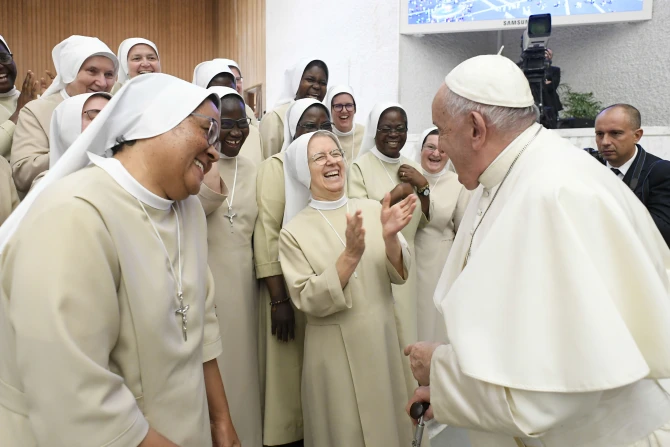
The pontiff called the many children he meets, as well as the elderly, “examples of spontaneity, of humanity.”
“[T]hey remind us that those who give up their own humanity give up everything, and that when it becomes hard to cry seriously or to laugh passionately, then we really are on the downhill slope. We become anesthetized, and anesthetized adults do nothing good for themselves, nor for society, nor for the Church,” he wrote.
“Irony is a medicine, not only to lift and brighten others but also ourselves, because self-mockery is a powerful instrument in overcoming the temptation toward narcissism,” the pope continued.
“Narcissists are continually looking into the mirror, painting themselves, gazing at themselves, but the best advice in front of a mirror is to laugh at ourselves. It is good for us. It will prove the truth of that old proverb that says that there are only two kinds of perfect people: the dead and those yet to be born.”
Pope Francis has spoken about humor several times throughout his papacy; in June of this year, he hosted and entertained a group of over 100 comics, stand-up comedians, and humorists in the largest — and possibly only — gathering of comedians in the Vatican since Pope Pius V eliminated the role of the papal jester in the 1500s.
During a recent visit with French President Emmanuel Macron in Corsica, Pope Francis recommended that Macron read his apostolic exhortation Gaudete et Exultate, drawing attention to a passage referencing St. Thomas More’s prayer for a sense of humor.
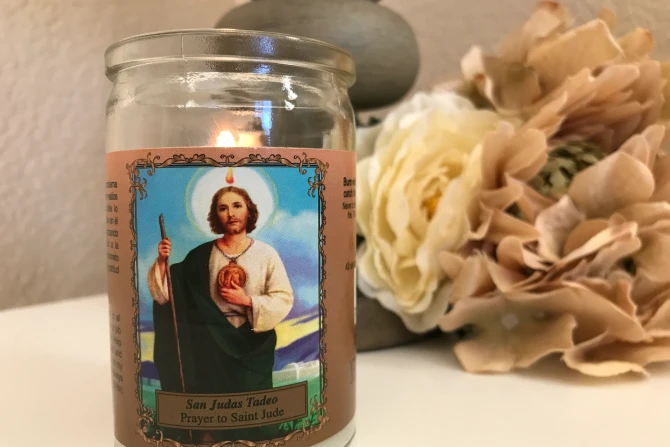
“Lord, give me a sense of humor. Grant me the grace to understand a joke, to discover in life a bit of joy, and to be able to share it with others,” reads the prayer, which Pope Francis has previously described as “very beautiful” and recites daily.
The pope in his essay offered examples of good humor shown by his fellow popes St. John XXIII and St. John Paul II.
St. John XXIII, for example, was said to have showcased his self-deprecating wit when he joked that he often resolved to speak with the pope about serious problems before remembering “that the pope is me.”
Relaying an anecdote about St. John Paul II’s playful resistance to rigid expectations of clerical conduct, Francis wrote that the saint was once, while still a cardinal, rebuked for enjoying many outdoor sporting activities, whereby John Paul responded that “these are activities practiced by at least 50% of cardinals.” In Poland at the time, there were only two cardinals.
“[S]ometimes we [popes] unfortunately come across as bitter, sad priests who are more authoritarian than authoritative, more like old bachelors than wedded to the Church, more like officials than pastors, more supercilious than joyful, and this, too, is certainly not good,” the pope wrote.
“But generally, we priests tend to enjoy humor and even have a fair stock of jokes and amusing stories, which we are often quite good at telling, as well as being the object of them.”
The pope in his essay also told a joke involving himself, printed here in its entirety:
As soon as he arrives at the airport in New York for his apostolic journey in the United States, Pope Francis finds an enormous limousine waiting for him. He is rather embarrassed by that magnificent splendor, but then thinks that it has been ages since he last drove, and never a vehicle of that kind, and he thinks to himself: OK, when will I get another chance? He looks at the limousine and says to the driver, “You couldn’t let me try it out, could you?” “Look, I’m really sorry, Your Holiness,” replies the driver, “but I really can’t, you know, there are rules and regulations.”
But you know what they say, how the pope is when he gets something into his head … in short, he insists and insists, until the driver gives in. So Pope Francis gets behind the steering wheel, on one of those enormous highways, and he begins to enjoy it, presses down on the accelerator, going 50 miles per hour, 80, 120 … until he hears a siren, and a police car pulls up beside him and stops him. A young policeman comes up to the darkened window. The pope rather nervously lowers it and the policeman turns white. “Excuse me a moment,” he says, and goes back to his vehicle to call headquarters. “Boss, I think I have a problem.”
“What problem?” asks the chief.
“Well, I’ve stopped a car for speeding, but there’s a guy in there who’s really important.” “How important? Is he the mayor?”
“No, no, boss … more than the mayor.”
“And more than the mayor, who is there? The governor?”
“No, no, more. …”
“But he can’t be the president?”
“More, I reckon. …”
“And who can be more important than the president?”
“Look, boss, I don’t know exactly who he is, all I can tell you is that it’s the pope who is driving him!”
This article was originally published on Catholic News Agency.