Skip to content

Pope Francis announces Chinese translations for weekly audiences

Starting next week, Chinese will be added as the ninth official language at papal general audiences, Pope Francis announced Wednesday.

Starting next week, Chinese will be added as the ninth official language at papal general audiences, Pope Francis announced Wednesday.

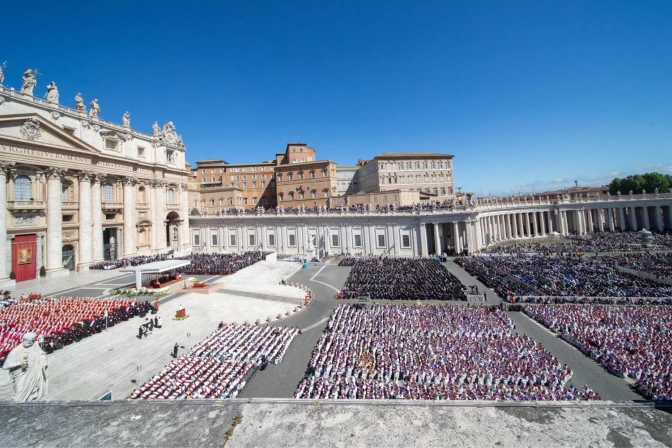
“Next week, with Advent, the Chinese translation will also begin here publicly,” the pope said on Nov. 27 during his general audience in St. Peter’s Square.

The addition marks a significant expansion of the languages used at the weekly papal events, where key portions — including Scripture readings, summaries of the pope’s address, and greetings — are delivered in eight languages: Italian, English, French, German, Spanish, Portuguese, Polish, and Arabic.

The translations make papal teachings accessible to pilgrims from around the world. They are traditionally delivered by staff members of the Vatican Secretariat of State or Vatican News.

World’s most spoken language

Mandarin Chinese is considered the world’s most spoken language, with nearly one billion speakers, ahead of Spanish and English. 

Varieties of Chinese — including Mandarin, Wu, Hakka, and others — collectively are used by more than 1.3 billion people worldwide.

The papal move to embrace Mandarin Chinese comes at a complex moment in Vatican-China relations. 

Just last month, the Holy See renewed its controversial agreement with Beijing on the appointment of bishops for another four years.

The renewal followed growing concerns about religious freedom in China, corroborated by recent reports. Some studies also indicate the Christian population has stopped growing after decades of expansion in the 1980s and 1990s.

This article was originally published on Catholic News Agency.

SIGN UP FOR OUR WEEKLY NEWSLETTER HERE

Receive the most important news from EWTN Vatican via WhatsApp. It has become increasingly difficult to see Catholic news on social media. Subscribe to our free channel today

Share

Would you like to receive the latest updates on the Pope and the Vatican

Receive articles and updates from our EWTN Newsletter.

I agree that EWTN will keep me informed about news, faith stories and how to best support their work. You will never receive e-mails from us that you do not want to receive. You can unsubscribe any time. For more information on how to unsubscribe, our privacy practices, and how we are committed to protecting and respecting your privacy, please review our Privacy Policy.

More news related to this article

Global 2033: Preparing for the 2000th Anniversary of Christ’s Resurrection

During the Jubilee of Hope this year in Rome, many are already talking about the big Jubilee year of 2033 a.d, the year in which our calendar marks the 2000th anniversary of the passing and resurrection of Jesus Christ.
Pope Leo in prayer during a Prayer Vigil for Peace in St. Peter’s Square — Credit: Vatican Media; archive photo: Daniel Ibáñez / EWTN

Pope Leo XIV welcomes Iran ceasefire, calls for Peace Vigil

Pope Leo XIV this week placed peace once again at the center of his public appeals, welcoming the

More than 3 million people attended Vatican audiences and ceremonies in 2025

During the year 2025, the participation of the faithful in audiences and liturgical celebrations at the Vatican reached

Preparing for the 750th Anniversary of St. Thomas Aquinas Death

Commemorating the 750th Anniversary of St. Thomas Aquinas: Father Serge-Thomas Bonino reflects on the Angelic Doctor's life and 'living Thomism,' and students at the Angelicum honor his rational approach to faith and enduring theological legacy

No pasta carbonara or hard liquor on cardinals’ conclave menu

Nutritionist Giorgio Calabrese, an Italian doctor who specializes in nutritional science, prepared the menu for the cardinal electors who have kicked off the conclave to elect the next pope.

Benedict XVI, Francis, and Leo XIV recommend this book, which warns of a world without God

The last three popes — Benedict XVI, Francis, and Leo XIV — have on more than one occasion recommended reading “Lord of the World,” the dystopian science fiction novel written by Robert Hugh Benson in 1907.

LIVE
FROM THE VATICAN

Be present live on EWTNVatican.com