On the first working day of the Synod on Synodality at the Vatican on Oct. 2, Cardinal Victor Manuel Fernández, prefect of the Dicastery for the Doctrine of the Faith, shut down speculation regarding further theological study into the possibility of women being ordained as deacons.
“We would like to share from the outset that, based on the analysis conducted so far — which also takes into account the work done by the two commissions established by Pope Francis on the female diaconate — the dicastery judges that there is still no room for a positive decision by the magisterium regarding the access of women to the diaconate, understood as a degree of the sacrament of holy orders,” Fernández stated on Wednesday.
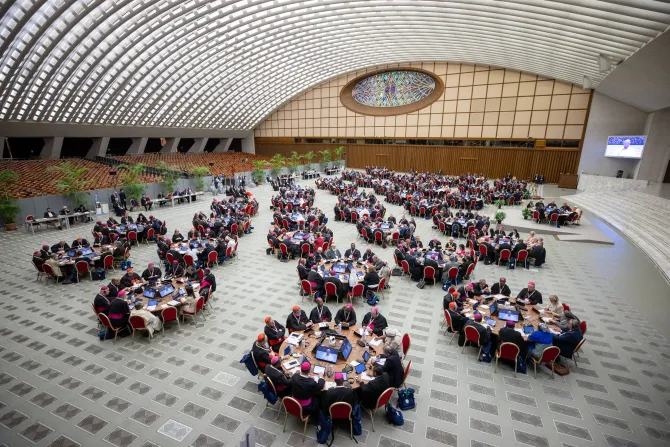
The Synod on Synodality — a multiyear, worldwide process of listening, dialogue, and discernment within the Catholic Church — commenced its second day on Thursday in which 356 participants convened at the Vatican to deep dive into the foundations and proposed mechanisms needed to realize Pope Francis’ vision for a more participative and missionary Catholic Church.
During an Oct. 3 press briefing, Father Giacomo Costa, special secretary of the synod, said this month’s discussions held in the Vatican should serve as “laboratories of synodal life.”
“We must learn. Many things may not be quite perfect but these [synod groups] will concede precisely to organize the [Vatican] dicasteries that play an effective role, then pass on decisions to other experts, bishops, men and women religious, lay persons,” Costa told journalists at the Holy See Press Office on Thursday.
“I invite you not to think that these groups are separated from the life of the Church but they are true labs of synodal life,” he continued.
“I really hope that they become opportunities that allow us to learn together as a Church in a different way; in a participative manner with different perspectives, ministries, roles — all different — but all within this journey so that the Church may proclaim the Gospel, listen, and be a sign of unity and hope in a world which is so fragmented.”
This year, 10 small study groups — “established at the will of the Holy Father” — were formed to facilitate deeper study into various theological, ecclesial, and pastoral issues outlined in Instrumentum Laboris, the Vatican’s working document for this month’s synod session published in July.
Although the synod’s general rapporteur, Cardinal Jean-Claude Hollerich, stated on Thursday that “nothing new” specifically emerges in Module 1 of the Instrumentum Laboris, titled “Foundations,” it is nevertheless key for synod participants to know and study it in order to “deepen our understanding of the mystery of the Church.”
“Without having the ambition of being a treatise on synodal ecclesiology, ‘[Instrumentum Laboris] seeks to outline the foundations of the vision of a missionary synodal Church,’” Hollerich told synod participants inside the Vatican’s Paul VI Hall.
Shedding some light into the evolving operations of the 10 study groups, Cardinal Mario Grech, general secretary of the synod, stated that these groups have an additional function to promote “broader participation” beyond the October meetings held at the Vatican.
“During the entire time in which the 10 groups will remain operational — and with them also the canonical commission — that is until the month of June 2025, it will be possible for everyone to send contributions, observations, proposals,” Grech communicated in a statement.
“Pastors and ecclesial leaders, but also and above all every believer, man or woman, and every group, association, movement, or community will be able to participate with their own contribution,” the statement reads.
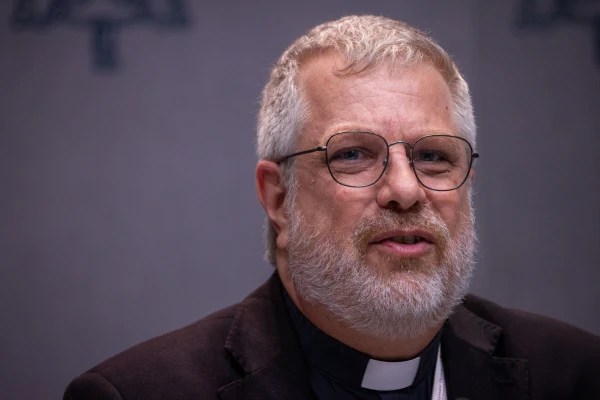
Toward the conclusion of the press conference, Bishop Daniel Flores of Brownsville, Texas, said the work of participants in the second session of the Synod on Synodality is to find the “cohesive voice” that expresses the life of the Church.
“There’s a ‘we’ involved essentially in the work of the synod, even more important than the many ‘I’s that are there,” Flores said. “We are searching for the ‘we’ and it’s the work that goes on in these smaller groups and it’s a work in progress.”
This article was originally published on Catholic News Agency.