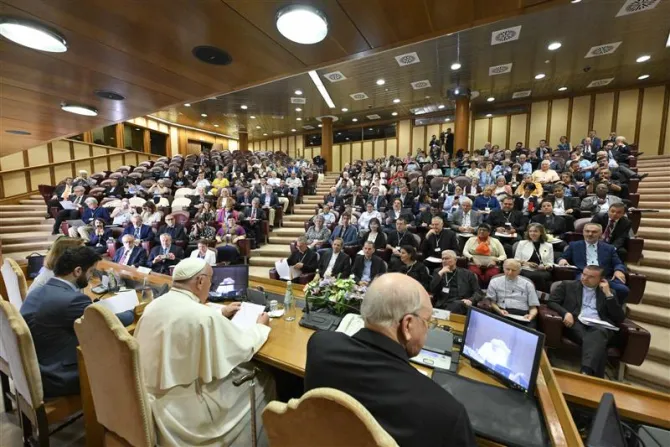
Around the world, bishops together with the Catholic faithful of their dioceses in Europe, Asia, Latin America, and Africa are gearing up for the second session of the 2021-2024 Synod on Synodality to take place Oct.2-27 in Vatican City.
The worldwide process launched by Pope Francis for the Catholic Church is centered on the theological concept of “synodality” or “journeying together” as the People of God. Synodality places particular emphasis on renewing the call of each baptized person to actively participate in the mission Jesus Christ entrusted to his church.
As part of this global process of listening, dialogue, and discernment, regional bishops’ conferences — in collaboration with clergy, religious men and women, and laypeople — have spearheaded continental-wide workshops to discuss key theological and pastoral considerations raised in the Instrumentum Laboris, the Vatican’s working document for the second and last global session of the Synod on Synodality released on July 9.
Europe
This month, 42 representatives from local churches across Europe will be divided into small focus groups at an Aug. 29-31 conference in Linz, Austria, to discuss the themes outlined in the Vatican’s working document for the second session of the Synod.
Members of the Council of the Bishops’ Conferences of Europe (CCEE), including the presidents of the bishops’ conferences of Italy, Austria, and Switzerland, will attend the three-day meeting, together with European experts in theology and canon law as well as Vatican representatives.
Pastoral theologian Klara-Antonia Csiszar, who took part in the first session of the Synod on Synodality last year, will also be present at the Linz meeting. She has said that diversity at all levels within the Catholic Church will be a key focus area of the meeting led by the CCEE.
“We have attached importance to how diversity can be perceived in Europe,” Csiszar said in an interview with Kathpress. “What message does this diversity have for the Church in Europe, what does it mean for our local churches, [and] what voice does the Church in Europe play in the symphony of the universal Church?”
Asia
In Asia, the Federation of Asian Bishops’ Conferences (FABC) held its regional workshop Aug. 5-8 in Bangkok and identified the necessity for unity and harmony for the growth of the Catholic church in a largely non-Christian region. The meeting was attended by 38 delegates from local churches spread across 17 countries.
“Asia has nurtured a diversity of cultures and religions, and by embracing harmony, mutual appreciation, and respect for differences, we can help the universal Church understand more about the experience of walking together amidst diversity,” Cardinal Stephen Chow said in the Sunday Examiner.
In association with its social communications office, the FABC have recently launched the “Synodality Asia” website to engage the Catholic faithful to engage with the synodal path of Asia.
Latin America
In South America, the Episcopal Council of Latin America and the Caribbean (CELAM) held a three-day congress in Bogota, Colombia, attended by nearly 2,000 people. Approximately 200 people attended workshops in person while an additional 1,200 people participated online in the Aug. 9-11 congress to discuss topics including church structures, the role of women, and the meaning of mission.
Referring to the 2023 synthesis report of the first session of the Synod on Synodality, Archbishop of Caracas in Venezuela, Monsignor Raúl Biord, said “the poverty of the proposals [on the key synod theme of mission] in the report is striking” and therefore challenged participants to consider more profoundly the relationship between synodality and mission as outlined by the Vatican in the Instrumentum Laboris.
“Reducing mission to a missionary pastoral care as proposed in many of our diocesan organizational charts is unfocused and impoverishing,” the archbishop said at the congress. “The true goal of synodality is the mission to which we are called (by the mandate of the Risen One), in which we are involved (from the Trinitarian dynamic) and committed (by baptism and the sacraments of Christian initiation).”
Africa
Prior to the release of the Instrumentum Laboris, the Symposium of Episcopal Conferences of Africa and Madagascar (SECAM) together with the African Synodal Initiative (ASI), convened a two-day meeting in Nairobi, Kenya in April.
Fifty delegates from local churches came together to explore the ways and means of being “a synodal church in mission” and discussed the unique experience and distinct contribution of the peoples of Africa in the evangelization of the continent.
Cardinal Fridolin Ambongo, president of SECAM and archbishop of Kinshasa, said the meeting recognized the importance of fortifying the Christian identity in the region.
“There was consensus among delegates that Africa must embrace the experience of Small Christian Communities (SCCs); and the rich philosophical principles of Ubuntu, which highlight the values of family, fraternity and solidarity. These discussions highlighted the need to integrate these distinct cultural and community forces into the broader mission of our Church,” Ambongo said in a press briefing following the April 23-26 conference.
The Oct. 2-27 meeting to be held in the Vatican with Pope Francis will close the discernment phase of the Synod on Synodality. The conclusions of both the 2023 and 2024 global sessions — as accepted and approved by the pope — are then expected to be implemented in all local churches with the purpose of creating a listening and more participative Catholic Church worldwide.
This article was originally published by CNA.