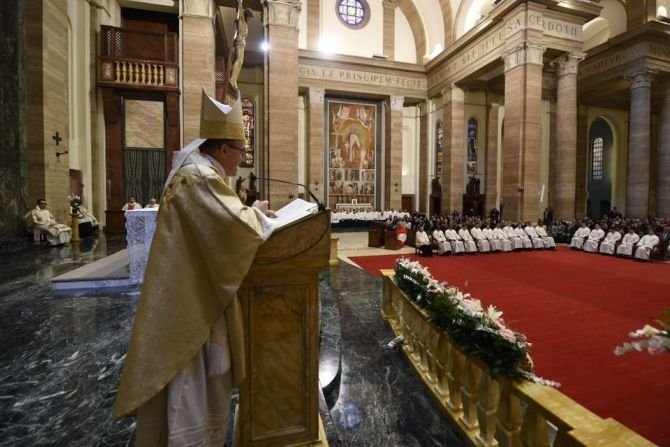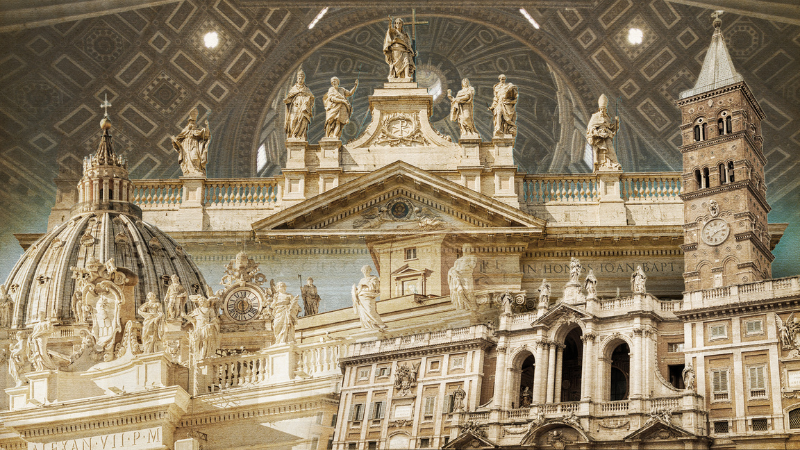
The Jubilee Year 2025 in Rome is fast approaching. More than 30 million pilgrims are expected to come to the eternal city and walk through the Holy Door in St Peter‘s. For this occasion, the EWTN Vatican Bureau created the EWTN Travel Jubilee App to assist pilgrims and introduce them to the hidden treasures of Rome and beyond. In one of the featured itineraries on the App, EWTN Vatican Bureau Chief Andreas Thonhauser takes us to the four Major Papal Basilicas. Each will have a Holy Door opened in the next year.
St. Peter’s Basilica: The Beating Heart of Catholicism
Standing before St. Peter’s Basilica, Andreas Thonhauser introduces one of EWTN Travel’s Jubilee itineraries: “It’s really the beating heart of the Catholic Church. But did you know that it’s actually only one of four Major Papal Basilicas? And each one has its own fascinating history. In this video, we want to take you to each one of those, and also help you and inspire you for your very own personal pilgrimage here in Rome.”
Thonhauser takes us to each of these most ancient churches of Rome: “We’re here at Saint Peter’s Basilica. It is inside the Vatican, and it’s built on the tomb of the Apostle Peter. Come on. I’ll take you inside.” Join us in the App to experience this guided tour, inside and out of St. Peter’s Basilica.
While the actual bones of Saint Peter are not open to public viewing, upon entering the basilica, one of the first things you will see is the famous Baldacchino. Built by Bernini in 1623, the bronze and wood spirals rise above the resting place of the first pope. It is also centered perfectly beneath the dome, which, at 448 feet, is not only the tallest dome in the world but also the highest point in Rome.
Basilica of St. John Lateran
Across town, we take you to the Basilica of Saint John Lateran, boasting its own claim to fame as the first church constructed after the legalization of Christianity.
Just like the baldacchino of St Peter’s, a ciborium at the center of the church holds relics of the heads of Saints Peter and Paul. If you walk towards the left side of the church, you will find a relic of a table which is believed to be the very same table where Jesus and the Apostles celebrated the Last Supper.
The apse holds the seat of the Bishop of Rome, and lining the nave are statues of the apostles. The basilica gets its name from the original owners of the property, the Lateran family, who owned the land before it was eventually donated to Pope Miltiades I after Christianity was legalized around the year 311.
Miracles and Relics at the Basilica of St. Mary Major
About a twenty-minute walk on foot, the Papal Basilica of Mary Major has its own multifaceted origin story.
In the guided tour, Thonhauser then takes us to the most important Marian church in Rome, a favorite of Pope Francis. He explains the miracle of the snow: “On the 5th of August, in 352, it snowed in Rome, right here in that spot. It is believed that Mary also appeared on that very day to Pope Liberius, asking him to build a church for her in this very place. And it became one of the oldest Marian shrines in the west that we know of today.”
St. Mary Major has also gained renewed attention in recent years for its art and relics. Pope Francis is known to make frequent visits to pray before the icon Salus Populi Romani before and after every apostolic trip of his pontificate. According to tradition, the icon was painted by St. Luke the Evangelist.
And beneath the main altar lies a relic of the manger in which Christ was born in Bethlehem, brought back to Rome by Saint Helen, the Mother of Emperor Constantine, after her pilgrimage in the Holy Land.
Saint Paul’s Outside the Walls: A Testament to Faith and Resilience
Last, but not least, we head to the final of the four major papal basilicas, St. Paul’s Outside the Walls.
Thonhauser explains its location: “Here we are outside the old city walls of Rome, and you can see the statue of Saint Paul, sword in hand. This basilica was erected above the apostle’s tomb, and quite honestly, it’s one of my favorite spots here in Rome.”
Although consecrated in the year 330, most of the structure was destroyed by a devastating fire in 1823. Donations poured in from around the world with everyone, from humble parishioners to Tsars, and the King of Egypt, contributing to restorations in what became the largest construction event of the century.
While today Saint Paul’s is a much quieter spot than its other counterparts, it is no less important, as it is also the spot where the Dogma of the Immaculate Conception was proclaimed in 1854.
This tour only scratches the surface of the art and history found in the four Major Papal Basilicas. To find out more, we invite you to download the EWTN Travel App and make sure to check out this itinerary and many others we have on there for you. Please let us know what you enjoy the most and which basilica is your favorite.
Thonhauser signs off: “God bless and safe travels.”
As the Jubilee Year 2025 approaches, and Rome prepares to welcome 30 million visitors, remember to download the EWTN Travel App to enhance your trip to the Eternal City.
Find the free EWTN Travel App available for download on Android and Apple in both Google’s Play Store and Apple’s App Store.
CLICK HERE TO DOWNLOAD ON GOOGLE PLAY STORE
CLICK HERE TO DOWNLOAD ON APPLE STORE
Adapted by Jacob Stein