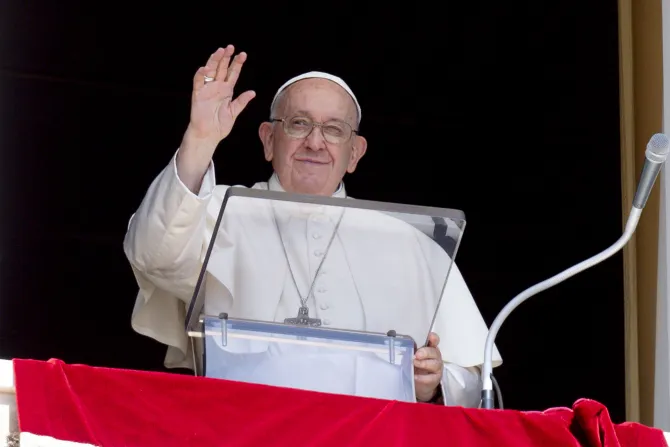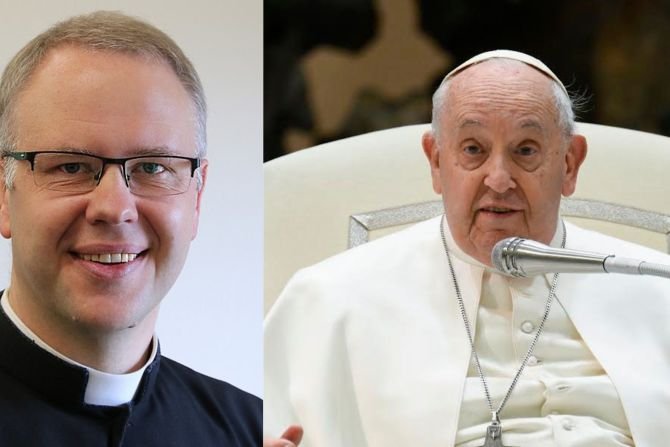
Pope Francis met with the superior general of the Priestly Fraternity of St. Peter (FSSP) on Thursday, confirming that restrictions on the celebration of the Traditional Latin Mass don’t apply to the order.
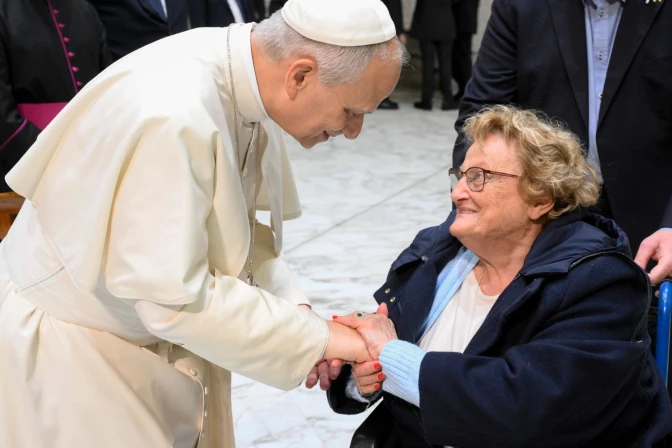
The private meeting between the pope and Father Andrzej Komorowski, who was accompanied by two priests from his order, came at the invitation of Pope Francis and followed a request from the FSSP.
According to a press release from the FSSP, the meeting was an opportunity to showcase “deep gratitude to the Holy Father” and to discuss the “liturgical specificity of the Fraternity of St. Peter.”

The FSSP was established on July 18, 1988, as a society of apostolic life of pontifical right by the Holy See, a canonical status that was granted by Pope John Paul II.
At the heart of the FSSP’s charism is the celebration of the Mass and the sacraments according to the extraordinary form of the Roman rite, also known as the Tridentine Mass, Traditional Latin Mass, or “Usus Antiquior.”
The FSSP’s statement noted that the priests shared with the pope “the difficulties encountered” in applying the pope’s Feb. 11, 2022, decree addressed to the fraternity,” in which he confirmed the right of the order to celebrate the Mass “according to the typical editions of the liturgical books, namely the Missal, the Ritual, the Pontifical, and the Roman Breviary, in force in the year 1962.”
“The pope was very understanding and invited the Fraternity of St. Peter to continue to build up ecclesial communion ever more fully through its own proper charism,” the statement said.
The FSSP was founded by 12 priests and 20 seminarians who were formerly part of the Society of St. Pius X (SSPX), a canonically irregular traditionalist priestly society established by French Archbishop Marcel Lefebvre in 1970. Lefebvre, one of the most influential leaders in the traditionalist movement, was excommunicated by Pope John Paul II in 1988 when he ordained four bishops for the SPPX, which was against the expressed prohibition of the Holy See.

The Feb. 29 meeting came amid a broad crackdown on the celebration of the Traditional Latin Mass following Pope Francis’ 2021 motu proprio Traditionis Custodes.
The papal decree severely curtailed the permission granted to priests for the celebration of the Traditional Latin Mass. Pope Benedict XVI, in his 2007 apostolic letter Summorum Pontificum, had previously allowed all priests to say Mass using the Roman Missal of 1962 without having to seek their bishop’s permission.
Traditionis Custodes reversed course and explicitly stated that it was the “exclusive competence” of the bishop to authorize Traditional Latin Masses in his diocese.
The Feb. 29 meeting between the FSSP and the pope is their second such encounter in recent years and comes after news broke that Cardinal Vincent Nichols, archbishop of Westminster, canceled the celebration of the Easter Triduum according to the old rite.
At the first private audience, held on Feb. 4, 2022, the FSSP asked for clarification regarding the implementation of Traditionis Custodes with respect to the Ecclesia Dei communities. In a press release, the fraternity noted that during the “very cordial meeting,” Pope Francis “expressed that he was very impressed by the approach taken by its founders, their desire to remain faithful to the Roman Pontiff, and their trust in the Church.”
“In the course of the audience, the pope made it clear that institutes such as the Fraternity of St. Peter are not affected by the general provisions of the motu proprio Traditionis Custodes, since the use of the ancient liturgical books was at the origin of their existence and is provided for in their constitutions,” the communique continued.
Since its foundation in 1988, the FSSP has grown to become the largest of the Ecclesia Dei communities. According to internal 2023 figures, the FSSP currently has 368 priests, 22 deacons, and 179 seminarians. The average age of their members is 39.
The FSSP is present in 146 dioceses, celebrates Mass in 246 locations, and counts 48 personal parishes. One of their most active parishes is Santissima Trinità dei Pellegrini in Rome, which is one of the main sites for the annual Summorum Pontificum pilgrimage.
The FSSP currently operates two international seminaries. Our Lady of Guadalupe Seminary located in Denton, Nebraska, is for English-speaking seminarians, while the seminary of St. Peter in Wigratzbad-Opfenbach, Germany, is divided into two sections for German- and French-speaking seminarians.
As a pontifical right society, the FSSP answers to the pope. The FSSP formerly operated within the framework of the Pontifical Commission Ecclesia Dei, established by Pope John Paul II. However, in 2019, Pope Francis suppressed the commission and put the fraternity under the Dicastery for Institutes of Consecrated Life and Societies of Apostolic Life.
This article was originally published on Catholic News Agency.