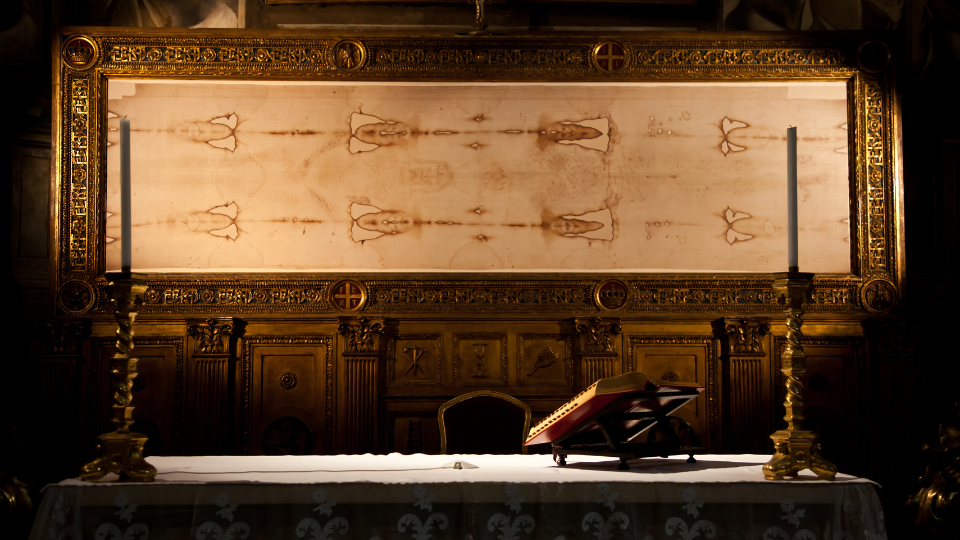
In the past, Christians’ belief in the Resurrection of Christ was sufficiently supported by faith in the Gospels, the Church Fathers, and the Church herself. However, since the 18th century, the rise of scientific rationalism has led many to question this event, prompting a search for scientific evidence. Amidst this quest, one relic stands out for its profound mystery and its ability to captivate and astonish: the Shroud of Turin. Despite over a century of thorough study, this relic continues to pose numerous questions, challenging the skepticism of many.
Father Maurizio Botta, the prefect of the Oratory of St. Philip Neri in Rome, explains it this way, “Either the resurrection is a historical fact or I have thrown my life into nothingness and spend it for nothing.”
Father Maurizio is a priest devoted to the Shroud. He explained why this may be the most important relic the Church possesses.
“All the wounds described in the Gospels,” Father said, “are compatible with those we find in the Shroud. It is not known how it was formed even today with all the experiments they have done. They have tried a thousand ways to explain it, they are all hypotheses.”
Skepticism about the Shroud began as scientific progress led people to believe that miracles and the supernatural could be explained by science and new technologies. Soon, however, scientists were faced with questions still unanswered today, such as the unique characteristics of the Shroud of Turin.
Nello Balossino, director of the Museum of the Shroud in Turin and longtime scholar and researcher of the Shroud, explained the details which set the Shroud of Turin apart from others.
“The so-called shrouds,” he said, “that are shroud-like have a very big flaw and that is they are all reproductions made by deteriorating the shroud threads, that is, by burning them for example, either with heat or sulfuric acid. But the Shroud, the fibers of the Shroud are intact and this is the first characteristic. The second problem is the three-dimensionality, and that is the three-dimensionality is an intrinsic feature of the Shroud that does not exist in other images.”
International interest in the Shroud began in 1898, after it was first photographed at the behest of King Umberto I of Italy.
Today, the original negatives of those early photos can be appreciated in Rome’s Museum of the Popes, a stone’s throw from St. Peter’s Basilica.
Ivan Marsura, Director of the “Museum of Popes” in Rome, explained the importance of these photographs.
“Here already,” Marsura said, “we see the Shroud displayed inside the Turin Cathedral and we see it quite sharply. And there’s also a nice detail because there’s an attendant from the service of the Turin Cathedral that we can glimpse behind, behind a candelabra. And that makes all the details for us. All very sharp and very clean details. Here, however, we already see the face and these are two details taken from Pia’s first photographs and we already have the detail of the face in negative and in positive.”
Can this image therefore really be the face of Christ? Could the Shroud kept in Turin be the ultimate proof of Christ’s Resurrection?
Nello Balossino explained the various scientific angles that can be used to examine the veracity of the Shroud.
“If I wanted to give an exhaustive discourse,” he said, “about all the evidence that somehow can lead us to say that that is likely, I use that term to say that there is slight dividing line, to the fact that there was the body of Christ, the investigations are multidisciplinary. So I talked about the photography, but there is also, of course forensic medicine that makes its contribution because it says what is the type of blood that is on the Shroud. There is palynology, because on the Shroud there are pollens that have been found that can be related to European pollens but also to Palestinian pollens. There are the morphological investigations that suggest how the crucifixion of the Sindonic man took place.”
Despite all these tests and experiments, we cannot yet be scientifically certain that the man in the Shroud is actually Christ.
Father Maurizio told EWTN Vatican that this is not a hindrance to belief. “On the level of principle,” he explained, “I do not need the Shroud in order to believe. However, in front of the Shroud I put myself in the same position as this first photographer who photographed it. I put myself humanly in the image of this man who, we can imagine: tripod, cloth over his shoulders, flash. And when he saw the impressed plate respond in that way and appear to outline the body with all the wounds, with everything legible, he must have wept. And I keep seeing that commotion, that crying in front of the Shroud.”
Adapted by Jacob Stein