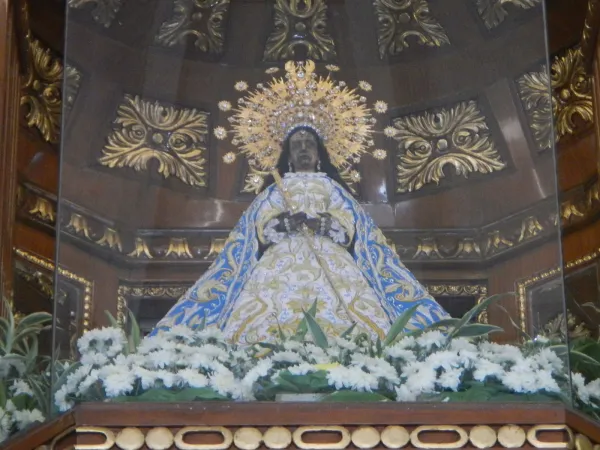
The Madonna of Peace and Good Voyage statue, arriving from Mexico to the Philippines in the 17th century and crossing the Pacific Ocean six times, holds a special place in the hearts of Filipino migrants worldwide. Last week, the Antipolo Cathedral, home to this revered statue, was declared an “international sanctuary.” This marks a historic event as it is not only the first international sanctuary in the Philippines but also in Southeast Asia.
Asia is home to two other international sanctuaries: St. Thomas Church in Kerala, India, and the Martyrs’ Shrine in Haemi, South Korea. However, the Antipolo sanctuary is the first dedicated to Marian worship.
On January 26th, 80 Filipino bishops gathered for a Mass at Antipolo, officially proclaiming it an international sanctuary. The celebration was led by Archbishop Charles John Brown, the Apostolic Nuncio, along with Bishop Ruperto Santos of Antipolo.
In his homily, the Nuncio highlighted the event as a testament to the “internationality of the Filipino Church,” linking the Filipino diaspora to evangelization efforts. Migrants often pray to the Virgin of Antipolo for safety during their travels.
The Virgin of Antipolo was first brought to the Philippines from Acapulco by Governor-General Juan Niño de Tabora in 1626, who credited her for his safe passage across the Pacific. The image was crowned in 1925 by decree of Pope Pius XI.
After Governor Tabora’s death, the statue, entrusted to the Jesuits, was intended for the Antipolo church. During its construction in 1630, the image mysteriously disappeared several times, reappearing atop a tipolo tree. This was interpreted as a divine sign, and the church was relocated to the tree’s location.
The church was burned during the Chinese uprising of 1639, and the statue was moved first to Cavite, then back to Mexico, crossing the Pacific six times during this period.
In 1944, the Japanese army invaded Antipolo, turning it into a garrison, and the church into an arsenal. The image was saved by sacristan Procopio Ángeles, who hid it in a burnt-out gasoline drum wrapped in a thick wool blanket. It was then moved from Antipolo, eventually installed in Quiapo Church in Manila, and returned to Antipolo only after the war.
The statue, crowned in 1926, was severely damaged during the 1629 Chinese revolt, the 1645 Luzon earthquake, and earthquakes in 1824 and 1883.
The Diocese of Antipolo was created on January 24, 1983, and canonically erected on June 25, 1983. The diocese’s official title is “National Shrine of Our Lady of Peace and Good Voyage – Parish of the Immaculate Conception.”
The Vatican granted the title of international sanctuary to the shrine in 2022, making it the 11th of its kind worldwide.
The largest pilgrimage to the sanctuary occurs on April 30th, the eve of the Marian month, with a procession to the sanctuary overnight to attend dawn Mass. The furthest starting point for this pilgrimage is Quiapo Church.