Skip to content

Did you know that the relic of the right arm of St. Francis Xavier is in Rome?

Saint Francis Xavier, a Spanish Jesuit priest and missionary from the 16th century, is often revered as the "Giant of the History of Missions," attributed to his fervent evangelizing zeal and spiritual fortitude.

The churches of Rome are renowned for housing numerous treasures of Christianity, and a prime example is the Church of the Gesù (Church of Jesus). This church is the custodian of an important relic of the missionary saint, whose feast day is celebrated on December 3rd.

Saint Francis Xavier, a Spanish Jesuit priest and missionary from the 16th century, is often revered as the “Giant of the History of Missions,” attributed to his fervent evangelizing zeal and spiritual fortitude.

He embarked on a mission to spread the Gospel to the East, particularly in Asia, in what was one of the most ambitious missionary expeditions of the time. Francis Xavier reached India and Japan and passed away before he could set foot on the shores of mainland China on December 3, 1552.

His body, initially placed in a lime-filled coffin for transport, was found incorrupt ten weeks later upon removal of the lime. Subsequently, his remains were first taken to Malacca (Malaysia) and then to Goa (India), where they are enshrined in the Church of the Good Jesus to this day.

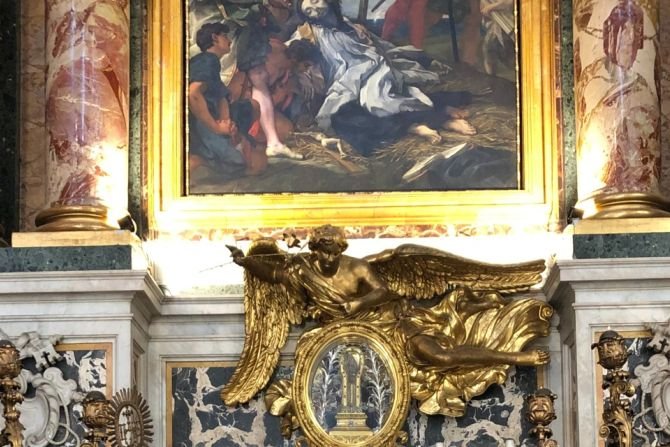
The relic of his right arm was transported to Rome and has been preserved there since 1614 in the Jesuit Society’s temple. This church, visited by Pope Francis on several occasions, also houses the tomb of the Order’s founder, Saint Ignatius of Loyola.

Positioned to the right of the church’s main altar, in the chapel dedicated to Saint Francis Xavier, the relic holds a place of honor. Xavier shared a profound friendship with Saint Ignatius, the founder of the Jesuits.

The arm, used by the indefatigable missionary to baptize and bless hundreds of thousands of converts during his Asian missions, is a first-degree relic and remains partially incorrupt, meaning it has not decomposed in the typical manner.

This article was originally published on ACI Prensa. 

Receive the most important news from EWTN Vatican via WhatsApp. It has become increasingly difficult to see Catholic news on social media. Subscribe to our free channel today

Share

Would you like to receive the latest updates on the Pope and the Vatican

Receive articles and updates from our EWTN Newsletter.

More news related to this article

Leo XIV: Peace is possible by ‘acknowledging, understanding, and surmounting’ disagreements

Pope Leo XIV on Friday stated that authentic peace “takes shape from the ground up” when the differences and conflicts they entail “are not set aside but acknowledged, understood, and surmounted.”

Pope Francis: Jesus is ‘the unsurpassed model of evangelization’

Pope Francis invited Christians on Wednesday to pray for the grace to have a “pastoral heart” like Jesus
Fresco of St. Francis of Assisi in Sacro Speco Monastery in Subiaco, Italy. Credit: EWTN Vatican

The First Image of St. Francis of Assisi

High above the Aniene Valley, the Monastery of the Sacro Speco clings dramatically to the rock. Built around

Encountering the Heart of Jesus: Reflections on Cardinal Kurt Koch’s Homily

The CNA Deutsch agency has reported on Cardinal Kurt Koch's homily, delivered on Friday at the Church of the Holy Rosary on Monte Mario in Rome, where the image of Mary Advocata is located

Pope Francis celebrates ‘the birthday of the priesthood’ with 1,800 priests on Holy Thursday

On Holy Thursday, Pope Francis presided over a Chrism Mass at which more than 1,880 priests, bishops, and

Pope Francis visits pediatric oncology ward at hospital, baptizes newborn baby

While staying at Rome’s Gemelli Hospital where he is undergoing treatment for bronchitis, Pope Francis paid a visit

LIVE
FROM THE VATICAN

Be present live on EWTNVatican.com