High above the Aniene Valley, the Monastery of the Sacro Speco clings dramatically to the rock. Built around the grotto where Saint Benedict of Nursia once lived as a young hermit, the “Holy Cave” is a cradle of Western monasticism — a place where silence, prayer, and work shaped the future of the Church.
Yet deep within these caves lies an unexpected link to another saint: Francis of Assisi.
Fr. Maurizio Vivera, Prior of the Sacro Speco Monastery, explains that Francis came here seeking what Benedict had discovered centuries earlier — solitude and communion with God. “Francis came here and stayed for a time and then he was, in a sense, immortalized, because we have this very famous fresco. And he surely remained here in prayer, out of devotion to the Benedictines, who would later inspire him in some way.”
In fact, Francis did not originally intend to found an order. As Fr. Vivera notes, “In fact, we can say that when Francis first begins his journey, he has no idea of founding an order. He wants to live on his own. His model is Saint Benedict. But later he sets that idea aside and founds the Franciscan Order.”
An “Ancient Photograph” of Francis
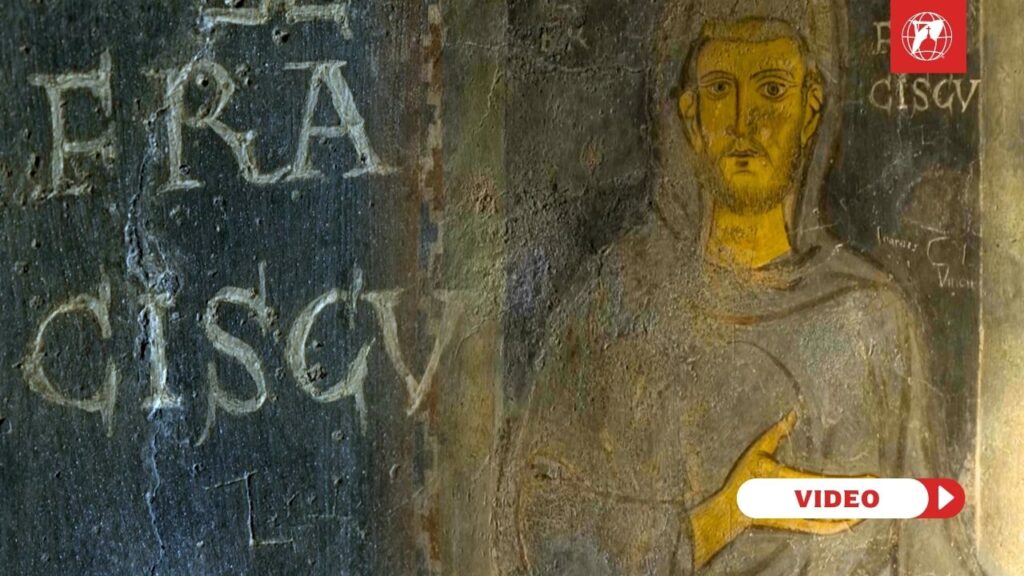
Inside the Chapel of St. Gregory, visitors encounter what art historian Martina Amati calls the “true effigy” of Francis. “Welcome to the Chapel of St. Gregory, where the true effigy of Francis is kept,” she says.
Amati describes the fresco as something like an “ancient photograph,” likely painted during Francis’ visit in 1223. “This portrait was probably made during Francis of Assisi’s visit here in 1223. He came to accompany Ugolino d’Ostia, who would later become Pope Gregory IX,” she explains. During that visit, Ugolino consecrated a small chapel, “and that is probably why an anonymous monk of the monastery decided to paint St. Francis’ portrait.”
In the image, Francis appears not as a canonized saint but as a friar in his early forties. “Here Francis is portrayed probably at his real-life size—more or less what people’s average height was at the time,” Amati notes. “First of all, there’s no halo, which suggests he was still alive. He’s identified simply as Brother Francis. He’s wearing that ash-grey habit, which indicates this is before the formal approval of the Franciscan Order, which would come a few months later under Pope Honorius III. And he has no stigmata, which he would receive the following year at La Verna, in 1224.”
The Byzantine style invites symbolic interpretation. Enlarged ears suggest attentiveness to God’s Word; a strong throat points to the Holy Spirit; a hand placed over the heart signals peace. In his left hand, a scroll bears the words Pax huic domui — “peace to this house.”
A Face Marked by History
Beyond symbolism, the fresco preserves a remarkable historical detail. “What tells us this is Francis is a detail in his face: you can see that one eye is larger and the other smaller,” Amati explains. “This is probably the sign of a harsh eye operation Francis underwent at Fonte Colombo, near Rieti, before coming to Subiaco—treatment for what is thought to have been an eye infection he likely contracted in the Holy Land.”
Over the centuries, pilgrims have left their own marks in the sanctuary — names and prayers etched into the walls. On Francis’ portrait, one signature stands out. “For example, on the portrait of Francis you can find what we might call an ‘illustrious’ signature, because it reads: ‘Pope Pius II was here.’ We know that Pope Pius II Piccolomini passed through here in 1461, visiting the monasteries, and he left his name.”
According to Amati, this fresco became a model for later depictions of Francis, influencing artists such as Cimabue in Assisi. A later copy on the opposite wall creates what scholars call a “double portrait” — further confirming Francis’ visit to this sacred cave.
In the silence of the Sacro Speco, the image endures: not a distant icon, but the living face of a pilgrim who once came seeking God among the rocks.
Adapted by Jacob Stein. Produced by Alexey Gotovskiy; Camera by Fabio Gonella, Sergio Natoli, Anthony Johnson; Video Edited by Alessio Di Cintio; Special thanks & Credits to the Monastery of St. Benedict.