Lebanon is one of the most fragile countries in the Middle East. Years of destruction caused by war, the influx of refugees from Syria, a devastating financial crisis, and widespread humanitarian suffering have made reconstruction a difficult task.
To address this crisis and support the country’s recovery, an international workshop on solidarity, dialogue, and reconstruction was held in Rome, sponsored by the Order of Malta and the Embassy of Germany to the Holy See and to the Order.
The Order of Malta has long had a presence in the country, tracing its origin to the Holy Land, and so close is the link between Lebanon and the Catholic faith that constitutionally the president must be a Maronite Catholic.
The event started with a special video message from the President of Lebanon, Joseph Aoun, who expressed his gratitude for the international support and stressed the critical need for action.
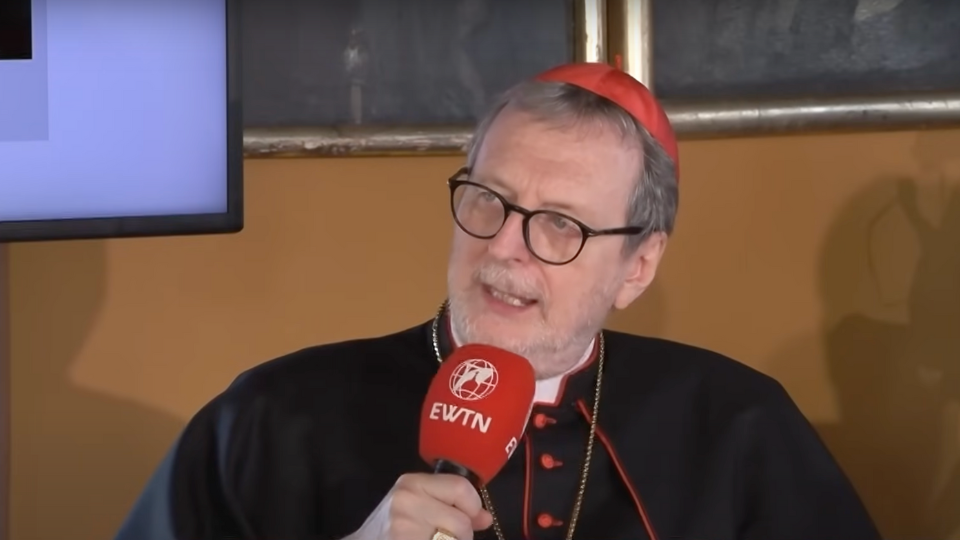
The meeting brought together high-level diplomatic, religious, and humanitarian authorities to reflect on how to bring about stability in the entire region. A panel discussion was held dedicated to Lebanon’s model of interreligious coexistence, which included the participation of Cardinal Claudio Gugerotti, the prefect of the Dicastery for the Eastern Churches, who stressed the importance of the Church to encourage Christians in Lebanon to stay since they are a vital part of the pluralistic nation’s and Church’s identity.
“So you see, our work is to try to convince them that for the Church to lose the Catholics or the Christians in Lebanon means to lose a part of the Church that cannot be reproduced, which means a part of the identity of the Catholic Church,” Gugerotti said.
Tobias Tunkel, the director for the Middle East and North Africa at the Foreign Ministry of Germany, also spoke about the importance of the interreligious richness of Lebanon:
“There is a certain tendency to believe that only ethnical and religious homogeneous states can provide stability. It is all the more important to help Lebanon to prove that the opposite is true, that the diversity, the richness of its people, is the source of its prosperity and of its peace.”
The Catholic Church has always seen Lebanon as a special place and model of how different faiths can live together in peace. When Pope Saint John Paul II visited the country in 1997, he told the Lebanese people that their country was a shining example of religious diversity and harmony and urged them to continue being a symbol of hope and coexistence for all. He emphasized Lebanon’s role not just as a unique example for the Middle East, but as a message for the world.
Marwan Sehnaoui, President of the Lebanese Association of the Knights of Malta, added:
“We are a little country with 18 different communities. The Christians are a minority, so if we believe that we are real Christians, we should try to build this famous experience that Pope Saint John Paul II called to Pope Benedict XVI and Pope Francis. Let’s create one Lebanese man made out of all those communities, based on love, based on security — that this is the only way to live in peace.”