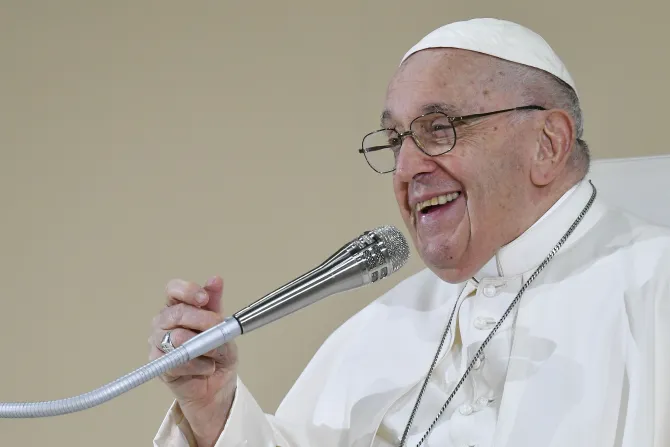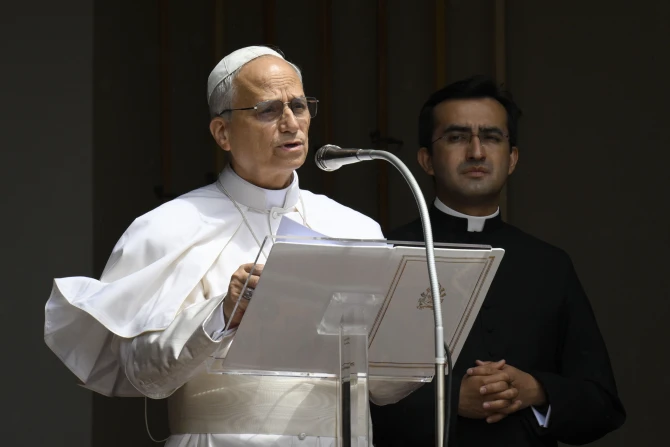
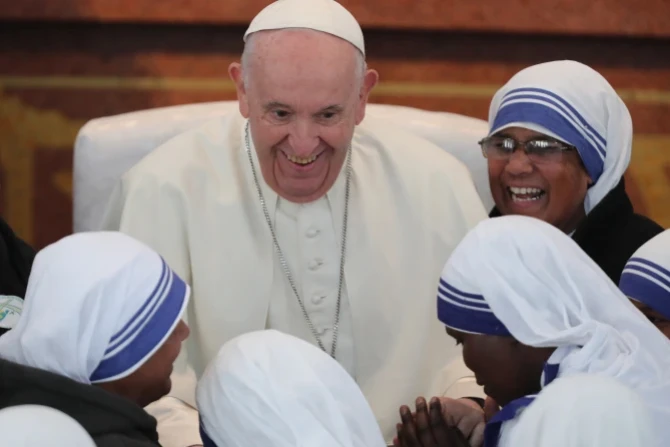
Since his time as archbishop of Buenos Aires, Pope Francis was already known for his humility, closeness to the poor, and an austere lifestyle that spoke louder than words.
SIGN UP FOR OUR NEWSLETTER HERE
In the 2013 documentary “Pope Francis: A Man of His Word,” the pontiff recalled that “Jesus, in the Gospel, tells us that we cannot serve two masters: Either we serve God or we serve riches. And the great temptation that Christians, humankind, and the Church have always faced throughout history has been that of riches.”
The following are some of the gestures of austerity and charity toward the most needy made by Pope Francis during his 12 years as pontiff.
1. He lived at St. Martha’s House.
Instead of moving into the Vatican’s Apostolic Palace, as is customary for pontiffs, Pope Francis decided to reside in Casa Santa Marta, the Vatican guesthouse — where he stayed during the March 2013 conclave — because he wanted to maintain a simple lifestyle close to the people.
In a handwritten letter to an Argentine priest, he explained: “I’m out where people can see and live a normal life: public Mass in the morning, eating in the dining room with everyone, etc. This is good for me and prevents me from becoming isolated.”
The pontiff also confessed that he didn’t want to live in the Apostolic Palace because he wished to maintain the same way of being he had as archbishop in Buenos Aires.
During a June 7, 2013, meeting with children in Paul VI Hall, a little girl named Sofía asked him directly why he didn’t live in the Apostolic Palace. The pontiff’s response was simple and convincing: “We all have to think about becoming a little poorer: We should all do it. We should ask ourselves: How can I become a little poorer to be more like Jesus, who was the poor teacher?”
2. He visited the sick in the hospital.
Pope Francis regularly visited children, parents, and doctors at the Bambino Gesù Children’s Hospital in Rome. He also visited the children’s section of Gemelli Polyclinic, the same hospital where he himself received medical treatment.
An example of this was on March 19, 2022, when, in the context of the war in Ukraine, the pope visited Ukrainian children hospitalized at Bambino Gesù, expressing his closeness and solidarity with the victims of the conflict.
A year earlier, while recovering from surgery, Francis visited children with cancer in the pediatric oncology department of the same hospital. The visit was prompted by the letters and drawings the children sent him wishing him a speedy recovery.
3. He opted for a simple iron pectoral cross and a silver-gilt fisherman’s ring.
After being elected pope, Francis didn’t want to wear the gilded crucifix with precious stones as his predecessors had done and instead opted to wear a simpler iron pectoral cross, known as the “Cross of the Good Shepherd,” that he had worn since 1998 as archbishop of Buenos Aires.
Likewise, the “fisherman’s ring,” a symbol of the pontificate that Francis wore starting with inaugural Mass on March 19, 2013, was not made of gold but of gilded silver. The design depicted St. Peter with his keys and was created by the Italian artist Enrico Manfrini. The choice of this model, among three options presented, once again reflected Pope Francis’ simplicity.
4. He wore his predecessor’s vestments as archbishop of Buenos Aires.
In a recent statement to ACI Prensa, CNA’s Spanish-language news partner, Marcelo Pivato, a close friend of Pope Francis, shared an anecdote that illustrates the pontiff’s humility. The story takes place during the time when Cardinal Antonio Quarracino was the archbishop of Buenos Aires.
Pivato fondly recalled that, at the time, Jorge Mario Bergoglio, coadjutor archbishop of Buenos Aires, was known for his simplicity and austere lifestyle. He then recounted how, after Quarracino’s death, a curious incident arose involving vestments.
“When Cardinal Quarracino died, he was a robust, heavy man, and Pope Francis was very thin. During the Corpus Christi celebrations, the nuns who were serving at the archdiocesan office told him that he would need a vestment for the occasion, and Quarracino’s was the one that was left, but it was very large. So he said, ‘Well, bring me an estimate so they can make it.’ When he saw the figure, he asked the nuns, ‘Who knows how to sew?’ And some of them did. Then he told them, ‘Well, make Cardinal Quarracino’s vestment smaller for me.’”
5. Pope Francis always carried his black briefcase.
The image of Pope Francis with his signature black briefcase caught the eye on his first papal trip, during World Youth Day in Rio 2013, although a friend assured he had been using it since he was a priest.
That year, the Holy Father told reporters on the return flight to Rome that he has always carried his own briefcase. “When I travel, I take it with me. Inside, I carry my razor, my breviary, my date book, a book to read. I carry one about St. Thérèse, to whom I am devoted.”
Pivato recalled with humor and admiration the pontiff’s attachment to that briefcase since he was a priest in Buenos Aires.
“You’ll remember that he always carried a leather suitcase. The little black one. So one day I gave him a new one. I said, ‘Here, Father, I brought you a new suitcase, so you can get rid of the one that was used by a door-to-door linens collector in my grandmother’s time.’ Because, in truth, sheets were collected in installments before, and those little suitcases were used. Well, he never used it. He stuck with that one,” he told ACI Prensa.
6. He organized lunches to feed the poorest.
Pope Francis instituted the World Day of the Poor on Nov. 21, 2016, through his apostolic letter Misericordia et Misera at the conclusion of the Extraordinary Jubilee of Mercy. With this initiative, he called all Christians to live in concrete solidarity with those who suffer most, especially by feeding the hungry and sharing one’s table with the poorest.
Throughout his pontificate, Pope Francis has provided a concrete example of this mandate. Between the establishment of the World Day of the Poor and the end of 2024, he shared lunch with thousands of people in need on several occasions in Paul VI Hall at the Vatican.
7. He wore his usual black shoes instead of the traditional red shoes.
True to his simple style, Pope Francis wore his usual black shoes made in Buenos Aires throughout his 12-year pontificate, abandoning the traditional red shoes of his predecessors and continuing to wear modest loafers.
In a phone call to his longtime shoemaker, Carlos Samaria, he asked him not to do anything new or flashy for the start of his pontificate: “No red shoes, just black as usual.”
Samaria, who made his shoes for 40 years, described the shoes the pope wore as having “a simple cut, made of black calfskin, with a smooth upper, no frills. If you pick up one of the pope’s shoes, it looks like a galosh, unadorned but with laces.”
8. ‘I was in prison and you visited me’: He was close to the incarcerated.
From opening a Holy Door in a prison to visiting prisons on his apostolic trips, Pope Francis has made accompanying prisoners a regular gesture.
During his first Holy Week after being elected pontiff, in 2013, he went to a prison to wash the feet of prisoners, a gesture he repeated every year until his final Holy Thursday, four days before his death, when he visited the inmates of Regina Caeli prison. That day, Francis personally greeted each of the inmates. Afterward, he addressed them “to pray the Lord’s Prayer together and impart his blessing.”
Another memorable moment was when the pope inaugurated the 2025 Jubilee of Hope and, two days later, on Dec. 26, visited the Rebibbia prison, where he opened a second Holy Door as a gesture of grace toward those deprived of their freedom, incorporating them in a special way into this jubilee year, despite the fact that, according to tradition, Holy Doors are found only in the four papal basilicas in Rome.
This story was first published by ACI Prensa, CNA’s Spanish-language news partner. It has been translated and adapted by CNA.