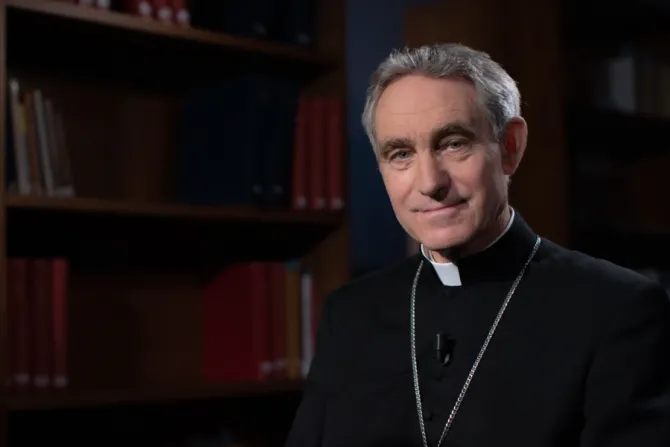
In the latest book by Archbishop Georg Gänswein, for 20 years personal secretary to Pope Benedict XVI, there is much more than bitterness at having been made a “halved prefect” by Pope Francis.
Indeed, while the hype surrounding the publication has focused on that particular situation — the removal of Gänswein as prefect of the papal household — and has characterized Gänswein as willing to seek tension, almost to place one pontificate against the other, the book offers much more than that.
In fact, perhaps its most precious content is the excerpts from the homilies that Benedict XVI gave in the Mater Ecclesiae Monastery, where he spent the last years of his life.
Those homilies are probably the most innovative element of the book, which Gänswein wrote with journalist Saverio Gaeta. Titled “Nothing but the Truth: My Life Beside Benedict XVI,” the book comes out in Italian on Jan. 12, but CNA was able to preview it.
As long as his voice allowed him, Benedict XVI personally prepared the homilies, with notes written in pencil in a notebook that would then serve as a guideline for what he would say. They were simple, precise, straight-to-the-point homilies that the four Memores Domini (the consecrated laywomen of Communion and Liberation) who served as Benedict XVI’s family recorded and transcribed.
Only a few could listen to some of those homilies because Benedict XVI rarely received people, so the report of those homilies is an invaluable treasure.
What else can be found in the book? First, of course, there is Gänswein’s open anger and surprise at being abruptly relieved of his post as prefect of the papal household by Pope Francis, without any explanation.
Other previews spoke of Benedict XVI’s bitterness in learning about Traditionis custodes, Pope Francis’ apostolic letter with which he overturned the former pope’s decisions to expand the celebration of the ancient Mass.
However “juicy” these details may be for the media, they are certainly not the most novel element of the book.
Without diplomatic filters, using the straightforward language that those who know him are used to hearing, Gänswein outlines various interesting and partially unpublished situations. These include: the case of the book by Cardinal Robert Sarah, which named Benedict XVI as co-author; contacts with Cardinal Jorge Bergoglio before and after he became pope; the long letter that Benedict XVI wrote to Pope Francis to comment on his first interview granted to La Civiltà Cattolica in 2013, and a new details about how Benedict’s decision to renounce the pontificate came about.
The book offers insights to these stories and others through the eyes of a direct witness. It should be understood as a memorial, not an indictment. It provides a faithful account of situations and stories as Gänswein experienced them.
The resignation
In some cases, new facts are given and previously known accounts are presented in a different light. One example is Gänswein’s explanation for why Benedict XVI placed the pallium on the tomb of St. Celestine V, the pope who renounced his pontificate in 1294. His tomb is in L’Aquila, in central Italy, where Benedict had gone in 2009 to visit areas affected by an earthquake.
Benedict’s gesture has been interpreted as an indication of a willingness to resign that would occur several years later.
However, it was not like that, Gänswein reveals. He explains that Benedict XVI wanted to do an act of homage to his predecessor. So he placed a pallium, which Archbishop Piero Marini, at the time master of liturgical celebrations for Pope John Paul II, had sewn. This pallium fell uncomfortably on the shoulders of Benedict XVI, who thus took advantage of the opportunity to pay homage and donate it. The decision also tells much about how Benedict XVI dealt with the issues: He sought elegant solutions without offending anyone while trying to unite everyone.
However, the details of the decision to resign are more dramatic. Gänswein explains how Benedict XVI had already begun withdrawing into more profound prayer after his trip to Cuba and Mexico in 2012. There were indications that he was considering resignation, which triggered some questions asked by Cardinal Tarcisio Bertone, then secretary of state. But such a decision was inconceivable.
When Benedict XVI reached the decision, there was no way to change his mind, Gänswein reports. Bertone and Gänswein only managed to convince him not to make the announcement during his annual Christmas greeting to the Curia on Dec. 21, 2012, but to postpone it a bit. If the announcement had been made on that day, and the pontificate had ended on Jan. 25, Christmas would not have been celebrated, Gänswein writes.
This article was originally published by National Catholic Register.