The Pontiff who commissioned the Gregorian Calendar, Pope Gregory XIII, will now have an asteroid named after him, as reported by the Vatican Astronomical Observatory, Specola Vaticana, in a press release sent to journalists last Tuesday, February 28.
One of the small rocky objects orbiting the Sun will be named Ugo Boncompagni , the baptismal name of Pope Gregory XIII.
Gregory XIII led the calendar reform, commissioning the astronomer Fr. Christopher Clavius to work on the project known as the “Gregorian calendar”, which was instituted by via papal bull in 1582. He also began the tradition of papal astronomers and observatories.
Alongside Gregory, three Jesuit astronomers who worked at the Vatican Observatory will have asteroids named after them.
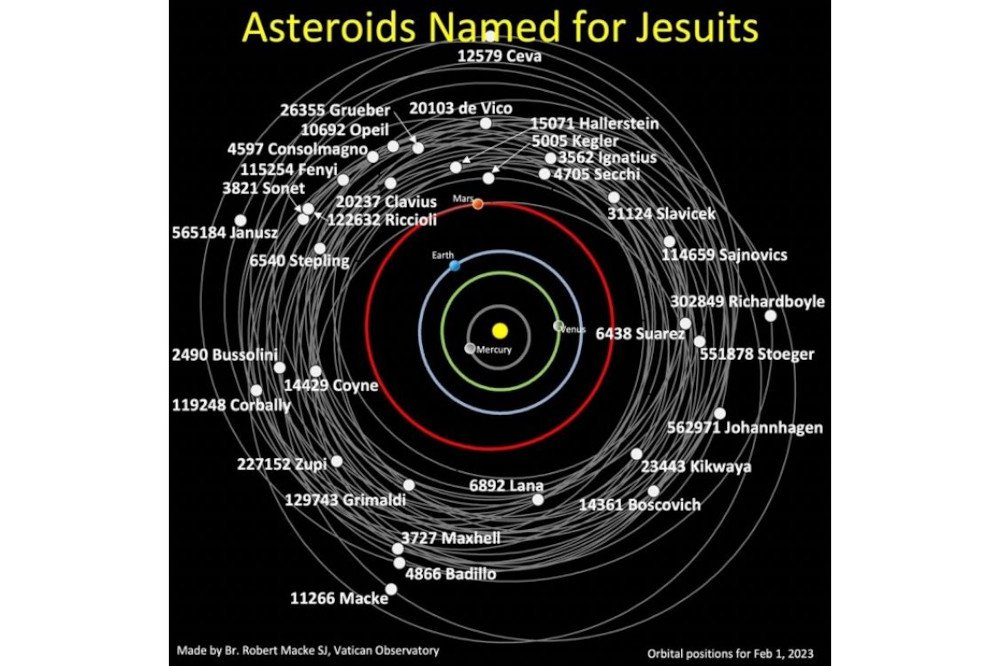
They are Fr. Johann Hagen, director of the Vatican Observatory between 1906 and 1930, Fr. Bill Stoeger, a cosmologist and theologian at the Vatican Observatory, and Fr. Robert Janusz, who currently works at the Observatory.
According to the Specola Vaticana, more than thirty asteroids bear the names of Jesuits. Some of them lived centuries ago, like Fr. Giovanni Battista Riccioli, who developed the system of lunar nomenclature that is still used today.
The assignment of a specific name to an asteroid (also known as a minor planet) occurs through a process that, in some cases, can go on for decades.
When a new minor planet is discovered, it is given a provisional designation, based on its date of discovery, such as “2002 LM60.”
Later, when the object’s orbit is determined well enough to be able to reliably predict its position, it receives a permanent designation number, issued from the International Astronomical Union (IAU).
At that point, the astronomer who discovered it is invited to suggest its name. Names of pets or commercial products or businesses are not allowed.
Also, names of political or military people or events may not be used for one hundred years following the person’s death or the event’s end.
Naming rights cannot be purchased, and proposed names are judged by the International Astronomical Union’s Working Group for Star Naming (WGSBN), made up of fifteen professional astronomers from around the world.
Astronomical searches have uncovered thousands of asteroids, so the WGSBN has been forced to limit the number of those given formal names. Therefore, most asteroids only receive a numerical designation.