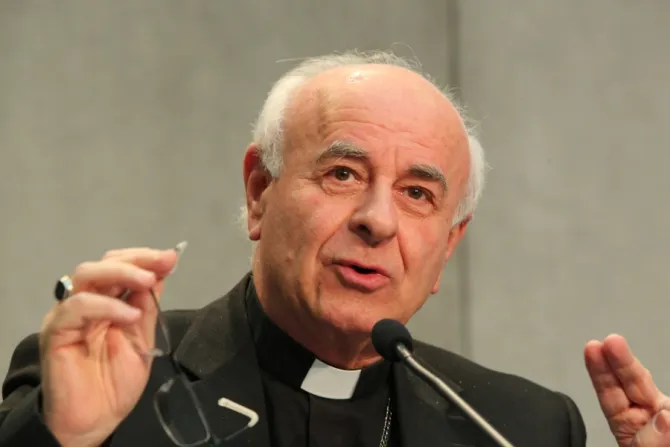
The Pontifical Academy for Life said Monday its president is against assisted suicide but thinks it is possible to have a “legal initiative” that would allow it to be decriminalized in Italy under “specific and particular conditions.”
The April 24 statement was issued following an outcry over a speech in which Archbishop Vincenzo Paglia defended legalizing medically assisted suicide in Italy. The archbishop called it a “feasible” approach to the issue in Italian society, despite the Catholic Church’s clear teachings against it.
“Personally, I would not practice suicide assistance, but I understand that legal mediation may be the greatest common good concretely possible under the conditions we find ourselves in,” Paglia said in a speech on April 19 during the International Journalism Festival in Perugia, Italy.
The Italian news outlet Il Riformista published the text of Paglia’s speech on April 22.
Monday’s statement by the Vatican academy said Paglia “reiterates his ‘no’ towards euthanasia and assisted suicide, in full adherence to the magisterium.”
The academy added that the president’s comments were about a ruling in the Italian Constitutional Court and “the specific Italian situation.”
The archbishop gave his opinion, the statement said, that a “legal mediation” but “certainly not a moral one” is possible in order to keep assisted suicide a crime in some cases, while decriminalizing it under certain conditions.
Both assisted suicide and euthanasia are currently illegal in Italy, where the criminal law says that “anyone who causes the death of a man, with his consent, is punished with imprisonment from six to 15 years.” Assisted suicide is the providing of lethal drugs so patients can take their own lives, while euthanasia is the direct killing of patients by doctors.
A bill to decriminalize assisted suicide, known in Italian legislation as “homicide of the consenting,” passed the Chamber of Deputies, the lower house of Italy’s Parliament, last year. It has not yet been passed by Italy’s Senate.
The proposed law, which follows a 2019 ruling from Italy’s Constitutional Court, stipulates that medically assisted suicide would be decriminalized only in cases that meet the following conditions: “the person must be ‘kept alive by life-support treatment and suffering from an irreversible pathology, a source of physical or psychological suffering that he or she considers intolerable, but fully capable of making free and conscious decisions.’”
According to Monday’s statement from the Pontifical Academy for Life, “for Archbishop Paglia, it is important that the [court’s] ruling states that the crime [of assisted suicide] remains as such and is not abolished. Any further consideration is misleading.”
“On a scientific and cultural level, Archbishop Paglia has always advocated the need for accompaniment towards the sick in the terminal phase of life, based on Palliative Care and proximity, so that no one is left alone in the face of illness and suffering, in the difficult decisions they entail,” the statement said.
Italy’s constitutional court last year blocked a referendum to decriminalize physician-assisted suicide in the country, stating that a repeal of the existing criminal law would leave the country without “the constitutionally necessary minimum protection of human life, in general, and with particular reference to weak and vulnerable persons.”