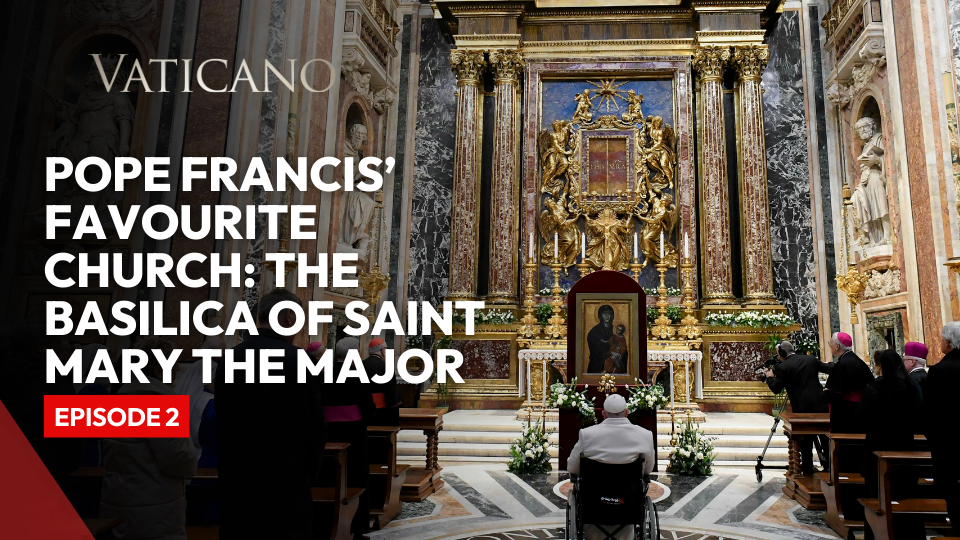
The beating heart of the Basilica is the altar that enshrines some of the most precious relics of Christendom. The complex is crowned by a baldachin, and a chapel underneath provides access to venerate the relics of the nativity that arrived from Bethlehem in the 7th century.
Guido Sante, guiding us through the time, the art, and the spirituality of the Papal Archbasilica of Saint Mary Major, relates some recent history of the Basilica, “In the 19th century, about 150 years ago, (…) Pope Pius IX, who reigned for many years, decided to construct a confession. Essentially, this involved opening up an area in the floor with two large staircases leading beneath the main altar to preserve the Holy Cradle.”
With this new construction, he explains, “Pilgrims, visitors, and believers can thus descend these stairs every day, enter the heart of the Basilica beneath the main altar, and there, pray in front of the relic of the Holy Cradle. This relic consists of 5 planks of Sycamore wood, an oriental tree, housed in a large reliquary made of crystal, silver, and gold, crafted by Giuseppe Valadier in 1802. At the center of the confession is the statue of Pius IX, a large statue depicting him kneeling, looking towards the relic, and facing the altar.”
But even more so, “The altar, a precious basin made of imperial red marble and porphyry, houses other significant relics preserved at Saint Mary Major. For example, the relics of St. Jerome, the relics of the apostle Matthew, and a series of other relics.”
In the place of the confession under the altar, “There is, therefore, a very precise connection between the relic of the Holy Cradle, the relics of the nativity, the doctors, and the saints, and the main altar.”
Sante continues to explain, “Overarching all of this is a huge, beautiful baldachin executed and designed by architect Ferdinando Fuga in 1750 for the Jubilee of 1750, commissioned by Pope Benedict XIV. It echoes the concept of Bernini’s baldachin at St. Peter’s but is no longer Baroque. Instead, it embodies the style of the 18th century, reflecting a taste for ancient art. The columns are once again made of porphyry and imperial marble, and all the decorations are in gilded bronze, reminiscent of St. Peter’s baldachin but with a completely different style.”
The heart of the Basilica is indeed the altar and the Holy Cradle, and every year, on August 5th, the Basilica commemorates its foundation. This foundation is linked to the miracle of the snowfall that Pope Liberius found on this hill by the will of Mary. According to tradition, Mary appeared to him in a dream and instructed him to establish a church dedicated to her where he would find snow the next day.
Sante recounts the miracle of the snow, “It was August, so it should have been very hot, but the miracle caused it to snow here. Every year, this snowfall is remembered. In the center of the ceiling, right above the confession of Pius IX, on August 5th each year, a hatch opens. During the solemn Mass commemorating the foundation of the Basilica, white rose petals and white flowers rain down, precisely to recall the snowfall that founded the Basilica by the will of Mary.”
Saint Mary Major houses several chapels, including the Crucifix Chapel by Ferdinando Fuga. Notable among them are the Cesi Chapel, dedicated to Saint Catherine of Alexandria, and the historically significant Sforza Chapel. Michelangelo’s final architectural work, the SforzaChapel, became his last masterpiece, as he fell fatally ill while supervising its construction.
However, the most beautiful and important chapels are the Pauline Chapel, which houses the Icon Salus Populi Romani, and the Basilica’s Sistine Chapel.
Adapted by Jacob Stein