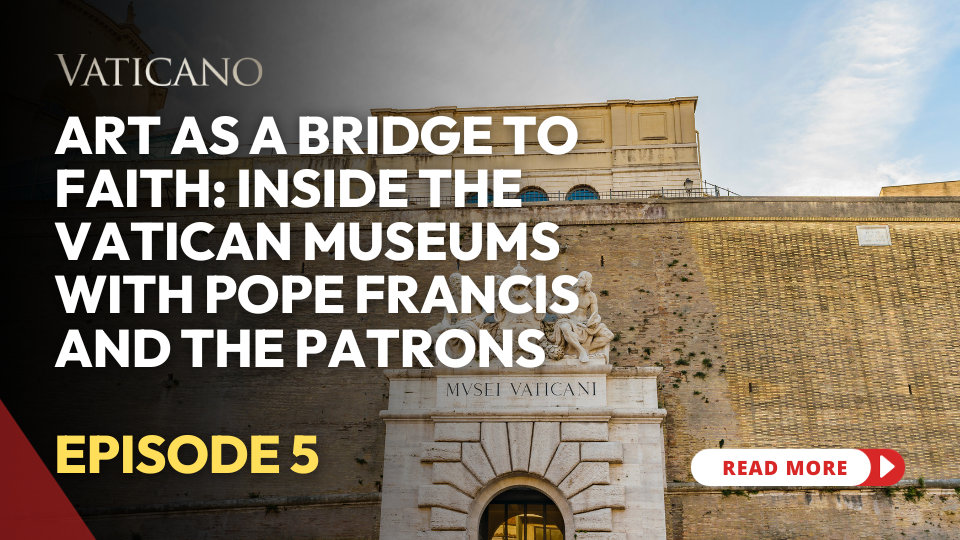
Vatican Museums — Barbara Jatta is the Director of the Vatican Museums. Recently, the Patrons of the Arts of the Vatican Museums celebrated the 40th Anniversary of their founding with a pilgrimage to Rome and the Museums. In the midst of their program, the international chapter members were received in a private audience with Pope Francis.
In speaking about this reality of pilgrimage to the Vatican Museums, Jatta said, “For a Christian, coming to our museum is a special journey. It’s a special journey that, with the seven miles of the museum, they can find precisely what Pope Francis is asking us: to find the root, to find the tradition, to find the heritage of our culture, of our faith, of our history, of our Christian history.”
She continued, saying this is an “essential part of a pilgrimage.”
Pope Francis, in the private audience, speaking of the commitment of the Patrons, said, “Your commitment is a concrete sign of your appreciation of the potential of the arts, in their many forms, to open minds and hearts to the beauty of God’s creation and the richness and mystery of our human life and calling.
The Pope continued, “Art, and religious Art in particular, can convey a message of mercy, compassion, and encouragement. It has the power to foster a recognition of our common humanity, to build bridges between cultures and peoples.”
Recognizing the value of the work of the Patrons, the Pope encouraged their continued effort, “Dear friends, with these sentiments, I renew my appreciation for your support of the mission of the Vatican Museums, and I encourage you to persevere in your praiseworthy enterprise.”
Barbara Jatta highlighted the importance of visits made to the Vatican Museums by the Patrons, saying, “Each visit held by a group of patrons of the arts in the Vatican Museums is special because it is a moment of sharing, sharing ideas, and to show them what they support produces in terms of maintenance, in terms of caring for our artifacts.”
As a sign of appreciation and hope for the future, the Vatican Museums’ staff and restorers, together with the Patrons, held a ribbon-cutting ceremony to celebrate the restored works of the Pius Christian Museum, works which were sponsored by a chapter of the Patrons.
Every successful restoration is the result of a detailed process and dialogue between the Patrons and the Museums’ curators.
Monsignor Terence Hogan is the Vatican Office Coordinator for the Patrons of the Arts of the Vatican Museums. He explained, “The curators of a section within the museum provide a list of artifacts that they would like to see restored. Then, that list goes on to be approved. Every year, this process results [in] what we call a wish book for patrons and anyone else who wants to participate in the patronage.”
Barbara Jatta told us, “There are many, many chapters that are arriving with younger generations in their trip to the Vatican.” She hopes that this trend might continue to increase.
Richard Altig of the Patrons Northwest Chapter (USA) told EWTN Vatican, “We have nine grandchildren and four children, and they love being patrons themselves.” His wife Lisa explained it as a generational endeavor in their family. Richard continued, “And now they’re coming, they’re bringing their kids. And you hear the little kids talking about, you know, now that they’re eight years old, how they get to go to the Vatican Museums. That’s pretty satisfying for us.”
This was echoed by Barbara Jatta. She said, “I always feel that this is a very important aspect because, in young generations, you plant seeds. You don’t need the seeds to grow in the short term. But they will grow.”
On the last evening of their visit, the growing community of Patrons gathered for a concert with the Choir of the Sistine Chapel.
Guided by sacred music, the Patrons found beauty, serenity, and grace in the experience.
People often experience such grace in the Sistine Chapel. Sister Emanuela Edwards, Head of Educational Activities of the Vatican Museums, is one such person. She told us, “One of the places where I can contemplate God the most would be properly in the Sistine Chapel because it’s like a Bible in glorious technicolor.”
Debra Mauro, Patron of the Canada Chapter, shared with EWTN Vatican her appreciation of the Sistine Chapel, saying, “I stand inside the Sistine Chapel, and I am moved to tears. And it’s a really wonderful emotion, but it’s a real emotion.”
Monsignor Hogan emphasized the benefit of the work of the Patrons, saying, “The Patrons of the Arts of the Vatican Museums have done an incredible job supporting the work of the Holy Father and the Vatican for the entire world.”
He said further, “From generation to generation, because of the work of the Patrons, we know that the generations to come will be able to experience the art, the faith, the truth, the beauty of those talented artists who have received, as we believe, truly their gift from God.”
Adapted by Jacob Stein.