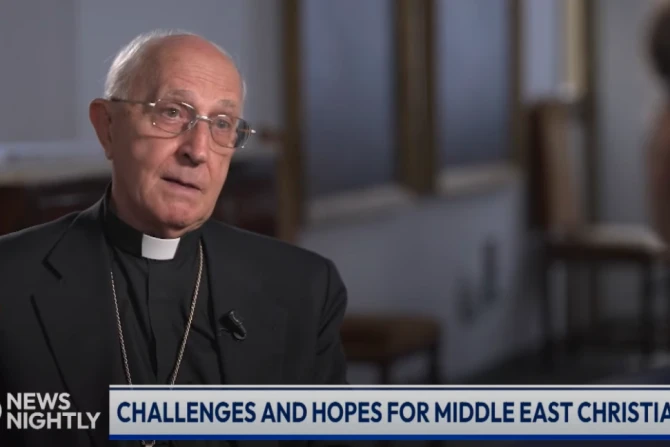
A longtime Vatican diplomat now dedicated to aiding Christians in the Holy Land recently offered reflections on the Church’s mission in conflict zones and its roots in the Middle East.
SIGN UP FOR OUR NEWSLETTER HERE
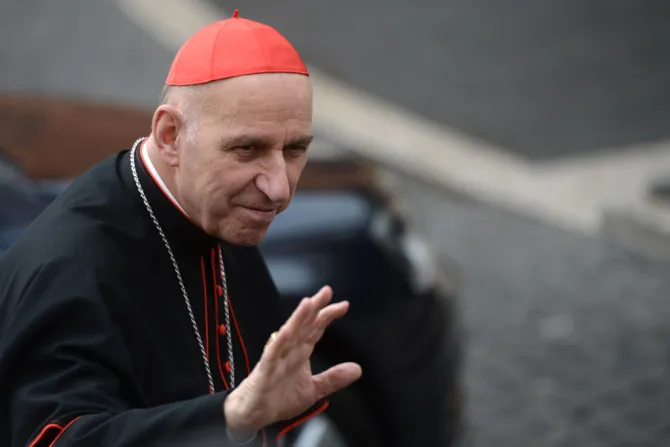
In a wide‑ranging interview with “EWTN News Nightly” on July 22, Cardinal Fernando Filoni underscored that the Middle East is not just part of Christianity’s past but remains an area of vital importance.
“Being there means not letting this vast region be considered only historically as the beginning of the Church, without living Christian communities,” he said. A portion of the interview was broadcast on Tuesday evening.
Despite waves of emigration and violence, Filoni insisted, the Church cannot forget her roots. “Jerusalem is the Mother Church. No one should forget their mother’s and father’s home,” he said.
Filoni recalled vividly his service as apostolic nuncio in Baghdad during the first Gulf War. Even as bombs fell and many left the country, he and the bishops agreed: “We remain. The people remain, we remain.”
At that time travel was perilous and telephones were quickly knocked out, but Filoni and an auxiliary bishop made parish visits to check on priests and laity. “We needed to show our faithful, even though we were a minority in a largely Islamic reality: We are with you,” Filoni said.
Reminded of his own statement that “if a shepherd flees in difficult moments, the sheep scatter,” the cardinal described it as a biblically inspired call to action.
“Jesus himself, speaking of the good shepherd, recommended that those entrusted with the Gospel face difficulties with the same dignity that Christ himself showed,” the cardinal said.
“This remains a fundamental heritage of the Church,” he added.
As grand master of the Equestrian Order of the Holy Sepulchre, Filoni now leads a chivalric order that supports the Latin Patriarchate of Jerusalem, headed by Cardinal Pierbattista Pizzaballa, and assists Christians throughout the Holy Land.
The order provides financial aid, funds schools and parishes, and supports humanitarian efforts that allow Christians to remain in their ancestral homeland.
“We are not the main actors,” Filoni said, “but we are those who, behind the scenes, support the patriarchate and all its actions. This is the Church’s communion in action.”’
Filoni, a former prefect of the Congregation for the Evangelization of Peoples, stressed the Church’s role as peacemaker in the region.
“Peace is not a secondary option but a primary one,” he said. “We cannot live always thinking of past injustices. The Church is there to remind everyone that a normal, serene life is what children, men, and women truly desire.”
The cardinal pointed to past Vatican efforts — such as an informal, indirect role in encouraging prisoner exchanges during the Iran-Iraq war — as examples of how even small gestures can open doors.
Today, amid the war in Ukraine, the Church is working to trace missing children, advocate for prisoners and the wounded, and deliver aid. “These actions create a platform for dialogue, starting from the concrete suffering caused by war,” he said.
Filoni warned, however, that such efforts are ultimately futile if warring powers don’t seek peace. “You can even offer a golden platform [for negotiations], but it won’t work because it’s the will of the people involved in the war who must accept or reject the possibility of dialogue, of discussion,” he said.
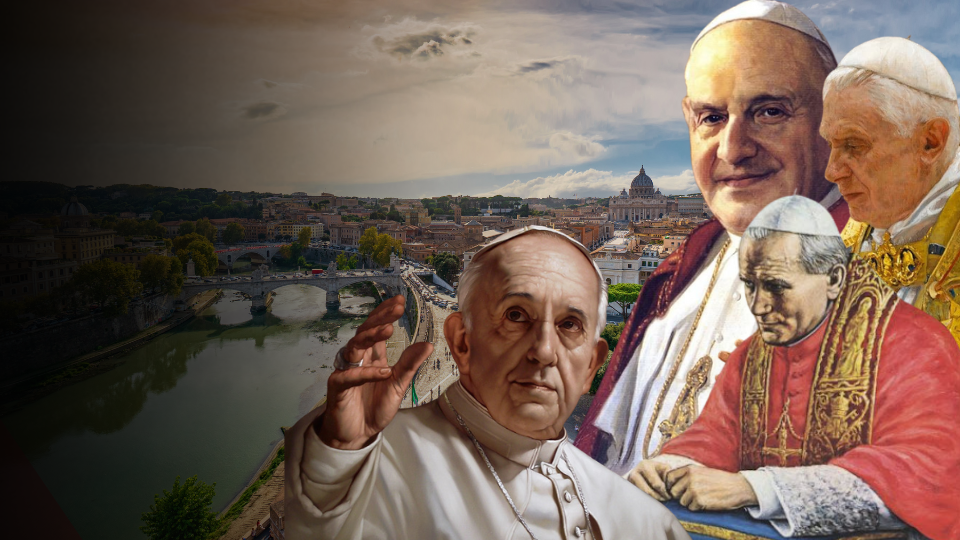
The cardinal praised Pope Leo XIV’s early reaffirmation of Sollicitudo Omnium Ecclesiarum, the foundational document on Vatican diplomacy issued by St. Paul VI, and observed how St. John Paul II expanded this mission through his extensive travels.
“There is a centripetal and a centrifugal dynamic — one that brings in and one that reaches out,” Filoni explained. “In this exchange, the life of the Church is created.”
Asked what could distinguish Pope Leo XIV’s approach, Filoni replied that a new pope “does not follow his predecessor — he follows Peter.”
“There is continuity, but also something new,” he said. He noted that the world has changed rapidly, with the revolution of artificial intelligence emerging in just the past decade. Leo XIV’s unusually varied background as a missionary bishop, head of his religious order, and superior of the Roman Curia has prepared him well for such challenges, the cardinal said.
Turning to Gaza, Filoni struck a somber note. “Sadly, there is no place in Gaza untouched by the violence of weapons, war, revenge, and killings. To keep kidnapped people in captivity is unacceptable. And to attack those searching for water or food is terrible,” he said.
“There is no justification,” the prelate added. He called for the immediate release of all hostages and an end to indiscriminate bombings. The Patriarchate of Jerusalem, under Pizzaballa’s leadership, he said, works tirelessly to provide aid and remain present, supported by the Holy See and by the Order of the Holy Sepulchre.
The cardinal shared an image of the Church’s resilience he witnessed in Mosul, Iraq: After a bombing, a priest showed him a wall where the image of the pope remained intact amid the rubble. “Here, the cross did not fall,” the priest told him.
Filoni reflected: “That is the message. The cross is stronger than violence, because it is the instrument through which God made peace between heaven and earth.”
This article was originally published by CNA.