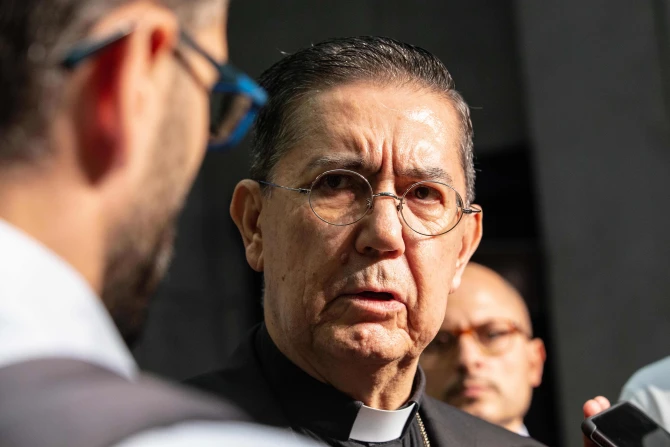
Cardinal Miguel Ángel Ayuso Guixot, a Spanish-born prelate and prefect of the Dicastery for Interreligious Dialogue, died Monday aged 72 after a long illness.
Pope Francis asked for prayers for the cardinal earlier this morning, telling an international Jain delegation at the Vatican that the cardinal was “very ill, near the end of his life.”
A respected expert in Islam, Ayuso devoted much of his career to promoting dialogue with the Muslim religion and played a key role in Pope Francis’ “Document on Human Fraternity for World Peace and Living Together,” signed in Abu Dhabi in 2019.
He took part in Pope Francis’ historic visits to Muslim-majority nations, first as secretary of the Pontifical Council for Interreligious Dialogue, and after October 2019, as the dicastery’s prefect.
The visits included the UAE and Morocco in 2019, and then, as dicastery prefect, to Iraq in 2021, and Kazakhstan and Bahrain in 2022. The Vatican said he “remained active in his mission until health challenges overtook him.”
Born on June 17, 1952, in Seville, Spain, Ayuso came from a large, devout Catholic family and was the fifth of nine children.
He initially studied law at the University of Seville but felt called to religious life. In 1973, he joined the Comboni Missionaries of the Heart of Jesus, taking his perpetual vows in 1980. He was ordained a priest the same year. He pursued further ecclesiastical education in Rome, obtaining a licentiate from the Pontifical Institute for Arabic and Islamic Studies (PISAI) in 1982 and later a doctorate in dogmatic theology from the University of Granada in 2000.
Following his studies, Ayuso embarked on missionary work in Egypt and Sudan from 1982 to 2002. During this time, he served as a parish priest in Cairo and directed a catechetical center in the diocese of El-Obeid, Sudan. His academic career flourished as he taught Islamology in Khartoum from 1989 and later in Cairo. In 2006, he became the president of PISAI in Rome, solidifying his reputation as an expert in Islamic studies.
Ayuso’s expertise in interreligious dialogue led to his appointment as a consultor of the Pontifical Council for Interreligious Dialogue in 2007. His career in the Vatican progressed rapidly: In 2012, Pope Benedict XVI named him Secretary of the Pontifical Council for Interreligious Dialogue; in 2016, Pope Francis appointed him archbishop and Titular Bishop of Luperciana; in 2019, he was named President of the Pontifical Council for Interreligious Dialogue; and in October that same year, Pope Francis elevated him to the rank of cardinal.
One of Ayuso’s most significant achievements was his role in resuming dialogue with Grand Imam Ahmed el-Tayeb of Cairo’s Al-Azhar University.
Renowned as Islam’s most prestigious institution for Islamic learning, Al-Azhar suspended dialogue with the Vatican in 2011 on the grounds that Pope Benedict XVI had made “repetitive and negative statements” about Muslims.
Ayuso’s brokered reconciliation culminated in the landmark but controversial “Document on Human Fraternity for World Peace and Living Together,” signed in Abu Dhabi in February 2019 by Pope Francis and el-Tayeb. The cardinal had also represented the Holy See on the board of directors of the King Abdullah Bin Abdulaziz International Centre for Interreligious and Intercultural Dialogue (KAICIID) since its founding in 2012.
In response to critics concerned about the Vatican’s current course of interreligious dialogue and its alleged tendency toward syncretism, he emphasized that interreligious dialogue and initiatives like the “Document on Human Fraternity” were not about creating a “melting pot” where all religions were considered equal. Instead, he argued it was about recognizing “that all believers, those who seek God, and all people of good will without religious affiliation are equal in dignity.”
He asserted that the Catholic Church always engages in interreligious dialogue while remembering “the value of her own identity.” Ayuso also noted that pluralism in societies invites reflection on one’s own identity, “without which authentic interreligious dialogue is impossible.”
Responding to criticism that the “Document on Human Fraternity” could lead to syncretism, he reiterated that each faith retains its own identity in these dialogues, and used the metaphor of a “rich mixed salad” to describe how different faiths can come together while maintaining their distinct identities.
In 2023, Cardinal Ayuso strongly endorsed the Abrahamic Family House, an interfaith complex in Abu Dhabi designed to promote mutual understanding, peaceful coexistence, and interfaith dialogue among Islam, Christianity, and Judaism. The cardinal said the complex, which opened in 2023, was a “beacon of mutual understanding” and that he believed it could foster mutual respect and understanding while allowing each faith to maintain its distinct identity. Critics argued that the initiative fostered religious indifferentism and was theologically unsound.
Vatican News said Nov. 25 that Cardinal Ayuso “embodied Pope Francis’ vision of fraternity,” as outlined in the 2020 encyclical Fratelli Tutti (All Brothers), and that through his “tireless dedication to dialogue, he demonstrated that peaceful coexistence among diverse faiths is both possible and necessary.”
This article was originally published on Catholic News Agency.