Celebrating Art and Spirituality
A special exhibition in Rome titled “Dalí’s Christ in Rome” brought together the famous Spanish painter Salvador Dalí and the Spanish saint and Doctor of the Church John of the Cross.
This is the third exhibition of “The Jubilee is Culture,” the program of cultural initiatives in preparation for the 2025 Jubilee. Open to visitors at the church of San Marcello al Corso in Rome, from May 13 to June 23, the exhibition attracted more than 300,000 visitors.
The Iconic “Christ of Saint John of the Cross”
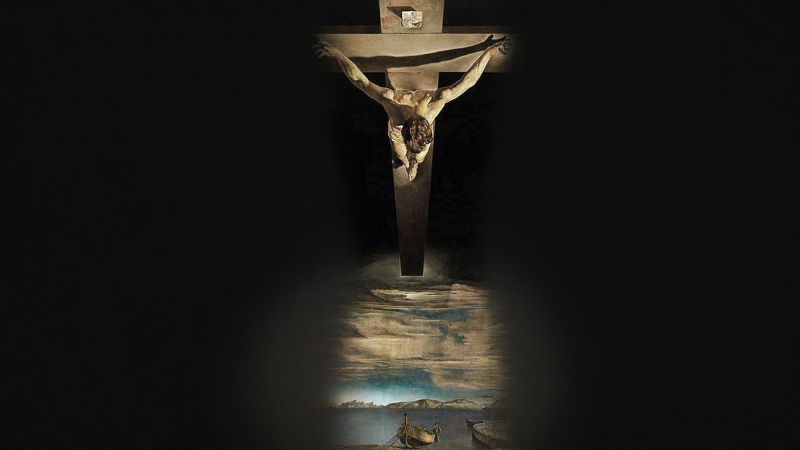
Salvador Dalí’s famous “Christ of Saint John of the Cross” is the exhibition’s main piece.
“The exhibition is receiving a lot of attention because it features one of the greatest works in Art History, namely one of Salvador Dalí’s most iconic works. Clearly, the work in itself attracts, but it is also attractive because it speaks of a spiritual need in a world where it is often set aside,” commented Davide Mambriani, Official for Cultural Affairs of the Dicastery of the New Evangelization.
The painting was named “Christ of Saint John of the Cross” because it was inspired by a small relic drawing by the 16th-century Spanish Carmelite friar John of the Cross. The small ink sketch on parchment is itself believed to be a product of a mystical vision.
The two works, which have never been exhibited side by side, can now be admired together for the first time.
Completed in 1951 after his return to the faith, the painting and its unusual details were supposedly revealed to Dalí in what he claimed was a “cosmic dream.”
“Dalí’s Christ is a Christ who doesn’t suffer,” Mambriani continued. “He is a beautiful Christ, a young and healthy Christ, depicted without any signs of the Passion: the nails are missing, the crown of thorns is missing, and there is nothing written in the scroll above his head. The words INRI are missing.”
The artist aimed at depicting how, despite gravity pulling the body downward, a supernatural divine force holds it to the Cross. This force is the sacrificial will and love of Jesus, who willingly offered himself for the salvation of humanity.
A Divine Perspective on the Crucifixion
The painting, which depicts Jesus on the cross floating in the darkness over a body of water, is also the first one ever to depict Christ Crucified from God the Father’s point of view.
“Dalí’s surrealism allows us to see God the Father’s perspective on the crucifixion for the first time in an artwork. We are used to seeing this event from below, as something we contemplate, and not used to thinking that God also has a perspective on the Crucifixion and Sacrifice of His Son. Thanks to this work, we can imagine the divine perspective on the crucifixion, on this weighty moment which is the death of the Savior,” Mambriani noted.
Besides its remarkable beauty, Dalí’s painting also conveys the theme of Christian Hope, making it particularly fitting in the context of the upcoming Jubilee.
Adapted by Jacob Stein