European Catholics debated Thursday morning the contents of a final document that will influence the discussions of the Synod of Bishops at the Vatican in the fall.
On the final day of public speeches in Prague on Feb. 9, the 200 delegates at the European Continental Assembly were asked if the assembly’s final document — drafted by a six-member committee — was faithful to what was discussed in the previous three days of the assembly.
Ukrainian Bishop Oleksandr Yazlovetskiy, a Latin auxiliary bishop of Kyiv, was one of the first to take the floor, raising an objection to the repeated use of the term LGBTQ on “every other page” in the document, suggesting instead that it would be better to cover the topic within a single paragraph.
Archbishop Stanisław Gądecki objected to the framing of “conservative and liberal” when describing the Church, suggesting instead to clarify whether given statements agree or disagree with the Gospel.
The Polish prelate added that the document does not communicate the position of the Church in its references to “LGBT” persons.
Bishop Georg Bätzing, the president of the German bishops’ conference, said that the Church is not yet in a “new Pentecost” as the document claimed.
Archbishop Felix Gmür of Basel, Switzerland, noted that parts of the text seemed “too vague” and could be more clear, especially in underlining where tensions exist.
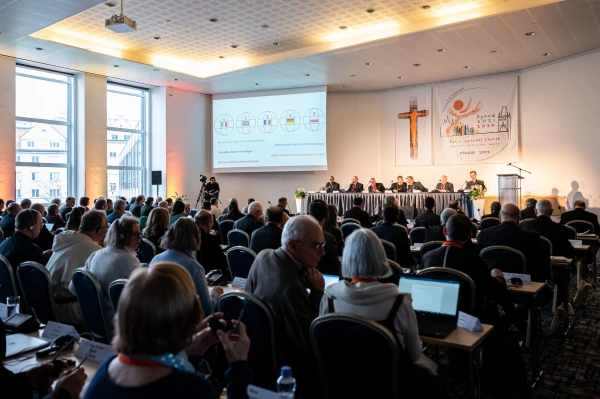
Speaking in French, German, Italian, Polish, and English, delegates made suggestions as to how the text could be improved.
Bishop Brian McGee said that the Scottish delegation was surprised to see how the document “presented the labeling or characterizing of various groups in a single sentence multiple times.”
“We are not opposed to the inclusion at all, but we feel that it could be dealt with more sensitively,” he said.
Archbishop Eamon Martin said “we were a little bit embarrassed” because “the voice of the poor” was not more prominent in the document, despite the contributions during the assembly from Caritas International and other Catholic charities.
“I would just like a little bit more prominence to the cry of the poor, the cry of the Earth, and the cry for peace,” he said.
Bishop Aliaksandr Yasheuskiy, auxiliary of Minsk, Belarus, recommended that the text should be clarified to note that the comments on the ordination of married men and the ordination of women did not reflect the common opinion of the assembly.
While the majority of the speakers who opted to give their opinions on the text were bishops, several women also addressed the assembly.
Anna Diouf, a young woman representing the Observatory on Intolerance and Discrimination against Christians in Europe, asked how the text could underline the important role women play in the Church without mentioning the Blessed Virgin Mary.
The final document
Due to time constraints, delegates were not able to read and reflect on the final document before entering into the debate. Instead, Father Jan Nowotnik read aloud the draft document summarizing and synthesizing the contributions offered by Catholics from across the continent over the past three days.
Secularization, clerical abuse, tensions around the liturgy, and ecumenical dialogue were among the many themes highlighted in the still unpublished draft document, which seeks to provide a European perspective on a synodal Church.
The text mentions that the ordination of women to the diaconate was mentioned as a possibility at the assembly and added: “On the other hand, there is a clear divide in Europe on the ordination of women to priesthood, not only between East and West, but also within the various Western countries.”
The document also mentioned how many European delegates had expressed fear that the Synod on Synodality could result in a “watering down” of Catholic doctrine.
“Some highlighted that in a process like this, there was a risk of submitting to the spirit of the world. These fears were also expressed during our meeting, concern for possible watering down of doctrine or for the use of sociological expressions in working groups was underlined,” it said.
There was no vote on a final text from the first half of the assembly. Instead the assembly organizers asked if anyone had any objections to the draft text being made public.
Cardinal Jean-Claude Hollerich assured the delegates that their comments and suggestions in the morning’s debate will be taken into account in the formation of the final draft.
Beginning on Feb. 10, European bishops will meet privately for three days in Prague for the second half of the assembly to collectively review the document, listen to speeches by the president of each country’s bishops’ conference, and produce their own second final document for the synod’s continental process.
The Prague assembly is one of seven synod continental assemblies occurring across the globe in February and March.
Hollerich noted that he and Cardinal Mario Grech will be traveling to attend continental assemblies in Beirut, Bangkok, and Bogotá, Colombia, in the coming weeks.
This article was originally published by EWTN News English.