Since 2014, the Pontifical Commission for the Protection of Minors has played a crucial role in promoting the safety and well-being of minors and vulnerable individuals within the Church.
Bishop Luis Manuel Ali Herrera, who serves as the Commission’s secretary, is committed to supporting survivors of abuse and formulating strategies to prevent future cases. His efforts are part of a wider initiative within the Church to promote healing and uphold justice for those who have been harmed.
This mission was reaffirmed during a recent meeting with Pope Leo, who expressed his continued support for the Commission’s work and emphasized the Church’s responsibility in safeguarding the vulnerable.
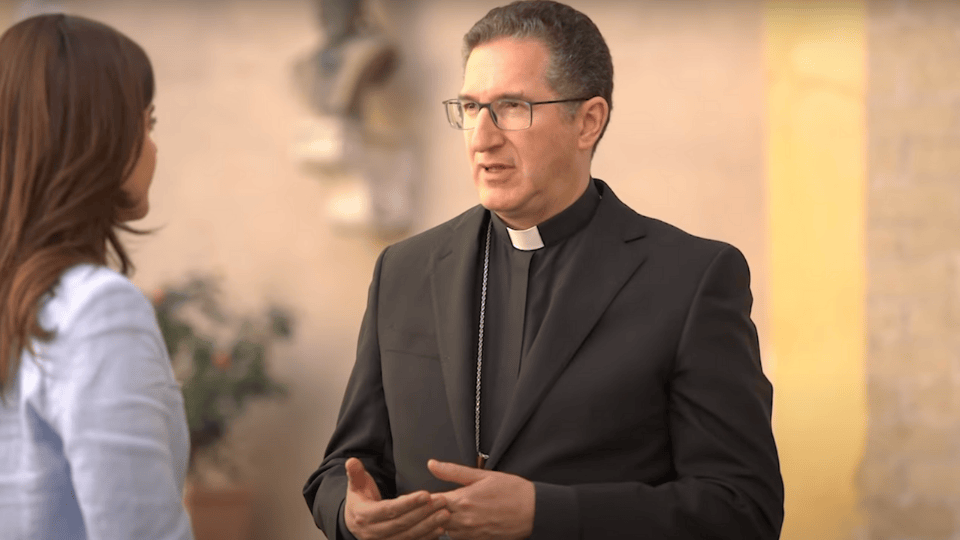
Paola Arriaza, EWTN Vatican Correspondent, spoke with Bishop Herrera to explore the challenges facing the Commission and the mission entrusted to it by the late Pope Francis.
“Pope Francis reminded us of this in a message he sent in 2023 to all members of the Pontifical Commission for the Protection of Minors. He said that we need a spirituality of reparation. When someone is harmed, especially a victim of abuse, the damage is devastating. It harms not only the individual, but also the very image of God within them. It breaks their relationship with the Church, their relationships with others, and their sense of self. For the victim, it shatters life plans and deeply affects their ability to recover and be resilient. That’s why reparation isn’t just a single act. It’s a broad and ongoing process—one that starts, above all, with truly listening to the victims.”
How does the Commission ensure that victims are at the center?
“One thing I want to highlight is that, within the Pontifical Commission, we have victims themselves as members. Their voices are essential—not only to understand how to speak to other victims and survivors, but also to guide our response in prevention efforts. Their experience helps shape everything we do.”
Do you remember any conversation where you listened to a victim and were able to understand their pain? And not just that, but also think of ways to help them?
“The Lord always has many ways of calling us. One of those came when I met a victim. When I had the opportunity to speak face to face with that person, it completely changed me. Of course, I had read about it, studied it, analyzed it in my academic work—but it’s something entirely different when you’re faced with tears, with pain, with that deep sense of hopelessness.”
You propose this psycho-affective formation for seminarians and for people in the discernment process. What does this formation involve?
“In initial formation—in the seminary—affective, community, and sexual formation must be present from the very beginning, from the propaedeutic stage, all the way through to the final year of theological studies. It has to be a process, something ongoing and integrated, that also involves continuous work on the emotional world and on interpersonal relationships.”
When we talk about new vocations, do you think that the abuse crisis has, to some extent, affected or acted as a deterrent for new vocations?
“It has affected us, but it has also helped. It has affected us, and this is clearly seen in some situations where information begins to appear in the media about sexual abuse committed by priests, or by male or female religious. That has an impact on vocations—on the number of young men who choose the priestly life. But it has also had a positive impact, because it has led us to rethink the way we carry out vocational ministry. We’ve realized that we are also people—we have our own emotional conflicts, our own crises—and that, before the Lord, and through a real process, we have to face them like any other human being. In other words, it has helped us to understand that the priest is a human person.”
On March 31st, the works displayed on the façade of one of the main basilicas at the Sanctuary of Lourdes, created by Marco Rupnik, were covered. What does the Commission think of these measures? Do you believe this is an approach to the victims?
“Art is a very powerful tool for healing. But at the same time, both the content of a work of art and the artist behind it can be traumatizing for someone who has suffered this horrific crime. When they see a piece of art, they may feel retraumatized. We can reflect on this and make a discernment with the victims in mind. That doesn’t mean we are making judgments ahead of time, or interfering with processes we fully respect. It’s about putting ourselves in the shoes of the victims.”
SIGN UP FOR OUR NEWSLETTER HERE
Adapted by Jacob Stein
Andrea Manna contributed to this story; Produced by Alexey Gotovosky; Camera by Gianluca Gangemi; Video edited by Andrea Manna; Special thanks & Credits to the Pontifical Commission for the Protection of Minors