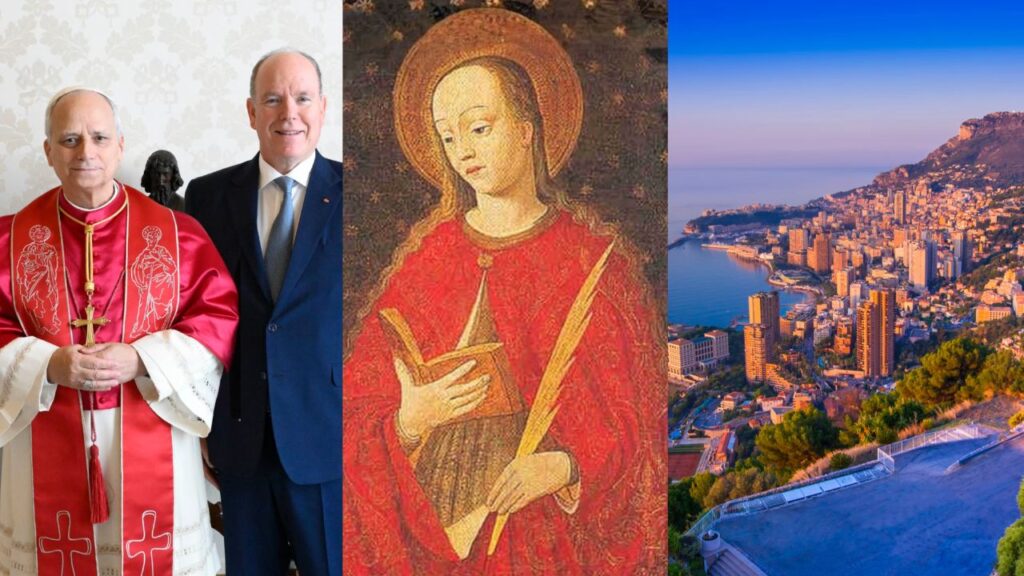
On March 28, Pope Leo XIV made history by becoming the first pope in the modern era to make an apostolic visit to Monaco.
Tucked along the Mediterranean coast, the principality of Monaco — whose official language is French — is often associated with Formula 1, wealth, glamor, and the famed Monte Carlo Casino. Yet beneath its polished exterior lies a profoundly Catholic heritage that continues to shape its laws, culture, and monarchy.
Here are 10 key things to know about Monaco and its enduring Catholic identity:
1. Monaco is the last European country that is Catholic by law.
Unlike many modern European nations, Monaco officially recognizes the Catholic Church as the state religion. Only a tiny handful of countries still have Catholicism as their official state religion in law including Vatican City, Malta, Costa Rica, and Liechtenstein. Monaco is the last European country whose constitution declares “the Catholic, apostolic, and Roman religion” as the state religion, making Pope Leo’s visit a spotlight on Europe’s final officially Catholic state.
Currently, more than 90% of the population — roughly 38,000-39,000 people — identifies as Catholic.
Monaco also has an older population. Roughly a third or more of residents are over 65. Life expectancy in Monaco is among the highest in the world — often estimated in the late 80s — which means the Church here walks with a very elderly population.
2. The current sovereign has deep Catholic roots.
The ruling family of Monaco, the House of Grimaldi, has long been closely tied to Catholicism. Prince Albert II of Monaco, the current sovereign, was baptized and raised in the faith, as were his predecessors. Prince Albert is the son of Prince Rainier III and American actress Grace Kelly, who was also Catholic.
Prince Albert II is 68 and has been married to Charlene Wittstock, a former Olympic swimmer, since 2011. They have two children — twins Jacques and Gabriella.
Before marrying Wittstock, Albert had two children out of wedlock — Jazmin and Alexandre. While both are recognized as children of Prince Albert, they are not in the line of succession for the throne because their parents never married.
3. Monaco is the second-smallest country in the world.
Believe it or not, Monaco is smaller than New York City’s Central Park. Only Vatican City is smaller than Monaco. The principality covers just about 2 square kilometers (less than 1 square mile), yet it packs in a dense population and world-class infrastructure.
It should be noted that Monaco is both a principality and a country. It is a sovereign, independent city-state and its status as a “principality” relates to its form of government — a constitutional monarchy ruled by a prince.
4. Monaco has only one Catholic diocese and one archbishop.
The small country only has one diocese, the Archdiocese of Monaco, and the Guiness World Records recognizes it as the smallest diocese in the world by territory.
During his visit, Pope Leo will meet with Archbishop Dominique‑Marie David — a French priest ordained in Nantes, France, and appointed to Monaco in 2020 — the only archbishop in the country.
5. Catholicism by the numbers in Monaco
Monaco has a surprisingly rich parish life: Six parishes and about 15 churches and chapels serve this tiny country.
There are 29 priests in active ministry — including one official exorcist: Canon Alain Goinot, who was appointed in 2015 — as well as 14 religious sisters. The four communities of religious sisters include Dominicans, Oblates of the Virgin Mary of Fátima, Filles du Saint‑Cœur de Marie, and Sœurs de Notre‑Dame de l’Incarnation.
Additionally, if you were to look at a map of Monaco you would see that on each corner of the principality there is a church: the Cathedral on the Rock, Saint‑Charles with the Dominicans, Saint‑Martin–Sacré‑Cœur, Sainte‑Dévote, Saint‑Nicolas in the port, and the Prince Palace’s own chapel dedicated to St. John the Baptist.
6. Monaco is where a billionaire and a housemaid can sit in the same pew.
Monaco has one of the highest GDPs per capita in the world. Its economy thrives on luxury tourism, banking, and real estate, attracting millionaires and billionaires from across the globe.
One major reason the wealthy flock to Monaco is that it does not levy personal income tax (with a few exceptions). This has helped establish it as a global tax haven.
Abbé Christian Venard, episcopal vicar for communications of the principality’s archdiocese, told EWTN News in an interview that “while there are very wealthy people, ordinary people, sometimes even very simple ones, are also needed to make the system work. This social mix gives our diocesan Church a truly unique character. Sometimes in church, a billionaire and a housemaid can sit on the same pew. The Church is one of the rare places of social intermingling in the principality and must take this important aspect into account in its daily apostolate.”
7. Monaco hosted one of the most-watched royal Catholic weddings.
The Cathedral of Our Lady Immaculate — formerly the Cathedral of St. Nicholas — is where Prince Rainier III and Grace Kelly were married in 1956 and where many princes and princesses, including Kelly, are buried. Their wedding Mass is still one of the most-watched royal Catholic weddings in history.
8. Monaco’s patron saint is St. Devota.
Monaco’s patroness, St. Devota (Sainte Dévote), is so important that her feast — Jan. 27 — is a solemnity and day of precept in the archdiocese. Her relic is even kept in the palace chapel.
St. Devota is a revered early Christian martyr believed to have lived in the late third or early fourth century. According to tradition, she was born in Corsica and killed for her faith during Roman persecution. Her body was said to have been placed on a boat by fellow Christians, which miraculously drifted to Monaco, where she became the principality’s patron saint.
9. It is a pro-life country.
One of the clearest reflections of Monaco’s Catholic identity is its legal stance on abortion. Influenced by Catholic moral teaching, the country has historically prohibited abortion except in very limited circumstances. This legal framework reflects a strong cultural commitment to the dignity of human life.
Last November, Prince Albert refused to sign a bill that would further liberalize abortion in the principality, even though it passed in Parliament 19-2. Albert said he understands “the sensitivity of this issue” but insisted the current law better respects Monaco’s Catholic identity and the special place of the Church while still ensuring “safe and more humane” support for women.
10. A princess was removed from the British line of succession for becoming Catholic.
In 2018, Princess Alexandra of Hanover, a member of the royal family of Monaco, was removed from her distant place in the British line of succession after becoming a Catholic.
Princess Alexandra was born in Austria and baptized a Lutheran two months after her birth. She is the daughter of Caroline, Princess of Hanover, and Prince Ernst August of Hanover. Through her father she is descended from Victoria, Princess Royal, the eldest child of Queen Victoria and Prince Albert.
Alexandra is the granddaughter of Grace Kelly, who in 1956 became Princess of Monaco when she married Rainier III. So in addition to having been in the British line of succession, Alexandra was the 12th in line to the Monegasque throne.
Because the British monarch is head of the Church of England, which is the established church there, British law bars Catholics from succeeding to the throne.
The Succession to the Crown Act 2013 allowed heirs to the throne to marry Catholics, among other changes. However, the law still stipulates that the acting British sovereign must not be a Catholic. Catholics have been barred from the English throne since the Act of Settlement 1701.
Here are the LIVE UPDATES of the Pope’s Apostolic Journey in Monaco.