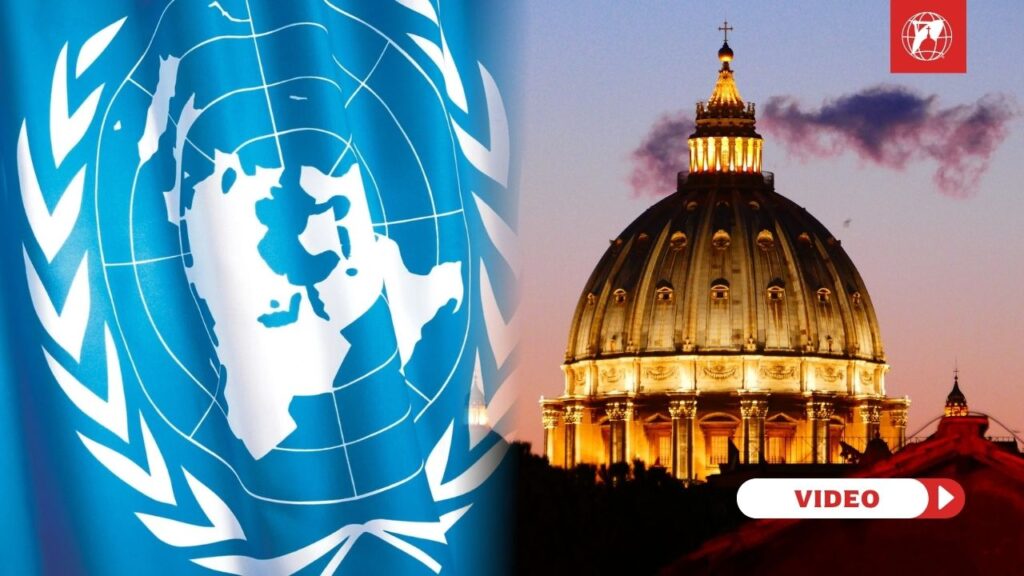
GENEVA — The Holy See may be the world’s smallest sovereign state, but its mission reaches far beyond the walls of the Vatican.
Through its participation in international organizations such as the United Nations, the Holy See brings the Church’s voice to global discussions on peace, human rights, and social issues. At the center of that mission in Geneva is Archbishop Ettore Balestrero, the Holy See’s Permanent Observer to the United Nations.
While many associate the Holy See primarily with St. Peter’s Basilica, Archbishop Balestrero says the Church’s mission has always been much broader.
“The heart of the mission of the Church is the world”
For Archbishop Balestrero, serving at the United Nations is a reminder that the Church’s mission is not confined to the Vatican.
“Well, if they come to the Vatican, they won’t see me because I am in Geneva. So that’s an evidence, proof, that it is not just inside the Vatican.”
“The Holy See is called to evangelize and to be missionary in the whole world and in all the fora. The heart of the mission of the Church is not the international organization. It is the world and it is where people are.”
The Holy See’s unique role at the United Nations
Unlike member states, the Holy See participates in the United Nations as a Permanent Observer, a role Archbishop Balestrero says is especially suited to its universal mission.
“The Holy See participates in the debates, the Holy See participates in the general conferences, the Holy See can present, of course, participate in all negotiations, can ‘table’ possibly amendments or even present resolutions in case they relate to the Holy See.”
“And I think the permanent observer status is the one most fitting for the Holy See, because the Holy See is a state, but it’s a universal state, and it’s not in line with the religious nature and universal nature of the Holy See, to take a specific stand on a strictly political issue.”
He noted that there are occasions when the Holy See cannot support certain international documents.
“Secondly, we must say also that there is the requirement to adopt sometimes some documents, which we as Holy See, and therefore as Catholic Church, we have objections, because their anthropological vision is not the one we share.”
A consistent voice for peace and human dignity
According to Archbishop Balestrero, one of the Holy See’s greatest concerns today is the growing number of armed conflicts around the world.
“The tensions and conflicts that are unfortunately present in the world are increasing. They say there are about 65 conflicts all over the world.”
“So, it means that for the Holy See, it’s very important to be relentless in promoting peace and in recalling mankind that peace is possible and even necessary.”
He also emphasized that promoting respect for international law and defending human dignity remain central to the Holy See’s diplomatic work.
“I think it is also somehow a mission of the Holy See to promote respect for international law to work for the respect, of course, of the human dignity, which nowadays is often put into question, especially in the areas of human rights.”
Because the Holy See does not pursue political interests, he said, its message remains consistent over time.
“A peculiarity of the Holy See is the fact that it hasn’t… we don’t have political interests. So, our position is consistent and it is coherent.”
“So, we don’t change our positions when years pass or when the popes pass and change. We are trying simply to implement the Gospel and to apply it and to live it and to preach it in a language which is consistent with the language of the international community.”
Bringing the Church’s voice to global negotiations
The Holy See’s participation at the United Nations extends beyond speeches and conferences to active involvement in international negotiations.
“We participate in negotiations, for instance. Now there is an ongoing negotiations regarding ‘LAWS’: lethal autonomous weapons systems.”
“And the point is to try to reach a consensus to avoid that the ultimate decisions on human life can be taken by an algorithm, which is absolutely, morally, ethically unacceptable.”
Archbishop Balestrero also highlighted the Holy See’s efforts to defend religious communities affected by conflict.
“In the past years, a number of places of worship have been vandalized, especially in the context of conflicts.”
“And even other religious communities asked the Holy See to do something and to put forward this problem, which is a direct violation of humanity, and it is a direct violation of principles of humanitarian law.”
“I am there as a priest”
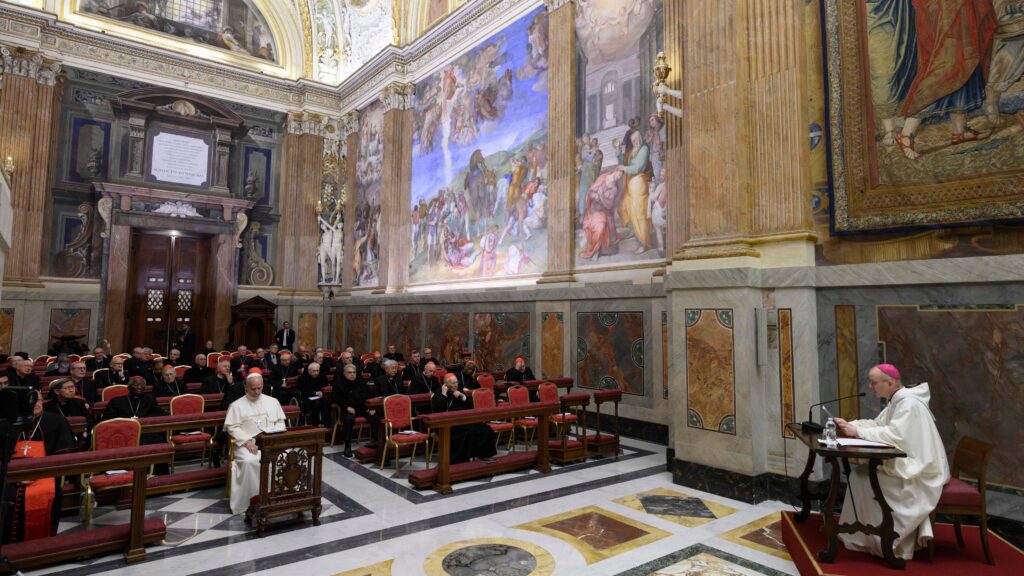
Reflecting on Pope Leo XIV’s recent address to the Pontifical Ecclesiastical Academy, in which the Holy Father said the mission of papal diplomats is “born of the Gospel,” Archbishop Balestrero explained that diplomacy has never replaced his priestly vocation.
“When I started to follow Jesus as a priest, I was not thinking to be a diplomat. I was thinking to follow Jesus as a pastor.”
“So, He is the reason of my life. And if I could not be a priest and live as a priest, I would not go to the UN.”
For him, serving at the United Nations remains an extension of his pastoral ministry.
“So, I am there as a priest who is trying to evangelize and to reach out to all people who somehow are my parish or my diocese.”
“…and then it’s an opportunity, I would say, for the Gospel to be presented in an area and in a context which badly needs it, and where otherwise there wouldn’t be anyone else.”