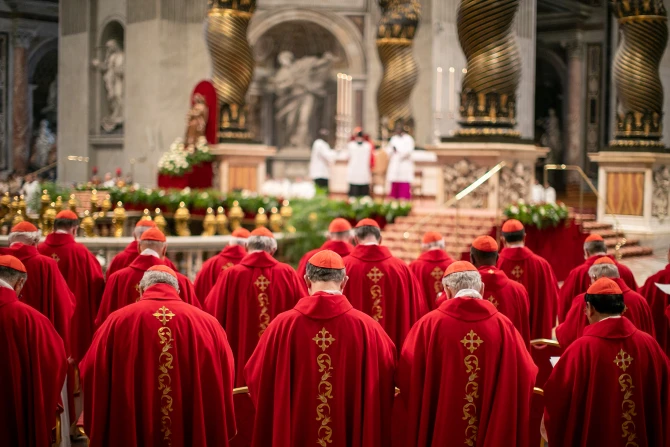
On May 7, an expected 133 cardinal electors will enter the Sistine Chapel to elect the new Roman pontiff, the successor to Pope Francis, who shied away from giving red hats to the traditional archdioceses but opted to give the honor to far-flung places, many of which had never had a cardinal before.
SIGN UP FOR OUR NEWSLETTER HERE
Of the 133 cardinals with the right to vote in this conclave, 108 were created by Pope Francis and therefore will be participating in the election of a pontiff for the first time.
Compared with the 2013 conclave that chose Pope Francis, none of the major sees typically headed by a cardinal will be represented this time around, including the archdioceses of Sydney, Vienna, Genoa, Paris, Milan, Palermo, Armagh, and Krakow.
Pope Francis’ choice of cardinals from nontraditional countries and sees has dramatically shifted what used to be large and powerful representations within the college, such as the cardinals from Italy.
Now, only 52 Europeans will enter the Sistine Chapel, less than half of the entire electoral body. Of these 52, just 17 are Italians, including curial cardinals — those who work inside the Vatican — and those who live in Rome.
The Italian presence is significantly reduced compared with the 2013 conclave, which had 28 cardinals of Italian origin.
By contrast, the continent of Africa has grown by seven cardinal electors since the last conclave for a total of 18 red hats, and Asia’s representation has increased to 20 from 10 in 2013.
Countries represented by a cardinal elector for the first time include Haiti, Mongolia, Myanmar (Burma), Malaysia, Tonga, Cape Verde, East Timor, Sweden, Iran, Luxembourg, Singapore, South Sudan, Ghana, Rwanda, El Salvador, Bangladesh, Central African Republic, Papua New Guinea, and Serbia.
Another change to the College of Cardinals made by Pope Francis was the decision to surpass the limit of 120 voting cardinals set by Paul VI and confirmed by John Paul II. This limit was exceeded in June 2017, when Francis designated five new cardinals, bringing the total to 121. The total number of cardinal electors currently stands at 135.
In the apostolic constitution governing a “sede vacante,” Universi Dominici Gregis, it says that a cardinal who has been “created and published before the College of Cardinals thereby has the right to elect the pope” if he has not reached the age of 80.
Under Pope Francis, there was also an increase in cardinal electors representing the Eastern Catholic Churches “sui iuris”: Cardinal Mykola Bycok (Ukrainian Greek Catholic Church); Cardinal George Jacob Koovakad (Syro-Malabar Church); Cardinal Baselios Cleemis Thottunkal (Syro-Malankar Church); Cardinal Berhaneyesus Demerew Souraphiel (Ethiopian Metropolitan Church “sui iuris”); and Cardinal Louis Raphaël Sako (Chaldean Church).
Other geographical areas instead have not seen large changes in the number of voting cardinals.
The United States will have 10 voting cardinals (one less than in the 2005 and 2013 conclaves). Canada will have four and Mexico will have two representatives inside the Sistine Chapel.
From Europe, there will be five cardinal electors from France, four from Spain, four from Portugal and Poland, three from Germany and the United Kingdom, two from Switzerland, and one each from Belgium, Bosnia, Croatia, Hungary, Lithuania, Luxembourg, Malta, Holland, Serbia, and Sweden.
Central America will bring to the Sistine Chapel one cardinal each from Cuba, Nicaragua, Guatemala, and Haiti. South America will see the presence of seven cardinals from Brazil, four from Argentina (there were two in 2013 and one in 2005), and one each from Chile, Colombia, Ecuador, Paraguay, Peru, and Uruguay.
The 18 African cardinals include two from the Ivory Coast and one each from Algeria (although Cardinal Jean-Paul Vesco is French by birth), Burkina Faso, Cape Verde, Central African Republic, Democratic Republic of Congo, Ethiopia, Ghana, Guinea, Kenya, Madagascar, Morocco (Cardinal Cristóbal Lopez Romero is Spanish by birth), Nigeria, Rwanda, South Africa, South Sudan, and Tanzania.
There are 20 cardinals who will participate in the conclave from Asia: four from India, three from the Philippines, two from Japan, and one each from China, East Timor, Indonesia, South Korea, Malaysia, Mongolia (Cardinal Giorgio Marengo is Italian by birth), Myanmar, Pakistan, Singapore, Sri Lanka, and Thailand.
The Middle East will be represented by three cardinals, one each from the Holy Land (Cardinal Pierbattista Pizzaballa is Italian by birth), Iran (Cardinal Dominique Joseph Mathieu is Belgian by birth), and Iraq.
From Oceania, four cardinals will be eligible to vote: one each from Australia (Bycok is Ukrainian by birth), New Zealand, Papua New Guinea, and Tonga.
Marco Mancini of ACI Stampa, CNA’s Italian-language news partner, contributed to this report.