
The challenge of addressing abuse within consecrated life — in all its dimensions: sexual, power, conscience, and also economic — was the focus of an international meeting organized by the Pontifical Commission for the Protection of Minors held at the Maffei Marescotti Palace in Rome.
Under the theme “Building Communities that Safeguard Dignity,” representatives of religious institutes from some 20 countries are gathering Nov. 17–19 to share experiences, examine structural shortcomings, and work on the preparation of the third annual report, which will involve 40 communities.
The commission’s president, Archbishop Thibault Verny, thanked the nearly 60 participants from various countries for their presence and emphasized that preventing abuse “is not a local task but a universal commitment of the Church.”
The third report on abuse, the archbishop clarified, “is not intended to add a burden” but rather to be “an opportunity” to promote “attention to the most vulnerable members” and strengthen “the quality of formation.” This journey “cannot be traveled alone,” Verny pointed out.
‘I believe you, you are not alone’
One of the most significant moments was the intervention of Sister Véronique Margron, president of the Conference of Religious Men and Women of France, who clearly outlined the initial steps for supporting a consecrated woman who reports abuse.
Her first recommendation was direct and unequivocal: “The first words must be: I believe you, you are not alone, I will help you and do everything necessary,” she stated, according to Vatican News.
“We must speak honestly; otherwise, it’s impossible to build dialogue and trust,” she added.
For the religious, reparations are a broad process that cannot be reduced to a mere procedure: They demand justice, support, and the genuine involvement of those who suffered violence. She therefore pointed out that the second step is “to work toward all forms of justice,” involving the victims at every stage, without “minimizing” the cases or diminishing responsibilities.
Structures, failures, and silence
The meeting addressed head-on the panorama of abuse within religious life, including its less visible forms. In convents and monasteries, there have been not only cases of a sexual nature but also abuses of power and conscience, practices that can give rise to “conflicts, asymmetries in power, marginalization, and unbalanced relationships,” as Verny noted in his address.
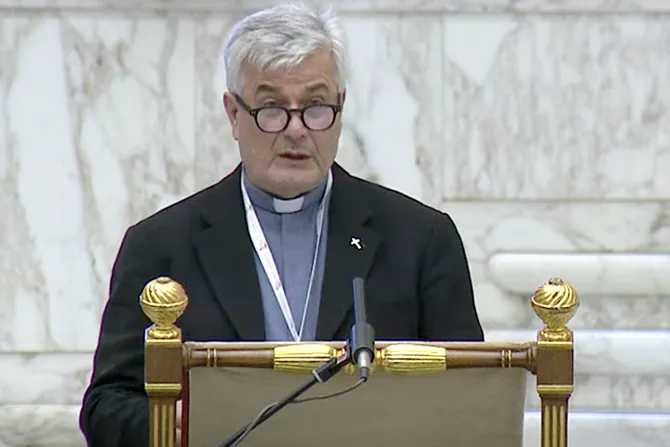
Providing an analysis, Claretian Father Krzysztof Gierat, head of the office of the Dicastery for Institutes of Consecrated Life, emphasized that “every measure taken for protection comes with a face, with a story that demands listening, truth, and care,” clarifying that “protection cannot be treated as an added technical element; it’s not a protocol appended to consecrated life.”
Gierat listed structural factors that foster abuse even in communities with seemingly exemplary regulations, such as the absence of a “healthy system” of relationships. A community, he noted, may have “impeccable protocols” but then ambiguous authorities, “informal” hierarchies based on geographic origin, aggressivity, unhealthy relationships, missed warning signs, and ignored conflicts emerge. “Even without malicious intent, all of this becomes fertile ground for abuse,” he warned.
“Protection begins with the quality of the environment we breathe,” the priest emphasized.
Impact of the digital world
Gierat also addressed a particularly sensitive topic: the impact of the digital world. Consecrated life, he reminded everyone, can no longer be considered exempt from social media, chat rooms, or online exposure. The risks are numerous: public image, privacy, and digital grooming. “Protection isn’t just a matter of convent corridors but also of virtual spaces,” he pointed out.
And he pointed to a key aspect: the need for “comprehensive, spiritual, and psychological formation” for religious superiors. “A transparent, evangelical, and service-oriented authority is the first line of defense,” he said.
“Many abuses stem from authorities left to themselves and not adequately trained. And all abuse stems from a lack of communal discernment,” he added.
The meeting made it clear that the issue of abuse is not confined to church walls. For Stefano Mattei, policy director of Tutela Minorum(“Protection of Minors”), the goal is also to “drive change” in society: “It’s about putting the weight of the Church at the service of cultural change to protect children and the vulnerable,” he explained.
This commitment, he said, is possible thanks to the Church’s widespread presence, wealth of charisms, and its integration into very diverse contexts.
The discussions were complemented by international experiences. From Germany, Franciscan Andreas Murk, provincial of the order, presented particularly revealing figures: According to a 2019 survey, 1,412 people contacted the Conference of Superiors to declare: “I have been abused.”
Murk also detailed the work of the Independent Commission for Recognition, which manages compensation for victims of clerical abuse, with compensation of up to 20,000 euros ($23,160).
When asked about the risk of false accusations, he responded emphatically: “For decades, victims were ignored; now we must focus on them.”
In his province, he explained, “one or two accusations turned out to be unfounded; 40 others were not, and of those, only five asked for money. Not everyone comes for money; they just want recognition.”
However, he warned, even today “some communities refuse to confront the issue of abuse; they still lack the necessary sensitivity. Our duty is to be active in this area, even if it makes [people] uncomfortable.”
This story was first published by ACI Prensa, CNA’s Spanish-language news partner. It has been translated and adapted by CNA.