
Pope Francis has praised the Catholic Church’s first council in China 100 years ago as “an authentic synodal journey” that opened the way for the Church in China “to increasingly have a Chinese face.”
In a video message to a conference in Rome on the Catholic Church in China, the pope noted that Chinese Catholics have endured “times of patience and trial” in the past century.
“The Lord in China has safeguarded the faith of the people of God along the way. And the faith of God’s people has been the compass that has shown the way throughout this time,” Pope Francis said in the May 21 address.
The pope pointed to a Church council that took place in Shanghai 25 years before the Chinese Communist Revolution as an example of a moment when “the communion between the Holy See and the Church in China manifested its fruits, fruits of good for all the Chinese people.”
The 1924 council, called the Primum Concilium Sinense, brought together 105 Catholic missionaries, bishops, and Chinese Catholics to establish a framework for a native Chinese hierarchy.
“The Fathers gathered in the Concilium Sinense lived an authentically synodal experience and made important decisions together,” Pope Francis said.
“Remembering the Council of Shanghai can also suggest today new paths to the entire Church and open paths to be undertaken with boldness to proclaim and bear witness to the Gospel in the present,” he added.
Among the crowd listening to the pope’s video message were representatives from the People’s Republic of China, including Bishop Shen Bin of Shanghai, who was unilaterally installed by Chinese authorities as bishop of Shanghai in April 2023 without a papal mandate, thereby breaking the terms of the Vatican-China deal. Pope Francis confirmed his appointment in July 2023.
The Holy See first entered into a provisional two-year agreement with Beijing on the appointment of bishops in 2018, which has since been renewed twice and is again up for renewal this fall.
Pope Francis opted not to speak of the Vatican’s diplomatic efforts with Beijing or religious freedom in China in his message but said that Chinese Catholics today “bear witness to their faith through works of mercy and charity, and in their witness they give a real contribution to the harmony of social coexistence.”
A large statue of Our Lady of Sheshan stood on the pope’s desk as he spoke. The pope noted that during the month of May many Chinese Catholics usually go on pilgrimage to the Marian Shrine of Sheshan, located near Shanghai.
“I too ideally climb the hill of Sheshan, and let us all together entrust to Mary, Help of Christians, our brothers and sisters in the faith who are in China, all the Chinese people, and all our poor world, asking for her intercession, so that peace may always win everywhere,” Pope Francis said.
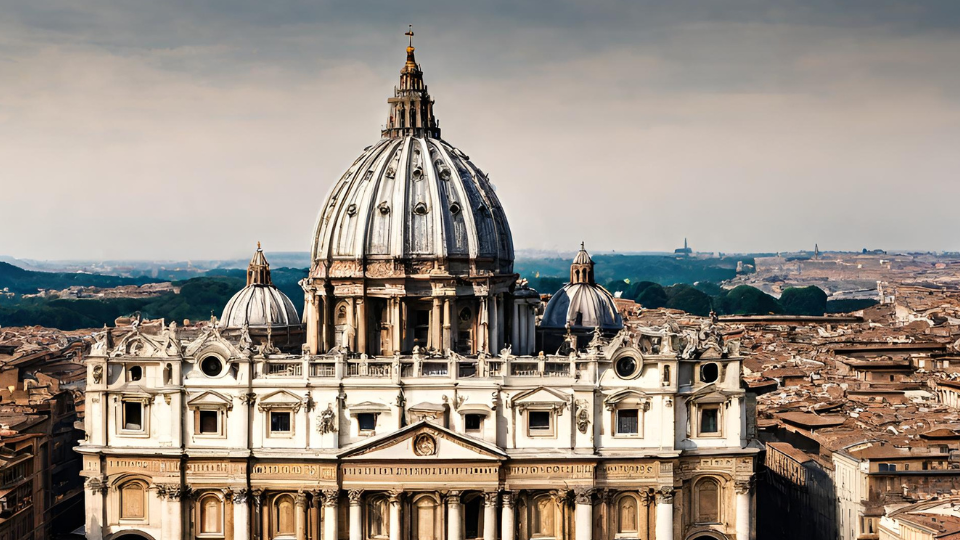
Following the pope’s message, Shen Bin delivered a 15-minute speech in Chinese to the packed auditorium of the Pontifical Urban University on the Janiculum Hill overlooking St. Peter’s Basilica.
The Chinese bishop offered a different interpretation of the 1924 council from the pope in his speech, saying that “the Council of Shanghai did not lead to an immediate and radical change in the Church in China,” adding that by the 1949 Communist Revolution “only 29 of China’s 137 dioceses had Chinese bishops, and only three of 20 archbishops were Chinese.”
“The Catholic Church in China had not really freed itself from foreign powers to become a work led by Chinese Christians and had not yet managed to shed the label of ‘foreign religion,’” he said.
Shen Bin, who has held leadership positions in the Chinese Catholic Patriotic Association established by the Chinese Communist Party and under the control of the United Front Work Department, went on to defend Beijing’s religious freedom record and underlined the need for the Church in China to “follow a path of sinicization.”
“The policy of religious freedom implemented by the Chinese government has no interest in changing the Catholic faith but only hopes that the Catholic clergy and faithful will defend the interests of the Chinese people and free themselves from the control of foreign powers,” Shen Bin said in his speech.
“Today the Chinese people are carrying out the great rebirth of the Chinese nation in a global way with Chinese-style modernization, and the Catholic Church in China must move in the same direction, following a path of sinicization that is in line with Chinese society and culture today,” the Shanghai bishop added.
The conference, titled “100 Years Since the ‘Concilium Sinense’: Between History and the Present,” was held in Chinese and Italian in the Great Hall of the Pontifical Urban University. The Pastoral Commission for China and Agenzia Fides, the information service of the Pontifical Mission Societies, organized the conference, which featured Vatican Secretary of State Cardinal Pietro Parolin and Cardinal Luis Antonio Tagle as speakers.
Speaking to journalists on the sidelines of the conference, Parolin said the Holy See would like to increase and deepen its contacts in China.
“We have been hoping for a long time now to have a stable presence in China, even if initially it may not have the form of a papal representation of an apostolic nunciature,” Parolin said.
This article was originally published on Catholic News Agency.