Skip to content

In new book, the late Benedict XVI defends Christianity against claims of intolerance

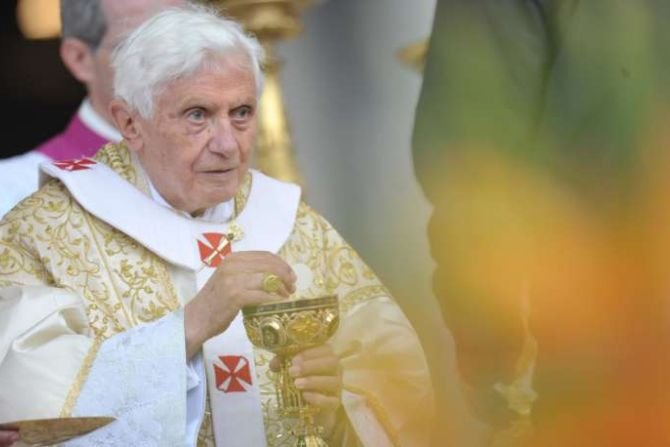
Reference image of Benedict XVI

Pope Emeritus Benedict XVI has posthumously defended Christianity against claims of intolerance “in the name of tolerance.”

In a new book published in Italy, the late pontiff warns of a “radical manipulation of human beings” and “the distortion of the sexes by gender ideology” in the name of tolerance.

Rejecting the argument of a German theologian about monotheism being linked to intolerance, Benedict counters that “the authentic counterweight to every form of intolerance” is, in fact, Christ crucified.

The late pontiff’s contribution, dated December 2018, is published in a new collection of texts by the theologian pope, touted by the Italian publisher as a spiritual “quasi-testament.”

The 190-page volume is called “What is Christianity?” It contains 16 contributions, four of which were previously unpublished.

According to CNA Deutsch, CNA’s German-language news partner, all of the texts were written after Benedict’s resignation in 2013.

Apart from his reflection on monotheism and modern intolerance against Christianity, the texts cover several other theological topics, from intercommunion to the reform of the liturgy and the Church’s dialogue with Islam.

Several of these issues have triggered vehement responses from German bishops and theologians and put the Church in Germany at odds with the Vatican — and the late pontiff.

One such virulent topic is the question of intercommunion between Protestants and Catholics — which leading German bishops have pushed for, despite Vatican objections.

The late pontiff reflects on the sacrament of the Eucharist in his essay on intercommunion. He explains why real ecumenism needs to account for the differences between Protestants and Catholics, rather than papering over these.

Responses from German circles against such explanations and his own person in the past were one reason why — according to the publisher — the pope emeritus chose to publish posthumously, and in Italian first.

This article was originally published by EWTN News English.

Receive the most important news from EWTN Vatican via WhatsApp. It has become increasingly difficult to see Catholic news on social media. Subscribe to our free channel today

Share

Would you like to receive the latest updates on the Pope and the Vatican

Receive articles and updates from our EWTN Newsletter.

I agree that EWTN will keep me informed about news, faith stories and how to best support their work. You will never receive e-mails from us that you do not want to receive. You can unsubscribe any time. For more information on how to unsubscribe, our privacy practices, and how we are committed to protecting and respecting your privacy, please review our Privacy Policy.

More news related to this article

Pope Benedict XVI and His Search for Truth

HAMBURG, GERMANY / VATICAN CITY — On April 18th, 2005, German Cardinal Joseph Ratzinger delivered a memorable sermon
A nun at work embroidering a liturgical vestment. Credit: EWTN Vatican

Daughters of St. Joseph: Sewing for the Eucharist

A needle and thread in the right hands can create something extraordinary. For the Daughters of St. Joseph,

Castel Gandolfo: The Papal Palace That Sheltered 12,000

Castel Gandolfo is known as the summer residence of the Popes, but during the Second World War it

Cardinal Hollerich: ‘Today we have politicians. Politicians have no convictions’

In an interview with the French newspaper La Croix on Thursday, Cardinal Jean-Claude Hollerich, SJ, discussed the European elections and the dwindling influence of Christianity on politics.

Pope Francis: “Fiducia supplicans” seeks to include

In a long interview with the Italian newspaper “La Stampa,” Pope Francis once again repeated his thoughts on Fiducia supplicans, the Declaration on Blessings published on December 18. 

Empowering Women in Holiness: The 4 Female Doctors of the Church

There are only four female Doctors of the Church: Saint Teresa of Avila, Saint Catherine of Siena, Saint Thérèse of Lisieux, and Saint Hildegard of Bingen.

LIVE
FROM THE VATICAN

Be present live on EWTNVatican.com