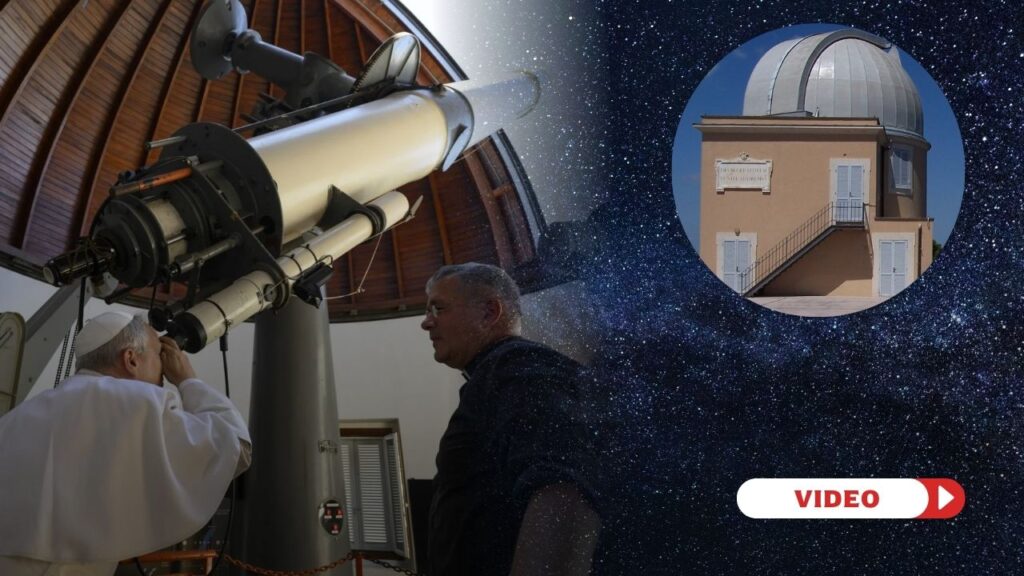
There is more to Castel Gandolfo than the Apostolic Palace. It is also home to one of the world’s oldest active observatories, where the Catholic Church continues to study the cosmos and contemplate God’s creation through science.
The Vatican Observatory and the Search for God in Creation
From as early as the 1600s, the Catholic Church has investigated the cosmos and sought to understand more deeply God’s creation through science.
Today, the Vatican Observatory is led by the Jesuits, who dedicate much of their time to astronomical research, analysis, and scientific discovery. Father Richard D’Souza was appointed Director of the Vatican Observatory by Pope Leo XIV in 2025.
“I consider myself an Indiana Jones of astronomy,” Father D’Souza says.
In this interview with EWTN Vatican’s Zofia Czubak, he explains why astronomy and the Catholic faith are more closely connected than many people might think.
A lot of people might see science and God as being in conflict, but how do God, faith, Catholicism and science go together?
Father Richard D’Souza: “I think one should take a step back and talk first about how faith and reason go together. The Church has always sustained that both faith and reason need to go hand in hand.
This has always been the official position of the Church: not to instrumentalize science to show that it is against religion, and not to instrumentalize religion against the sciences.
I think the best example of this would be the theory of the Big Bang, proposed by Father Georges Lemaître in the 1930s. He proposed that the universe was expanding and that, if you extrapolate back in time, it began as a dense, hot initial object, an initial star, which he called the primordial atom. This theory was derided by many scientists, but was celebrated by Pius XII as a great discovery. Finally, the proof came in the 1960s, and we know this theory today as the Big Bang. It is a very Catholic theory.”
Why the Vatican Has an Observatory
The origins of the observatory date back to the 16th century. Why did the Vatican decide that it needed an observatory? Could you tell me a little bit about the history?
Father Richard D’Souza: “The Church has always been interested in cosmology and adopted the Greek cosmology of the time. But around the 16th century, a serious problem arose: the calendar being used at the time, the Julian calendar, was a bit out of sync with the seasons, and they could not predict the date of Easter well.
And so the Church began to formally study astronomy in those days.
The biggest observatory was always at the Roman College, the former Gregorian University, but there were also observatories within the Vatican, at Campidoglio and at Monte Mario. When Italy took over all the observatories after it conquered Rome at the end of the 19th century, the Pope was left without an observatory. Pope Leo XIII then refounded this observatory in 1891, first within the Vatican. In the 1930s, we moved here to Castel Gandolfo due to the growing light pollution of Rome, and we have been here since then.”
A Jesuit Priest and Astronomer
You’re a Jesuit priest. You’re also an astronomer. How did you eventually come to work in astronomy?
Father Richard D’Souza: “I must start off by saying that I joined the Jesuit order very young, at the age of 17 or 18. I was always interested in the sciences, and before joining the Jesuits, I had to seriously decide between the life of a scientist or engineer and that of a priest, and I chose that of a priest.
As I entered the order and grew within the order, my own Jesuit superiors encouraged me to continue my pursuit of the sciences by studying physics and astronomy.
I would say that not all of us Jesuits at the Observatory have the same path. Many of my colleagues studied astronomy and physics before they decided to become priests. I did it in reverse: I became a priest and then studied astronomy. I think there are different ways of serving the Lord, and the Lord has His own ways of guiding us.”
How did it feel when Pope Leo XIV appointed you as the new director of the Observatory?
Father Richard D’Souza: “I felt it as a great opportunity, but also a bit of a burden. I must say I was very anxious about the fact that I would have to step into the role of these great giants who preceded me and who did such great, marvelous work as directors.
But I’m very grateful for that mandate, and I look forward to implementing all that he has asked us to do and to taking the Observatory forward, so that it may be a visible sign of the Church’s interest in the sciences and of the fact that faith and science go together.”
The Universe as a Path Toward the Creator
And as you study the vastness of the universe, the galaxies, space, I’m guessing that sometimes it’s easy to look at the world, to look at us and see that actually in the grand scheme of things, we are very small, we are very insignificant. But how has this helped you view our place in creation?
Father Richard D’Souza: “The more I study the universe, the more I study astronomy, the more I am able to understand our Creator and the more I am able to give praise to God for His marvelous creation.
So, in a sense, the natural world brings us towards God, points us towards God. We still need Revelation, but there are so many hints hidden in the natural world. Discovering these hints through the study of the sciences reinforces my own faith in God.
When I look up, I have to say that my attention is less turned inward and more pointed outward. I look up and say: wow, the vastness of the universe, the vastness of God. My thoughts are less about ourselves and more about the vastness of the universe and the vastness of God who created this universe. I must admit that I rarely think about the smallness of ourselves.”